Gurus and Bhagats, Bani Contributors · Origins & Gurus · Guru Gobind Singh Ji
Guru Gobind Singh Ji
Created the Khalsa (1699); vested eternal Guruship in the Guru Granth Sahib.
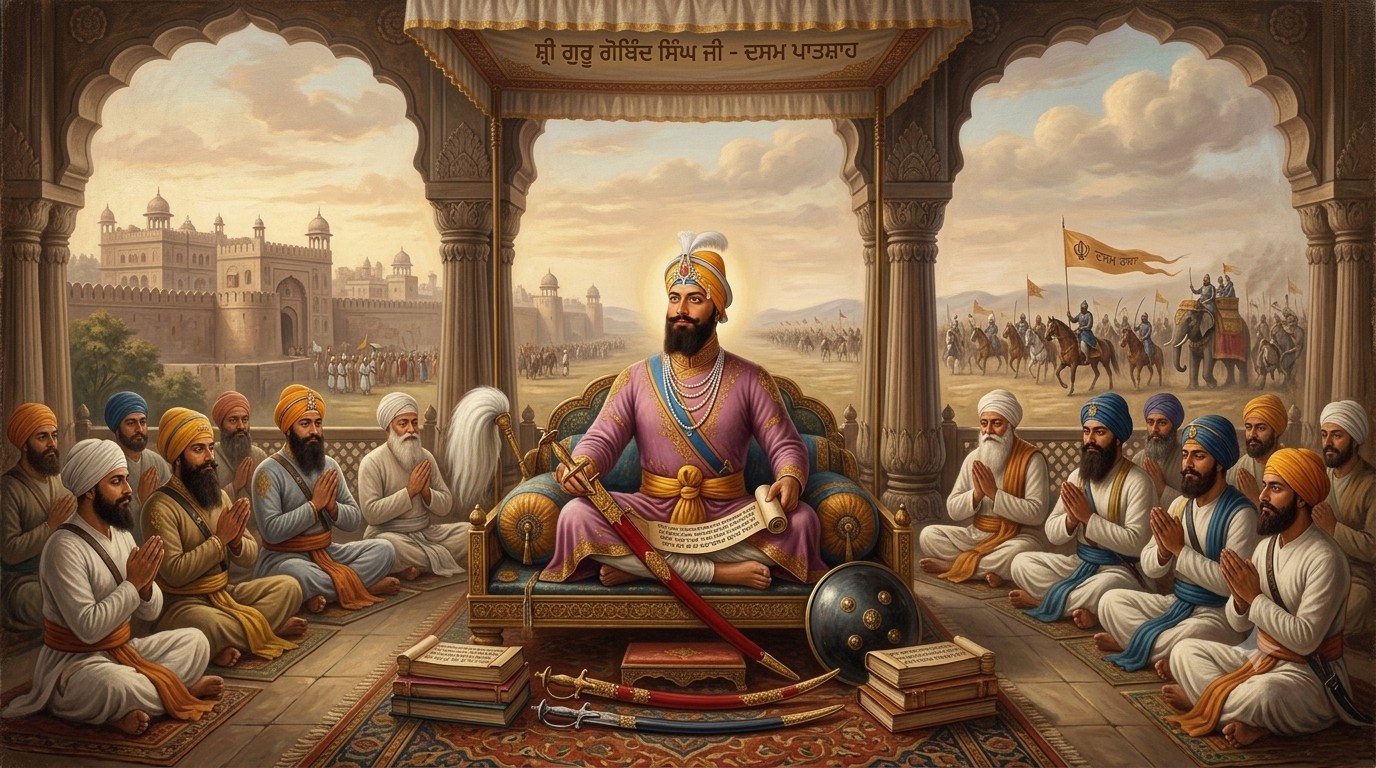
The Crucible of Sovereignty: Early Years of Guru Gobind Singh ji
To understand the advent of Guru Gobind Singh Ji, the tenth and final human Guru of the Sikhs, one must first comprehend the socio-political landscape of seventeenth-century India. It was an era characterized by the high-water mark of Mughal absolutism under Emperor Aurangzeb, whose policies of aggressive religious homogenization and heavy taxation systematically dismantled the pluralistic fabric of the subcontinent. In the mountainous retreats of Punjab and the northern hills, a quiet revolution had been brewing for over two centuries, initiated by Guru Nanak Dev Ji. When the young Gobind Rai was born in Patna in 1666, the Sikh community was already a distinct socio-spiritual entity, yet it faced an existential crisis of unprecedented proportions. The defining moment of his childhood arrived in 1675, when a delegation of Kashmiri Pandits, terrorized by imperial persecution, appealed to his father, Guru Tegh Bahadur Ji, for protection. The ninth Guru, in an act of supreme altruism, offered his own life to defend the freedom of conscience of another faith, culminating in his public execution in Delhi. At the tender age of nine, Gobind Rai inherited the spiritual mantle of a community that was now forced to reckon with the stark reality that absolute pacifism in the face of brutal tyranny could lead to complete annihilation. This tragic yet sublime event forged the crucible in which the young Guru’s worldview was shaped, convincing him that when all peaceful means of redress have failed, it is righteous to draw the sword.
The early years of Guru Gobind Singh Ji's leadership at Anandpur Sahib were marked by an intense period of self-cultivation, physical training, and intellectual exploration. Recognizing that a true leader of humanity must be both a master of the spirit and a master of the worldly arts, the young Guru immersed himself in the study of diverse languages, including Sanskrit, Persian, Punjabi, Arabic, and Braj Bhasha. He gathered around himself a court of fifty-two distinguished poets, scholars, and translators, transforming the foothill town of Anandpur into a vibrant renaissance center. During these quiet, contemplative years, the Guru synthesized ancient Indian mythology, classical literature, and historical narratives, extracting the heroic essence of past ages to revitalize the weary, demoralized psyche of his followers. He realized that the centuries of foreign invasions and caste-ridden social structures had induced a profound psychological paralysis among the masses, making them believe they were born to be ruled. Through his own poetry, which was marked by a dynamic, rhythmic cadence mimicking the clashing of swords and the beating of war drums, the Guru sought to awaken the dormant spirit of self-respect, valor, and divine agency within the common people, preparing them for the monumental transformation that lay ahead.
The Great Metamorphosis: Vaisakhi 1699 and the Creation of the Khalsa
The watershed moment in Sikh history, and arguably one of the most revolutionary events in human sociological history, occurred on the day of Vaisakhi in 1699 at Anandpur Sahib. Guru Gobind Singh Ji summoned a massive congregation of Sikhs from all corners of the subcontinent. Standing before the vast assembly with a naked sword in hand, the Guru made a startling demand that sent shockwaves through the crowd: he demanded a head as an offering for his beloved Divine. One by one, five courageous souls—representing different castes and hailing from geographically diverse regions of India, from Lahore in the north to Jagannath Puri in the east and Dwarka in the west—stepped forward, willing to make the ultimate sacrifice. When the Guru led them out of the royal tent, clothed in magnificent saffron robes and bearing weapons, they were introduced as the Panj Pyare, the Five Beloved Ones. This dramatic ritual was not merely a test of blind loyalty; it was a profound psycho-spiritual death and rebirth. By submitting their heads to the Guru, these individuals had completely severed their ties to their past identities, dissolving their previous caste status, familial lineage, and professional divisions to emerge as a unified brotherhood of spiritually liberated and politically sovereign beings.
The initiation ceremony, known as Amrit Sanchar, involved the stirring of water in a steel bowl (Kharag) with a double-edged sword (Khanda) while reciting sacred hymns, sweetened with sugar crystals added by the Guru's wife, Mata Sahib Kaur. This combination of steel and sweetness symbolized the ideal synthesis of character that the Guru wished to cultivate: a warrior who is fearless in battle yet filled with compassion, humility, and sweet devotion. In an act that shattered the traditional master-disciple hierarchy, Guru Gobind Singh Ji then knelt before the newly initiated Panj Pyare and requested them to initiate him into the order, thus earning the immortal title: "Waho Waho Gobind Singh, Ape Gur Chela" (How wondrous is Gobind Singh, who is himself both the Master and the Disciple). By adopting the uniform surname of "Singh" (Lion) for men and "Kaur" (Princess) for women, the Guru eradicated the deeply entrenched caste system of India in a single stroke, restoring absolute gender equality and giving the disenfranchised masses a collective identity of royal lineage, free from the institutionalized humiliation of untouchability and social stratification.
The Five Ks: The Visual and Spiritual Armor of the Khalsa
To sustain this newly awakened consciousness and to ensure that his followers could never hide from their responsibilities in times of crisis, Guru Gobind Singh Ji mandated that every initiated Sikh must wear five external articles of faith, commonly known as the Five Ks. Each of these symbols serves as a profound physical manifestation of an internal spiritual commitment, binding the individual to the collective discipline of the Khalsa.
Kesh Unshorn hair and beard, symbolizing acceptance of the Creator's natural design, spiritual maturity, and alignment with the cosmic order. Kangha A small wooden comb tucked into the hair, representing cleanliness, orderliness of mind, and the daily discipline of self-care. Kara An iron or steel bracelet worn on the wrist, serving as a constant visual reminder of one's unyielding bond to the Guru, the infinity of God, and the restraint of unethical actions. Kachera Undergarments designed for swift movement in battle and high mobility, symbolizing moral restraint, self-control, and chastity. Kirpan A ceremonial sword, representing the duty to protect the weak, defend human rights, and fight against injustice, never to be used as a weapon of aggression.The Battles for Justice: The Doctrine of Dharam Yudh and the Siege of Anandpur
The creation of the Khalsa was not viewed as a mere spiritual reform movement; it was recognized by the surrounding Hindu hill rajas and the imperial Mughal governors as a direct threat to the established feudal order. The Guru’s philosophy of Dharam Yudh (the War of Righteousness) was explicitly distinct from conventional territorial conquests or holy wars aimed at forced conversions. For the Guru, a Dharam Yudh was a war fought only as a last resort, without any hatred or desire for revenge, and with strict rules of engagement that prioritized the protection of non-combatants and respected the dignity of defeated adversaries. Despite his peaceful intentions, the Guru was thrust into a series of defensive conflicts against the combined forces of the hill chiefs and the Mughal state. Throughout these encounters, the Guru displayed unparalleled military genius, strategic brilliance, and an indomitable spirit that could not be broken by overwhelming numerical odds. The battles of Bhangani, Nadaun, and Anandpur demonstrated to the contemporary powers that the Khalsa was a highly disciplined, spiritually charged martial force capable of holding its ground against the mightiest empire of the world.
The prolonged siege of Anandpur Sahib in 1704 by a massive coalition of imperial forces tested the physical and spiritual endurance of the Sikhs to its absolute limits. Cut off from food, water, and essential supplies for months, the garrison faced starvation, yet they refused to capitulate. It was during this grueling siege that a small group of forty Sikhs signed a letter of disavowal (Bedawa) and left the fort, only to be shamed by their wives upon returning home and eventually returning to achieve martyrdom at the Battle of Muktsar under the leadership of the heroic female warrior Mai Bhago. When the allied forces swore oaths on the Quran and the Gita promising safe passage to the Guru and his followers if they evacuated the fort, the Guru, knowing the untrustworthiness of the enemy, reluctantly agreed to leave. The subsequent crossing of the flooded Sarsa river under the cover of night was a chaotic catastrophe, resulting in the separation of the Guru's family and the loss of invaluable literary treasures. The Guru's mother, Mata Gujri Ji, and his two youngest sons, Sahibzada Zorawar Singh (aged nine) and Sahibzada Fateh Singh (aged seven), were betrayed by a servant and handed over to the Nawab of Sirhind, while the Guru and his two eldest sons, Sahibzada Ajit Singh and Sahibzada Jujhar Singh, made their way toward the mud-walled fortress of Chamkaur.
The Epochal Sacrifices of the Sahibzadas
- The Battle of Chamkaur (The Elder Sons): At Chamkaur, the Guru and a mere forty exhausted Sikhs were surrounded by a colossal army of thousands of imperial soldiers. In this asymmetric conflict, the Guru sent his eldest sons, Baba Ajit Singh (18) and Baba Jujhar Singh (14), into the battlefield one by one. The Guru watched from the fortress tower as his beloved sons fought with legendary valor, piercing the enemy ranks before finally falling as martyrs, demonstrating that the pursuit of justice is more precious than life itself.
- The Martyrdom at Sirhind (The Younger Sons): Meanwhile, in the cold tower of Sirhind, the seven and nine-year-old Sahibzadas were subjected to immense psychological torture by the Mughal governor, who offered them riches, royal status, and lives of luxury if they renounced their faith and converted to Islam. The young children steadfastly refused, declaring their allegiance to the sovereign path of the Gurus, and were subsequently bricked alive, followed by execution, cementing their names in history as symbols of absolute moral fortitude.
The Literary Majesty: Zafarnama and the Psychological Triumph Over Aurangzeb
In the aftermath of these devastating personal losses, when any ordinary leader would have succumbed to grief and despair, Guru Gobind Singh Ji rose to a height of moral and spiritual grandeur that defies human comprehension. Resting in the jungles of Dina Kangar, he penned the Zafarnama (The Epistle of Victory), a masterfully crafted Persian poem of 111 verses addressed directly to Emperor Aurangzeb. The Zafarnama is not the letter of a defeated fugitive; it is a scathing, ethically charged indictment of an emperor’s spiritual and moral bankruptcy. Written in a tone of supreme sovereignty, the Guru accused Aurangzeb of violating his sacred oaths, abusing his imperial authority, and forgetting the true essence of God, who is the ultimate judge of all rulers. The Guru boldly declared that despite the loss of his army, his fortress, and his children, his spirit remained unbroken, and that he had achieved a decisive moral victory because the Khalsa still stood, ready to challenge imperial tyranny.
The impact of the Zafarnama on the aging emperor was profound. Historical accounts suggest that upon reading this powerful letter, which held up a mirror to his soul, Aurangzeb was struck with deep remorse, his health rapidly deteriorated, and he died shortly thereafter. The literary output of Guru Gobind Singh Ji, consolidated primarily in the Dasam Granth, reveals a mind of unparalleled genius that seamlessly bridged the gap between the mundane and the metaphysical. His compositions, such as Jaap Sahib, Tav-Prasad Saviye, and Akal Ustat, are characterized by a universalist theology that praises the nameless, formless, and boundless Divine while fiercely condemning empty ritualism, superstition, and religious hypocrisy. Through his writings, the Guru did not seek to establish a new dogmatic creed; rather, he sought to liberate humanity from the chains of spiritual ignorance and political subjugation, calling upon all human beings to "recognize the entire human race as one" ("Manas ki jat sabhe eke pehchanbo").
The Eternal Guru: Shifting Sovereignty to Guru Granth and Guru Panth
The final phase of Guru Gobind Singh Ji's earthly journey led him to Nanded in the Deccan region, where he established a peaceful sanctuary on the banks of the Godavari River. Here, he met and transformed the ascetic Madho Das into the fiery warrior-general Banda Singh Bahadur, whom he dispatched back to Punjab with the mandate to liberate the peasantry and dismantle the oppressive feudal administration of Sirhind. As his own end neared, due to wounds sustained from an assassination attempt by pathan mercenaries sent by the Governor of Sirhind, the Guru took a step that permanently altered the future trajectory of the Sikh faith. Recognizing that the era of personal, physical Guruship had served its evolutionary purpose of nurturing and maturing the community, the Guru gathered his followers on October 6, 1708, and performed a sacred ceremony before the compiled scripture, the Adi Granth.
By bowing before the scripture and declaring it to be the eternal, living spiritual guide of the Sikhs, Guru Gobind Singh Ji established the institution of the Guru Granth Sahib Ji. He declared that henceforth, the physical body of the Guru would be manifested in the collective body of the initiated community (the Guru Panth), while the divine, eternal spirit of the Guru would reside forever within the revealed Word (the Shabad). This revolutionary transition of authority prevented the rise of dynastic successions, priestly classes, and central religious hierarchies, ensuring that spiritual and temporal sovereignty remained democratic, decentralized, and directly accessible to every individual Sikh. The Guru's historic command to his followers became the guiding light of the Panth for centuries to come:
"Agya Bhai Akal Ki Tabhi Chalayo Panth, Sabh Sikhan Ko Hukam Hai Guru Manyo Granth."
(By the command of the Timeless Lord, the Panth was established. All Sikhs are commanded to accept the Granth as their Guru.)
Conclusion: The Enduring Legacy of the Tenth Master
As Sikh historians, when we reflect upon the life of Guru Gobind Singh Ji, we are left with the portrait of a personality that seems almost mythical in its dimensions: a spiritual master who scaled the highest peaks of mystical communion, a poet of supreme aesthetic genius, a fearless warrior who stood unshaken in the face of absolute tragedy, and a visionary social reformer who laid the foundations of a radical, egalitarian society. His legacy is not confined to the pages of history or the geographical boundaries of Punjab; it lives on in every Sikh who wears the turban with pride, in every kitchen (Langar) that feeds the hungry without discrimination, and in every collective struggle against tyranny and social injustice across the globe. Guru Gobind Singh Ji did not merely change the course of Indian history; he redefined the limits of human potential, proving that even the most oppressed and marginalized segments of humanity can be elevated to the status of kings and queens, endowed with the dual grace of the saint and the soldier (Sant-Sipahi), eternally committed to the welfare of all humanity (Sarbat da Bhala).