Panthic Personalities · Origins & Gurus · Guru Tegh Bahadur Ji
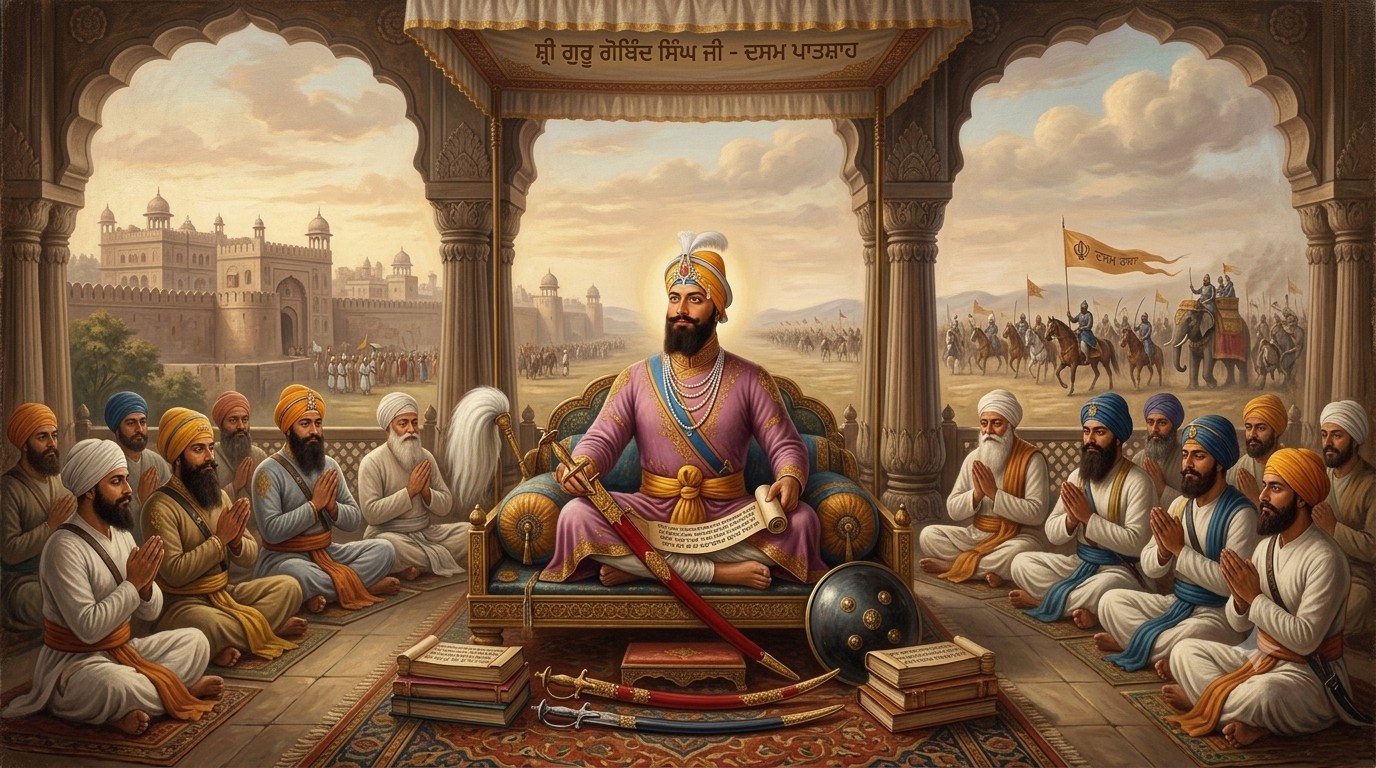
Guru Gobind Singh Ji (Gobind Rai)
At age nine, he famously told his father that 'no one is more worthy than you' to make the sacrifice needed to save the oppressed faith.
Guru Tegh Bahadur Ji (1621–1675)
At age nine, he famously told his father that 'no one is more worthy than you' to make the sacrifice needed to save the oppressed faith.
- Role
- Son & Successor
- Group
- Family & The Tenth Master
- Period
- Guru Tegh Bahadur Ji (1621–1675)
In the grand, turbulent theater of the seventeenth century, there stood a figure whose life was a symphony of clashing steel and celestial poetry. He was a king who lived like a saint, a soldier who fought with the heart of a father, and a poet who wrote with the ink of his own blood. He was Guru Gobind Singh Ji—the Tenth Sovereign of the Sikhs, the Father of the Khalsa, and the Archer of the Infinite.
His story is not a mere history; it is a spiritual odyssey that takes us from the banks of the River Ganges in Bihar to the high Shivalik hills of Punjab, and finally to the Deccan plains of Maharashtra.
1. The Divine Prince of Patna: A Childhood of Grace (1666–1670)
The story begins in the ancient city of Patna Sahib, Bihar, on December 22, 1666. At the time of his birth, his father, Guru Tegh Bahadur Ji, was away on a missionary tour. The child was named Gobind Das, later known as Gobind Rai.
The Two Pots of Sweetness
A Muslim saint named Shah Bheekh arrived with two earthen pots of sweets—one for Hindus and one for Muslims. Young Gobind placed one hand on each pot, symbolizing protection for all humanity.
The Bala Pritam and Shiv Dutt
Young Gobind was adored as the “Bala Pritam” or Beloved Child. He organized mock battalions among children and displayed extraordinary compassion and spiritual power.
2. The Shield of India: The Sacrifice of a Father (1670–1675)
In 1670, the family returned to Punjab and settled at Anandpur Sahib. Here, Gobind Rai received education in languages, spirituality, horsemanship, and martial arts.
The Plea of the Kashmiri Pandits
In 1675, Kashmiri Pandits sought Guru Tegh Bahadur Ji’s help against Mughal persecution. Young Gobind Rai boldly declared that no one was more suited for sacrifice than his father.
The Ascension at Age Nine
Guru Tegh Bahadur Ji was martyred in Delhi. At age nine, Gobind Rai became the Tenth Guru of the Sikhs.
“Ranghareta Guru Ka Beta.”
3. The Poet-Warrior: The Paonta Sahib Era (1685–1688)
Guru Gobind Singh Ji established Paonta Sahib on the banks of the Yamuna River. This became a center of literary brilliance and military preparation.
The 52 Court Poets
The Guru’s court included 52 poets and scholars who translated ancient scriptures into common languages.
“Someone is Hindu and someone a Muslim... but all human beings are recognized as one.”
The Battle of Bhangani
In 1688, Guru Gobind Singh Ji fought his first major battle against the Hill Rajas and emerged victorious.
4. The Birth of the Khalsa: Vaisakhi 1699
Vaisakhi 1699 marked the greatest turning point in Sikh history. Guru Gobind Singh Ji gathered thousands at Anandpur Sahib and called for a head sacrifice.
The Call for Heads
- Bhai Daya Ram
- Bhai Dharam Das
- Bhai Himmat Rai
- Bhai Mohkam Chand
- Bhai Sahib Chand
These five became the Panj Pyare, the Five Beloved Ones.
The Nectar of Immortality
Guru Gobind Singh Ji prepared Amrit using water, sugar, and a double-edged sword while reciting Gurbani.
The Khalsa was born as a community of saint-soldiers devoted to righteousness, equality, and courage.
The Five Ks
- Kesh
- Kangha
- Kara
- Kirpan
- Kacchera
5. The Great Separation and the Battle of Chamkaur (1704–1705)
Anandpur Sahib was besieged for months by Mughal and Hill Raja forces. After false promises of safe passage, the Sikhs were attacked while evacuating.
The Betrayal at Sirsa
The Guru’s family became separated at the flooded Sirsa River.
- The Guru and his elder sons reached Chamkaur.
- Mata Gujri Ji and the younger Sahibzadas were captured.
The Battle of Chamkaur
In a small fort at Chamkaur, 40 Sikhs faced a massive Mughal army.
Sahibzada Ajit Singh and Sahibzada Jujhar Singh fought bravely and attained martyrdom.
6. The Martyrdom of the Younger Sahibzadas
Baba Zorawar Singh and Baba Fateh Singh were imprisoned in Sirhind along with Mata Gujri Ji.
Bricked Alive
The children refused to abandon their faith despite promises of wealth and royalty.
They were bricked alive and later executed in 1705.
Mata Gujri Ji passed away shortly after hearing the news.
7. The Epistle of Victory and the Final Days (1705–1708)
The 40 Mukte and Mai Bhago
Forty Sikhs who had once abandoned the Guru returned under the leadership of Mai Bhago and attained martyrdom at Muktsar.
The Zafarnama
Guru Gobind Singh Ji wrote the Zafarnama to Emperor Aurangzeb, condemning betrayal and injustice.
“When all other means have failed, it is righteous to take the sword in hand.”
Nanded and the Eternal Guru
In Nanded, the Guru met Banda Singh Bahadur and inspired him to continue the struggle against tyranny.
Before departing from the physical world in 1708, Guru Gobind Singh Ji declared Guru Granth Sahib Ji as the eternal Guru of the Sikhs.
Timeline of Guru Gobind Singh Ji
- 1666 – Birth in Patna Sahib.
- 1675 – Guru Tegh Bahadur Ji’s martyrdom.
- 1685–1688 – Paonta Sahib period and Battle of Bhangani.
- 1699 – Creation of the Khalsa.
- 1704 – Battle of Chamkaur.
- 1705 – Martyrdom of younger Sahibzadas.
- 1706 – Writing of the Zafarnama.
- 1708 – Final declaration of Guru Granth Sahib Ji as eternal Guru.
Significant Teachings
Teaching Meaning Dharam Yudh Fight for righteousness and protection of the weak. Universal Brotherhood All humanity is equal. Chardi Kala Remain optimistic even in hardship. Sovereignty of the Soul The Khalsa belongs to God and victory belongs to God.Frequently Asked Questions (FAQ)
Why is Guru Gobind Singh Ji called “Sarbans Dani”?
Because he sacrificed his entire family for righteousness and humanity.
What do “Singh” and “Kaur” mean?
“Singh” means Lion and “Kaur” means Princess. These names were given to abolish caste distinctions.
Why were 52 poets present in his court?
To translate spiritual knowledge into languages accessible to ordinary people.
Why did Guru Gobind Singh Ji declare Guru Granth Sahib Ji as the final Guru?
To ensure the Sikh community would forever be guided by the eternal Divine Word.
Narrative Conclusion: The Flame That Never Fades
Guru Gobind Singh Ji transformed a vulnerable community into a fearless nation of saint-soldiers.
Through unimaginable sacrifice, he taught humanity the meaning of courage, dignity, equality, and spiritual sovereignty.
Today, his legacy lives on in every Sikh who stands for truth, justice, compassion, and fearless devotion to the Divine.