Gurus and Bhagats, Bani Contributors · Origins & Gurus
Guru Granth Sahib Ji
Final and Living Guru
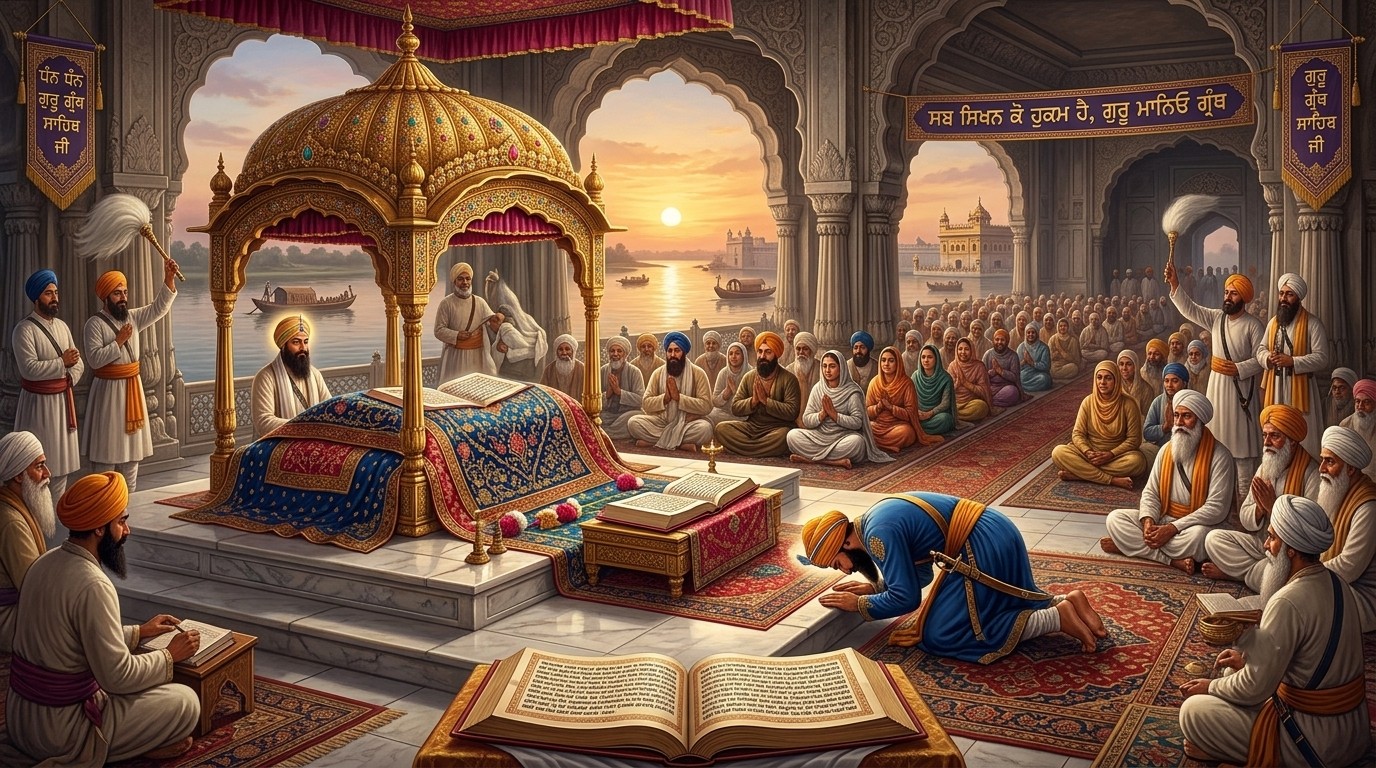
The Sovereign Legacy of the Shabad: Sri Guru Granth Sahib Ji
To understand the spiritual, socio-political, and philosophical landscape of South Asia, one must inevitably reckon with the monumental legacy of Sri Guru Granth Sahib Ji. As a Sikh historian, viewing the sacred scripture not merely as a book of hymns but as the living, breathing embodiment of the Gurus' eternal consciousness is essential to grasping the core of Sikh identity. In the year 1708, at Nanded, Sri Guru Gobind Singh Ji, the tenth human Guru, brought an end to the line of personal Guruship by vesting the spiritual authority of the community in the Adi Granth, henceforth known as the Guru Granth Sahib. This transition from a physical guide to an scriptural sovereign was not an abrupt historical departure, but rather the logical, pre-ordained culmination of a theology that had always prioritized the Shabad (the Divine Word) over the physical form. The physical body of the Guru was merely a vessel; the true Guru was, and had always been, the enlightened wisdom contained within the Word.
The Genesis: Guru Arjan Dev Ji and the Compilation of the Adi Granth
The historical trajectory of compiling this magnificent text began under the visionary stewardship of the fifth Master, Guru Arjan Dev Ji. In the late sixteenth and early seventeenth centuries, as the Sikh community (the Panth) expanded rapidly across Punjab and beyond, the need for an authentic, authoritative canon became paramount. Spurious compositions attributed to the Gurus were being circulated by schismatic sects like the Minas, threatening to dilute the pristine message of Gurmat (the Guru's path). Recognizing this existential threat, Guru Arjan Dev Ji undertook the monumental task of compiling the Adi Granth (the First Book) in 1603, completing it in 1604. Operating from the serene banks of the Ramsar Sarovar in Amritsar, the Guru gathered the authentic writings of his four predecessors—Guru Nanak Dev Ji, Guru Angad Dev Ji, Guru Amar Das Ji, and Guru Ram Das Ji—alongside his own extensive compositions. Assisted by the venerable scholar Bhai Gurdas Ji, who served as the scribe, the compilation process was a marvel of rigorous editorial discipline, literary genius, and spiritual discernment.
What makes this compilation process uniquely revolutionary in the history of world religions is its deliberate and radical ecumenism. Guru Arjan Dev Ji did not confine the scripture to the writings of the Sikh Gurus. In a profound assertion of universalism, he incorporated the compositions of fifteen Bhagats (saint-poets of Hindu and Muslim backgrounds), eleven Bhatts (court bards), and four prominent Gursikhs. By elevating the voices of low-caste saints like Bhagat Ravidas Ji, a leatherworker, and Bhagat Kabir Ji, a weaver, alongside Muslim Sufi mystics like Sheikh Farid Ji, Guru Arjan Dev Ji shattered the rigid caste hierarchies and religious hegemonies that had choked the spiritual life of India for centuries. This editorial decision was a socio-political declaration that divine revelation was not the exclusive monopoly of any single priestly class, language, or dogmatic creed. The language of the Granth, broadly termed Sant Bhasha, utilized local dialects, Sanskrit, Persian, Arabic, and Punjabi, written in the egalitarian Gurmukhi script, making the highest spiritual truths accessible to the common peasant, the laborer, and the scholar alike.
The Final Recension: Damdami Bir and the Crown of Guruship
The scripture we revere today reached its final, complete form through the actions of the tenth Master, Guru Gobind Singh Ji, during a period of intense imperial persecution and military conflict. Following the martyrdom of his father, the ninth Master Guru Tegh Bahadur Ji, and the subsequent evacuation of Anandpur Sahib, Guru Gobind Singh Ji stayed at Talwandi Sabo (now known as Takht Sri Damdama Sahib) in 1705–1706. There, in a legendary feat of memory and spiritual concentration, the tenth Guru dictated the entire Adi Granth from heart, inserting the sublime, contemplative compositions of Guru Tegh Bahadur Ji into their appropriate musical measures (Ragas). This final recension, known as the Damdami Bir, established the canonical text that would guide the Sikh Panth through the turbulent centuries to come.
The ultimate transformation of this text from a revered scripture to the Eleventh Guru occurred on October 20, 1708. Sensing his impending departure from the mortal world, Guru Gobind Singh Ji assembled his followers at Nanded, Deccan. In a solemn, historical declaration, he bowed before the Damdami Bir and uttered the historic commandment: "Agya Bhai Akal Ki, Tabhi Chalayo Panth. Sab Sikhan Ko Hukam Hai, Guru Manyo Granth." (By command of the Timeless Creator, the Panth was established. All Sikhs are hereby commanded to accept the Granth as their Guru). By declaring the Granth Sahib as the eternal, living Guru, the tenth Master anchored the Sikh community to an unalterable, immortal source of divine guidance. The Guru was no longer a mortal being subject to the ravages of time, but a perpetual, spiritual sovereign residing within the sacred verses, guiding the collective community (the Guru Khalsa Panth) through the ages.
The Structural and Musical Architecture of the Scripture
To fully appreciate the genius of Sri Guru Granth Sahib Ji, one must study its internal organization. The entire scripture is structured with mathematical precision, comprising exactly 1,430 pages (referred to as Angs, denoting limbs of the living Guru). Far from being a random collection of hymns, the text is systematically organized according to the classical Indian musical system of Ragas. The Gurus understood that intellectual comprehension of spiritual truths must be married to emotional resonance; music was the supreme vehicle to bypass the ego and touch the human soul. There are 31 major Ragas utilized in the scripture, each selected for its ability to evoke specific emotional states, times of day, seasons, and spiritual moods.
Within each Raga section, the hymns are arranged with strict structural discipline, categorized by author and poetic form. This rigorous system of categorization served as a protective mechanism against any future attempts at interpolation or alteration. The table below illustrates the diverse tapestry of divine voices integrated into this singular, harmonious spiritual masterpiece:
Category of Contributor Prominent Figures Historical and Spiritual Significance The Sikh Gurus Guru Nanak, Guru Angad, Guru Amar Das, Guru Ram Das, Guru Arjan, Guru Tegh Bahadur Form the theological core, establishing the path of householder devotion, social justice, and ultimate surrender to the Divine Will. The Bhagats (Saints) Bhagat Kabir, Bhagat Ravidas, Bhagat Namdev, Baba Farid, Bhagat Jaidev, Bhagat Trilochan Drawn from diverse geographical regions and caste backgrounds, affirming that spiritual enlightenment transcends sectarian and social divisions. The Bhatts (Bards) Bhatt Kalshar, Bhatt Kirat, Bhatt Mathura, Bhatt Jalap, and others Inscribed panegyrics praising the spiritual status and divine light operating through the first five Sikh Gurus. The Gursikhs (Devotees) Bhai Mardana, Baba Sunder, Bhai Satta, Bhai Balwand Contributed intimate reflections on the spiritual atmosphere of the Guru's court and the transformative power of holy congregation (Sangat).The sequence within each Raga begins with the Shabads of the Gurus in chronological order (designated by the term Mahala), followed by longer poetic structures like Ashtpadis, special longer compositions, and finally the hymns of the Bhagats. This intricate design ensures that when a congregation gathers, the singing of Gurbani (Kirtan) is not merely a performance but an immersive journey through structured emotional landscapes, designed to align the human mind with the rhythm of cosmic harmony.
The Egalitarian and Socio-Political Philosophy
As a historian, it is crucial to emphasize that Sri Guru Granth Sahib Ji is as much a socio-political manifesto as it is a manual for individual salvation. The Gurus did not preach a quietist, world-renouncing asceticism. Instead, they articulated a theology that demanded active engagement with the world to establish a just, compassionate, and exploitation-free society. The scripture forcefully denounces the tyranny of rulers, the corruption of religious elites, and the dehumanizing practices of caste discrimination. In a famous verse, Guru Nanak Dev Ji decries the moral decay of his times, comparing the rulers of the day to ravenous beasts and their administrators to wild dogs. By capturing the pain of the oppressed and validating their struggle, the Guru Granth Sahib Ji laid the ideological foundation for the subsequent Sikh resistance against tyrannical empires.
At the heart of the scripture's social vision is the concept of Halemi Raj (the Kingdom of Humility and Gentleness), where no one suffers from oppression or fear, and all live in dignity and peace. The integration of Bhagat Ravidas Ji's vision of Begampura (the city without sorrow, land of no taxes, worry, or class divisions) into the sovereign scripture of the Sikhs is a striking historical proof of this radical social commitment. By elevating these visions of structural equality to the status of divine word, the Gurus ensured that the struggle for social justice, human rights, and the defense of the downtrodden would forever remain an inseparable, spiritual duty for every practicing Sikh.
Conclusion: The Living Presence in a Fractured World
Ultimately, Sri Guru Granth Sahib Ji represents a unique paradigm in the history of global religions: a sovereign scripture that acts as a spiritual anchor, a democratic guide, and a living, eternal mentor. It does not demand blind faith or adherence to dogmatic rituals; instead, it invites the seeker to engage in Vichar (critical reflection) and Shabad-Surati (conscious alignment of the mind with the Divine Word). In a modern world increasingly fractured by sectarian violence, racial animosity, and economic inequality, the universal message of the eleventh Guru offers a profound blueprint for global peace. It proclaims the oneness of humanity, the sacredness of creation, the equality of women, and the necessity of compassionate action. To bow before the Guru Granth Sahib Ji is not an act of idol worship, but a profound surrender of the ego to the ultimate, universal truth of the cosmos—a truth that belongs to no single nation, caste, or creed, but to all of humanity.