Gurus and Bhagats, Bani Contributors · Origins & Gurus · Guru Har Krishan Ji
Guru Har Krishan Ji
The child Guru; served Delhi during a smallpox epidemic.
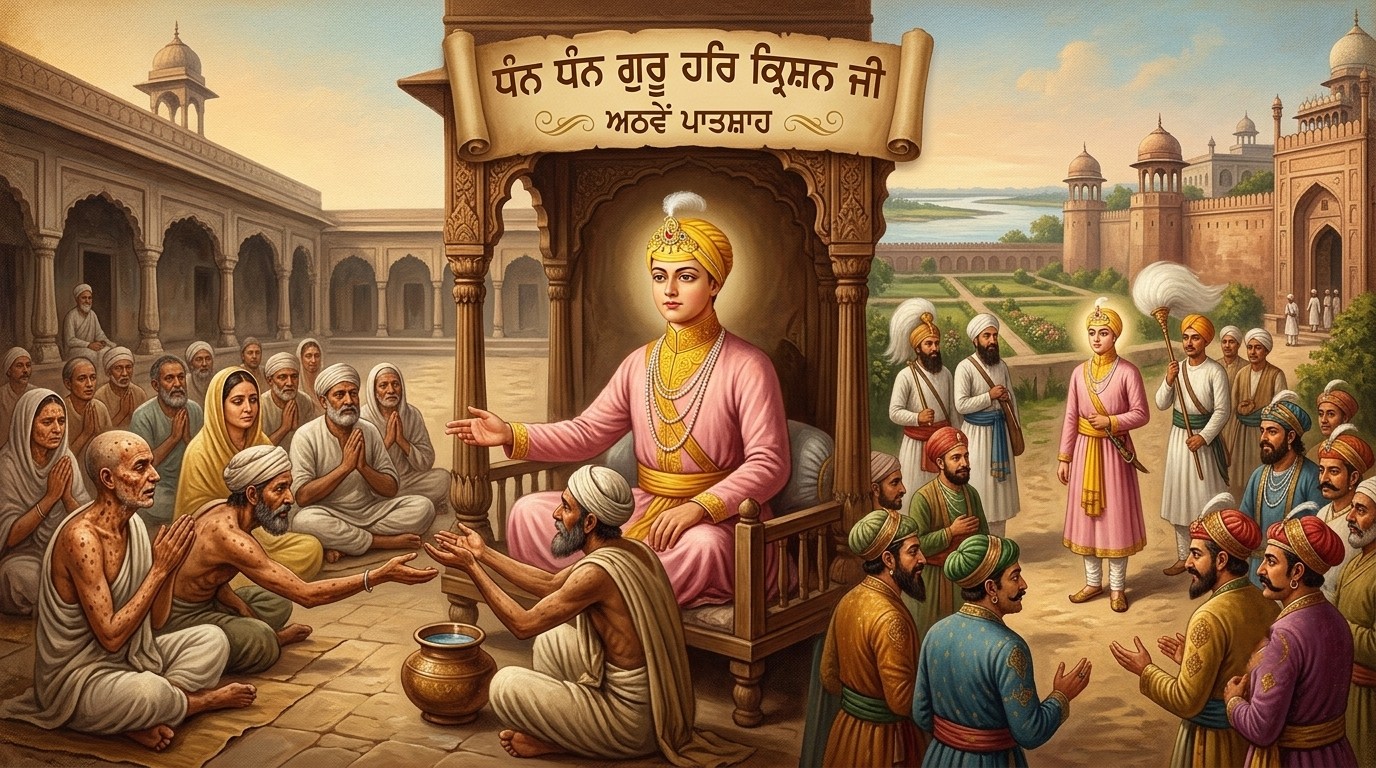
In the quiet dawn of the Shivalik foothills, where the air is often perfumed with the scent of wild jasmine and the rhythmic chanting of the Sukhmani Sahib, a light appeared that would challenge every human notion of wisdom, age, and power.
To the world, he was a child of five. To the suffering, he was a "Bala Pir"—a child prophet. To the Sikh faith, he was the Eighth Sovereign, the Eighth Nanak, whose short life remains the most profound testament to the truth that the Divine Light (Jyot) does not age with the body.
The story of Guru Har Krishan Sahib Ji is not merely a historical record; it is a cinematic journey of innocence meeting infinite wisdom. It is the narrative of a tender soul who stood between a ruthless Emperor and a fragmented community, and who finally stood between a dying city and the shadow of death.
This is the journey of the "Child-Guru," whose sight, even today, is believed to dispel all sorrow.
1. The Radiant Dawn: Birth in the Shivalik Hills
The story begins on July 7, 1656, in the serene town of Kiratpur Sahib. Born to the Seventh Master, Guru Har Rai Ji, and the compassionate Mata Krishan Kaur (also known as Mata Sulakhni), the child was named Har Krishan.
From his earliest days, the atmosphere in the Guru’s household was one of deep spiritual discipline. While other children his age were occupied with toys, young Har Krishan was often found in the Shees Mahal (the palace of mirrors), sitting in a state of absolute stillness (Samaadhi).
Tradition tells us that when he was born, his father, Guru Har Rai, carried the infant into the congregation and prophesied that this child would perform deeds that no one before him had ever accomplished.
The Contrast of Two Brothers
Guru Har Rai had two sons: the elder, Ram Rai, and the younger, Har Krishan. The difference between them was not just of age, but of spirit.
Ram Rai was brilliant, charismatic, and learned, but he possessed a streak of worldly ambition that would eventually lead him to the Mughal court of Aurangzeb.
A legendary test illustrates their inner natures. Someone once asked Guru Har Rai how he would choose his successor when both sons were so gifted.
The Guru suggested a test of "spiritual softness." He asked for a needle to be taken to a wooden table where the boys were reciting the Adi Granth.
When Har Krishan read the hymns with absolute, ego-less love, it is said the wood of the table became as soft as wax, and the needle slid in effortlessly.
When Ram Rai read, the wood remained hard and impenetrable. This was a symbolic sign that Har Krishan’s heart was so attuned to the Divine that it could "melt" the physical world around him.
2. The Weight of the Canopy: Becoming the Eighth Guru
In 1661, Guru Har Rai Ji felt his earthly journey nearing its end. He had already excommunicated Ram Rai for altering a verse of Gurbani to appease Emperor Aurangzeb—a betrayal of truth for the sake of political safety.
On October 20, 1661, at the age of just five years, Har Krishan was installed as the Eighth Guru of the Sikhs.
The scene was one of immense emotional weight: a toddler, barely tall enough to see over the high back of the Guru’s throne, being vested with the spiritual sovereignty of a nation.
The community was stunned by his composure. He spoke with a clarity that silenced the skeptics and a compassion that comforted the grieving.
The Storm of Jealousy
Ram Rai, consumed by jealousy and supported by the Mughals, contested the succession. He complained to Emperor Aurangzeb in Delhi, claiming he had been cheated of his birthright.
Aurangzeb, a master of political manipulation, saw an opportunity to control the growing Sikh community. He issued a summons for the young Guru to appear in Delhi.
The Sikh Sangat in Kiratpur was terrified. They remembered the martyrdom of the Fifth Guru and the imprisonment of the Sixth.
They could not bear the thought of their "Child-Guru" falling into the hands of a tyrant.
At first, Guru Har Krishan refused to go, honoring his father’s instruction to never show his face to Aurangzeb.
However, when the venerable Raja Jai Singh of Amber—a powerful court official and a secret admirer of the Gurus—promised to ensure the Guru’s safety and told him that thousands of devotees in Delhi were yearning for his sight, the Guru agreed to the journey.
3. The Miracle at Panjokhra: Wisdom Beyond Years
The journey from Kiratpur to Delhi was a moving procession of faith. Multitudes of Sikhs followed the Guru’s palanquin, unwilling to let him go.
When they reached the village of Panjokhra, near Ambala, the Guru instructed his followers to return to their homes, promising them that his spirit would always be with them.
It was here that a proud Brahmin scholar named Pandit Lal Chand confronted the Guru.
Seeing a child on the throne, he scoffed, "Your Guru is named after Lord Krishna, who gave the world the Bhagavad Gita. If this child is truly a Guru, let him explain the meanings of the Gita to me!"
The Guru remained calm. He did not engage in a debate to prove his own intellect.
Instead, he chose a path of radical humility. He asked Lal Chand to find any "humble person" from the village to speak on the Guru’s behalf.
Lal Chand, thinking he could humiliate the Guru, brought forward Chhajju Ram, a mute and illiterate water-carrier who was considered by the villagers to be a "village idiot."
The Guru touched Chhajju’s head with his walking stick. In an instant, the "idiot" was transformed into a vessel of light.
Chhajju began to expound on the most complex verses of the Gita with a depth that left Lal Chand trembling.
Humbled and ashamed, the Pandit fell at the child-Guru's feet, realizing that spiritual greatness is not a matter of age or study, but of Divine Grace.
4. The City of Shadows: Arrival in Delhi
Guru Har Krishan reached Delhi in 1664 and was hosted at the palatial residence of Raja Jai Singh in Raisina (now the site of Gurdwara Bangla Sahib).
The air in the capital was thick with intrigue. Aurangzeb was eager to see the "miracle child," but the Guru remained steadfast in his refusal to meet the Emperor.
The Test of the Queen
Raja Jai Singh's wife, the Rani, was still skeptical. She devised a test to see if the Guru truly possessed the "all-knowing" (Antarjami) quality of the Gurus.
She dressed herself in the coarse clothes of a maidservant and sat among a group of equally dressed women at the back of the room.
When the Guru was invited into the inner apartments, he walked past the ladies in their fine jewels, ignoring them.
He walked straight to the "maid" sitting in the corner and sat in her lap.
"You are the Rani," he said softly. "Why do you seek to hide from the light with a veil of tricks?"
The Rani was overwhelmed and immediately became a devoted disciple.
5. The Bala Pir: Service During the Epidemic
While the political elite were busy with tests and summons, a real horror was unfolding in the streets of Delhi.
A dual epidemic of smallpox and cholera had gripped the city.
Medieval Delhi was a place of stark contrasts: the white marble of the Mughal palaces against the crowded, narrow, and often unsanitary lanes where the poor lived.
As the disease spread, the city became a landscape of despair.
People were dying in the thousands; the smell of death was everywhere, and those who were still healthy fled in fear, abandoning their sick relatives.
The Fearless Healer
In this crisis, the seven-year-old Guru Har Krishan showed his true nature. He did not hide behind the walls of Jai Singh’s bungalow.
Instead, he went into the heart of the epidemic.
Picture a small, radiant child in simple robes, moving through the dark, disease-ridden alleys.
He would sit by the bedsides of the dying, regardless of whether they were Hindus, Muslims, or Sikhs.
He provided food, medicine, and most importantly, comfort.
The local Muslims, seeing his selfless service and his ability to remain calm amidst such suffering, began to call him "Bala Pir" (The Child Saint).
Tradition records that a spring of water appeared at Jai Singh’s bungalow through the Guru’s blessing, which acted as a cure for those who bathed in it.
Even today, the Sarovar at Bangla Sahib is visited by millions seeking physical and spiritual healing.
6. The Supreme Sacrifice: "Baba Bakale"
As the Guru absorbed the sorrows of the people, he eventually took the disease upon his own body.
He was seized with a high fever and the characteristic pustules of smallpox.
When his mother, Mata Krishan Kaur, saw his condition, she wept.
"You are the Guru," she cried. "Why have you caught this disease yourself?"
The child-Guru replied with a peace that surpassed understanding:
"Happiness and suffering are parts of life. This is the Will of the Almighty (Hukam), and I must obey it."
The Final Instructions
Knowing his end was near, the Guru moved to a simple tent on the banks of the River Yamuna (near where Gurdwara Bala Sahib now stands).
He forbade his followers from mourning, instructing them instead to sing the hymns of Gurbani.
The question of succession was urgent.
The Guru was too weak to travel or speak at length.
He asked for five coins and a coconut—the traditional tokens of Guruship.
He waved his hand three times in the air toward the west and whispered the words:
"Baba Bakale."
These two words were a cryptic prophecy. They meant that the next Guru—his "grandfather" figure—would be found in the village of Bakala.
This eventually led to the revelation of Guru Tegh Bahadur Ji.
On March 30, 1664, reciting "Waheguru" until his final breath, the eight-year-old Guru Har Krishan Ji merged back into the Eternal Light.
Timeline of the Life of Guru Har Krishan Sahib Ji
- July 7, 1656: Birth at Kiratpur Sahib.
- October 20, 1661: Installed as the Eighth Sikh Guru at age 5.
- 1663–1664: Journey to Delhi; Panjokhra incident with Lal Chand.
- Early 1664: Stay at Raja Jai Singh's bungalow (Bangla Sahib) in Delhi.
- February–March 1664: Fearless service during the smallpox epidemic.
- March 30, 1664: Joti Jot (passing away) after uttering "Baba Bakale."
Significant Teachings: The Power of Purity
Teaching Root Event / Narrative Compassion (Daya) Serving the smallpox victims in Delhi regardless of their faith. Humility Refusing to perform miracles for the Emperor; using a water-carrier to expound the Gita. Acceptance of Hukam Embracing his own illness as part of the Divine Will. Universality Earning the respect of Muslims as "Bala Pir" through humanitarian work.Why Guru Har Krishan Ji Still Matters Today
Guru Har Krishan Ji remains the ultimate symbol of youthful leadership and humanitarian service.
He reminds us that one is never too young to serve, to lead, or to sacrifice.
In a modern world often paralyzed by fear during health crises, his fearless movement into the heart of a plague remains a blueprint for empathetic leadership.
The transition from the Eighth to the Ninth Guru through the words "Baba Bakale" also highlights a central Sikh value: the rejection of ego.
By choosing his successor based on merit and spiritual depth rather than convenience, he ensured the continuity of the mission of Guru Nanak.
Frequently Asked Questions (FAQ)
Q1: What does the title "Bala Pritam" mean?
It means "The Beloved Child." It is an honorific used by Sikhs to describe the youthful beauty and spiritual sweetness of Guru Har Krishan Ji.
Q2: Why is Gurdwara Bangla Sahib so famous?
It was built on the site of Raja Jai Singh’s bungalow where the Guru stayed and served the sick.
The water of its Sarovar is believed by many to have healing properties in memory of the Guru’s service.
Q3: Did Guru Har Krishan ever meet Emperor Aurangzeb?
No. He strictly followed his father's instruction and refused to grant the Emperor an audience, emphasizing that a spiritual leader does not bow to temporal tyranny.
Q4: Who was Chhajju Ram?
He was a mute and illiterate water-carrier who, by the Guru's grace, was able to explain the deep meanings of the Bhagavad Gita to a proud scholar.