Gurus and Bhagats, Bani Contributors · Origins & Gurus · Guru Har Rai Ji
Guru Har Rai Ji
Promoted environmentalism and humanitarian medicine; maintained a peaceful army.
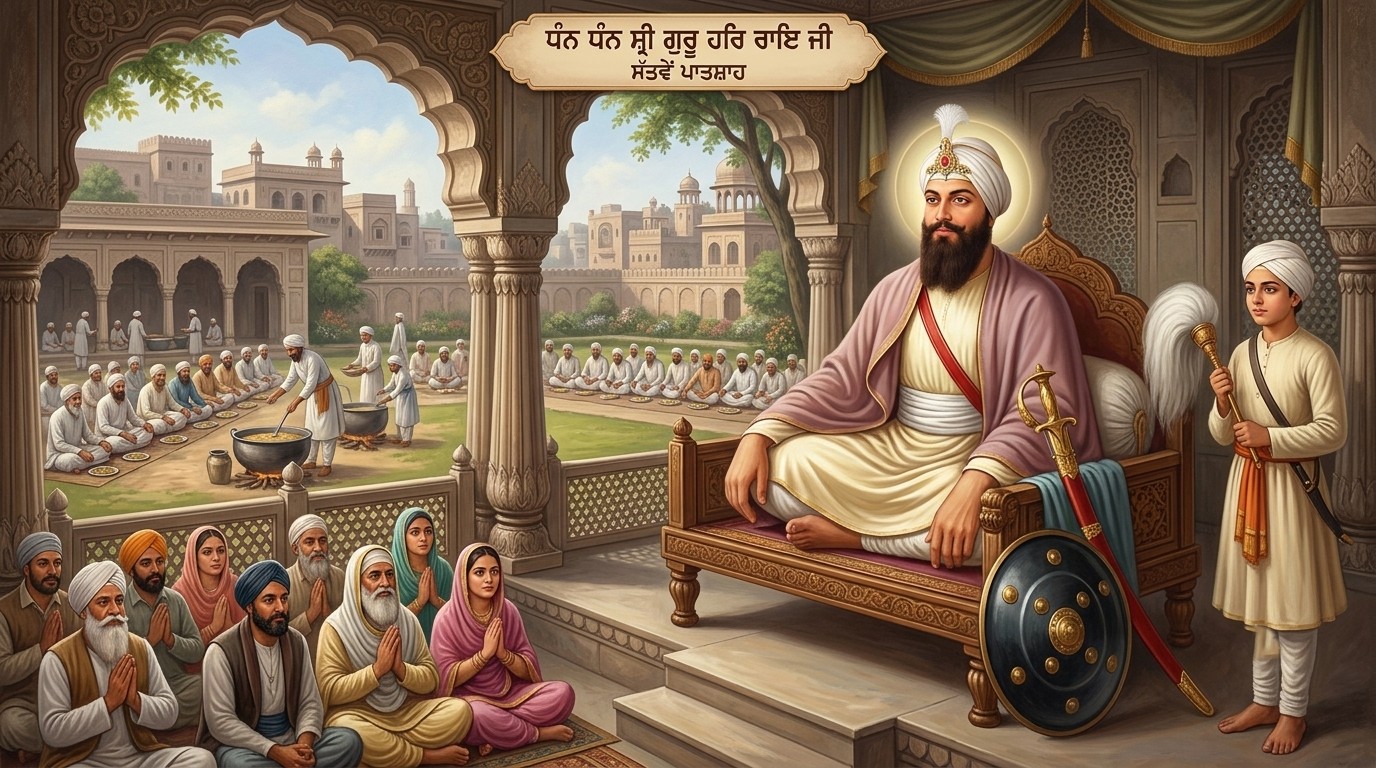
In the seventeenth-century Punjab, amidst the emerald Shivalik foothills where the Sutlej River carves its zigzagging path through the plains, there lived a sovereign who carried a sword of steel but refused to pluck a single petal from a rose. He was a master of twenty-two hundred armed horsemen, yet his greatest victories were won not on blood-soaked fields, but in the quiet chambers of a herbal hospital and the sprawling enclosures of an animal sanctuary.
This is the story of Guru Har Rai Sahib Ji, the Seventh Nanak—the "Green Guru," the "Image of Compassion," and the "Healer of Hearts." His life remains a cinematic testament to a profound spiritual truth: that true power is found in the ability to protect, and the ultimate warrior is the one who has mastered the landscape of their own soul.
1. The Radiant Dawn: Childhood in the House of Victory
The journey of Guru Har Rai Ji began on January 16, 1630, in the serene atmosphere of Kiratpur Sahib. Born into the house of the legendary warrior-saint Guru Hargobind Sahib Ji, he was the son of Baba Gurditta and Mata Nihal Kaur (also known as Mata Ananti).
His grandfather, the Sixth Master, had recently transformed the Sikh community into a martial force, donning the two swords of Miri (temporal power) and Piri (spiritual authority). Growing up in such a household, young Har Rai’s world was a blend of clashing steel and celestial kirtan. He was a striking child—intelligent, mature beyond his years, and possessed of a gentleness that seemed to radiate from his very being.
The Lesson of the Broken Rose
One afternoon, the young Har Rai was rushing through his grandfather’s flower garden to pay him homage after a morning of riding. He was wearing a regal, heavy robe—a 101-pleated chola—that billowed behind him like a cloud. In his excitement, he didn't notice the hem of his garment snagging on a rose bush.
As he pulled away, the cloth jostled the bush, and a cluster of delicate roses were battered, their petals scattering onto the soil. When Har Rai saw the damage his haste had caused, he did not shrug it off. He stood still, looking at the broken flowers, and began to weep.
Guru Hargobind Ji, seeing his grandson’s distress, walked over and offered words that would become the blueprint for Har Rai’s life:
"The Creator has made this whole creation. To serve God, we must take care of the creation... Keep wearing the chola, my son, just lift it out of the way when needed. A warrior must first master themselves as they walk their path through the world".
From that day forward, Har Rai vowed never to harm a living thing again. This was not a move toward weakness, but toward the highest form of discipline: the discipline of compassion.
2. The Weight of the Canopy: Becoming the Seventh Guru
In 1644, as Guru Hargobind Ji prepared to leave his physical form, he bypassed his eldest grandson, Dhir Mal, who had grown arrogant and treacherous. Instead, he chose the 14-year-old Har Rai to carry the Light of Nanak.
On March 3, 1644, Har Rai was installed as the Seventh Sikh Guru. He inherited a community that was under constant surveillance by the Mughal authorities of Shah Jahan. Yet, the young Guru maintained a "stately style," keeping the 2,200 mounted soldiers his grandfather had raised. He was a magnificent rider and trained in weaponry, yet his mission was consolidation and healing. He boosted the military spirit of the Sikhs not for conquest, but as a shield of righteousness.
Significant Places: Kiratpur Sahib as a Paradise
Under Guru Har Rai Ji’s stewardship, Kiratpur Sahib became an idyllic town of parks, gardens, and fruit-bearing trees. He developed it as a sanctuary where the "air was fresh with the scent of wildflowers and early morning rains". This wasn't merely landscaping; it was a spiritual statement that the Divine exists in every leaf and blade of grass.
3. The Healer’s Court: Naulakha Bagh and the Animal Zoo
If the Sixth Guru’s court was a court of justice, the Seventh Guru’s court was a court of mercy. Guru Har Rai Ji established the Naulakha Bagh, a vast botanical garden at Kiratpur where he grew rare medicinal herbs that were available nowhere else in India.
The Zoo of the Displaced
His love for animals was legendary. He would often go into the forest on "hunts," but he never killed. Instead, he would capture sick, injured, or endangered animals, bring them back to his zoo, and treat their wounds. Once they were healthy, they were released back into the wild. He taught that even animals were part of the Sangat (the holy congregation) and deserved to be in the presence of the Guru.
Healing an Enemy: The Case of Dara Shikoh
In 1652, the Mughal Prince Dara Shikoh, the eldest and favorite son of Emperor Shah Jahan, fell dangerously ill. Tradition tells of a slow poisoning orchestrated by his ambitious brother, Aurangzeb, using tiger whiskers. The royal physicians were helpless.
When Shah Jahan heard that the remedy existed only in the Guru’s garden, he sent a humble plea for help. Despite the fact that the Mughals had persecuted the Gurus for generations, Guru Har Rai Ji did not hesitate. He sent harar (chebulic myrobalan), cloves, and a special Jagmoti pearl to be ground into the medicine.
When asked why he helped the son of a tyrant, he replied with a profound metaphor:
"Behold, with one hand man breaks flowers and with the other he offers them, but the flowers perfume both hands alike. The axe cuts the sandalwood tree, yet the sandalwood perfumes the axe".
Dara Shikoh recovered and became a lifelong friend of the Guru, an intellectual who sought to bridge the gaps between faiths.
4. Missionary Journeys: Planting the Seeds of Faith
Guru Har Rai Ji was a tireless traveler. He toured the Malwa and Doaba regions extensively, moving with his 2,200 horsemen not to fight, but to organize and uplift the people.
- The Phoolkian State: During a visit to the village of Mehraj, two orphan brothers, Phul and Sandhvi, approached the Guru. They were hungry and beating their bellies in distress. The Guru blessed Phul, saying that his descendants would rule the land and their "steeds would drink water as far as the Yamuna River". This blessing eventually gave rise to the princely states of Patiala, Nabha, and Jind.
- The Manjis and Bakshishs: Realizing the existing Masand system was becoming corrupt, he established six new missionary centers called Bakshishs (gifts of grace). He appointed devoted souls like Bhagat Bhagwan (who established 360 centers in the East) and Bhai Pheru (who served Rajasthan and Southern Punjab).
The Heart of a Sikh: The Story of Bhai Gonda
In Kabul, a Sikh named Bhai Gonda once fell into a deep trance of meditation, feeling as if he were literally clinging to the Guru’s feet. At that same moment, miles away in Kiratpur, Guru Har Rai Ji remained sitting on his throne, refusing to move or eat for hours. When his attendants grew worried, the Guru explained that he could not move his feet because a devotee in Kabul was holding them with such love that any movement would break his concentration.
5. The Nature and Compassion of Leadership
For Guru Har Rai Ji, compassion was not a passive emotion; it was an active spiritual strength. He saw nature as a sacred manifestation of the Divine. His teachings emphasized that a "mandir or a mosque can be rebuilt, but not a broken heart".
In Sikh philosophy, the care for creation is a form of Seva (selfless service). The Guru taught that the air is our Guru, the water is our Father, and the earth is our Mother. By maintaining herbal gardens and protecting animals, he institutionalized environmental stewardship as a core Sikh duty centuries before the birth of modern ecology.
His leadership style was "soft of heart but strong of mind." He demonstrated that one can maintain a massive army and the readiness to fight without ever losing the capacity to weep for a broken flower.
6. Political Tensions: The Test of Gurbani and Ram Rai
As the Mughal succession wars ended with Aurangzeb seizing the throne, the atmosphere turned hostile. Aurangzeb summoned Guru Har Rai Ji to Delhi to explain his relationship with Dara Shikoh.
The Guru, following his father’s instruction to never show his face to the tyrant, sent his eldest son, Ram Rai, to represent him. He warned Ram Rai never to use miracles to show off and never to compromise the sanctity of the Gurbani.
The Betrayal of Truth
In the Mughal court, to please Aurangzeb, Ram Rai performed several miracles. However, the final blow came when Aurangzeb questioned a verse of Guru Nanak’s about the ashes of a Muslim (mitti musalman ki). Fearful of offending the King, Ram Rai changed the word "Musalman" (Muslim) to "Beiman" (faithless).
When Guru Har Rai Ji learned of this, his heart was heavy with sorrow. He declared:
"The Guruship is like the milk of a tigress, which can only be contained in a cup of gold. Ram Rai has shown himself unworthy by altering the Truth for a King’s favor".
He excommunicated Ram Rai and forbade him from ever showing his face again, establishing the strict policy that not a single syllable of the sacred scripture could ever be altered.
7. The Final Transition: Passing the Light
On October 6, 1661, at the age of only 31, Guru Har Rai Ji prepared for his departure from the physical world. He called for five coins and a coconut—the traditional tokens of Guruship—and installed his younger son, the five-year-old Har Krishan, as the Eighth Nanak.
His final instructions were to "not give way to despair, sing God's praises, and abide by the Will of the Almighty". He merged into the Eternal Light at Kiratpur Sahib, leaving behind a community that was not just physically strong, but spiritually rooted in the kindness of the Creator.
Timeline of Guru Har Rai Sahib Ji’s Life
- 1630: Birth at Kiratpur Sahib (January 16).
- 1640: Marriage to Mata Sulakhni (Kishan Kaur).
- 1644: Becomes the Seventh Sikh Guru at age 14.
- 1645–1658: Seclusion in the mountains due to Mughal hostility; missionary tours of Malwa/Doaba.
- 1652: Treating Dara Shikoh with medicines from Naulakha Bagh.
- 1660: Aurangzeb summons the Guru; Ram Rai is sent to Delhi.
- 1661: Excommunication of Ram Rai for altering Gurbani.
- 1661: Joti Jot (Departure) and succession of Guru Har Krishan (October 6).
Major Contributions to Sikhism
- Humanitarian Institutions: Founded free hospitals and dispensaries, emphasizing that physical health is essential for spiritual growth.
- Environmentalism: Pioneered the concept of wildlife sanctuaries and medicinal parks (Guru Ka Bagh).
- Educational Growth: Expanded the Sikh school system and training centers to promote literacy.
- Preservation of Gurbani: Established the absolute sanctity of the Guru Granth Sahib by refusing to allow even a one-word alteration.
- Community Organization: Created the Bakshish system to decentralize and expand missionary work across the subcontinent.
Life Lessons for the Modern Reader
- Environmental Responsibility: Long before "going green" was a trend, the Guru lived a life of ecological reverence. He reminds us that our spiritual practice must include the protection of the Earth.
- Strength Without Aggression: He maintained an army but never fired a shot in anger. He proves that being "strong" means having the restraint to choose peace.
- Integrity Over Approval: By excommunicating his own son for a small compromise of truth, he taught that standing by one’s principles is more important than family legacy or political safety.
- Compassion for the Enemy: His treatment of Dara Shikoh is the ultimate lesson in diplomacy—respond to hatred with healing.
Why Guru Har Rai Ji Still Matters Today
In an age of climate change, mass extinction, and polarized conflict, Guru Har Rai Ji is more relevant than ever. He is the "Green Guru" whose legacy inspires Sikh Environment Day (March 14). He taught us that a leader's character is defined by how they treat the most vulnerable—the sick, the animals, and the voiceless nature. Every time we plant a tree or care for a stray, the spirit of the Seventh Master shines through.
Frequently Asked Questions (FAQ)
Q1: Why is Guru Har Rai Ji called the "Green Guru"?
Because of his deep love for nature, his establishment of herbal gardens, fruit parks, and animal sanctuaries, and his teachings on the sanctity of all life forms.
Q2: Did Guru Har Rai Ji ever fight any battles?
Although he was trained in warfare and kept a large cavalry of 2,200 soldiers, he never directly engaged in military conflict. He used his army only as a deterrent for defense.
Q3: What was the "Naulakha Bagh"?
It was a famous garden at Kiratpur Sahib known for its wide variety of rare medicinal herbs and wildlife. It became a center for Ayurvedic healing.
Q4: Who was Suthre Shah?
A devotee who was abandoned as a child due to a deformity. He was rescued and raised by the Gurus and became a famous Sikh preacher in Delhi under Guru Har Rai Ji.
Narrative Conclusion: The Sandalwood Scent
As the sun sets over the modern-day gardens of Kiratpur, the legacy of the Seventh Master is not found in the thunder of drums, but in the rustle of the leaves and the quiet service of the dispensary. He was the king who chose a simple meal of coarse bread from a poor woman over a royal feast. He was the soldier who found more glory in a healed animal than a conquered fort.
Guru Har Rai Ji remains the eternal sandalwood tree, perfuming even the axe that cuts it. In our chaotic world, his message remains our sanctuary: "If you long to see the Beloved Lord, never hurt anyone's feelings".