Gurus and Bhagats, Bani Contributors · Origins & Gurus · Guru Hargobind Sahib Ji
Guru Hargobind Sahib Ji
Introduced Miri-Piri (Temporal/Spiritual authority); built Akal Takht.
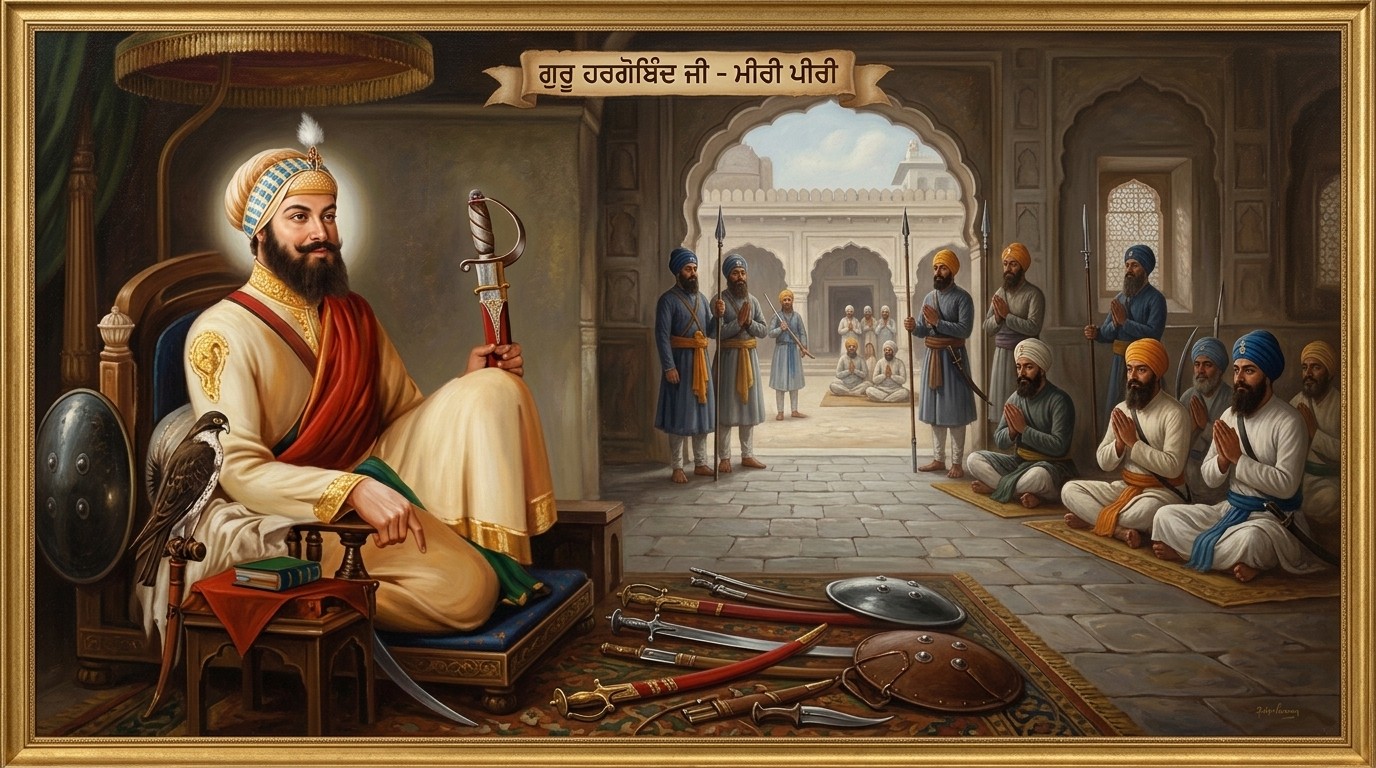
The air in Amritsar in the summer of 1606 was not filled with its usual scent of incense and the sweet melody of Kirtan. Instead, it was thick with a heavy, suffocating grief. The news from Lahore had arrived like a thunderclap: Guru Arjan Dev Ji, the Apostle of Peace, had been martyred under the orders of Emperor Jahangir.
Into this world of shadow and shifting tides stepped an eleven-year-old boy named Hargobind. He was the only son of the martyred Guru, but he did not come to the throne with the downcast eyes of a mourner. He came with the steady gaze of a sovereign. When the venerable Baba Buddha Ji approached him with the seli—the woolen cord traditionally worn by the Gurus to symbolize renunciation—the young Hargobind gently set it aside.
"The times have changed," he is said to have declared. "Sikhs must now defend their faith and commit to fight whenever necessary". He called for two swords to be brought to him. One for Piri (spiritual authority) and one for Miri (temporal power). In that singular act, the identity of the Sikh faith was transformed forever. This is the story of the Sixth Nanak—the Saint-Soldier who taught a people that true peace can only be protected by the strength of the righteous.
1. The Child of Prophecy: Birth and Shadows of Envy
The journey of Guru Hargobind Sahib Ji began in the village of Guru Ki Wadali, near Amritsar, on June 19, 1595. His birth was not merely a family celebration; it was the fulfillment of a divine promise. For years, Guru Arjan Dev Ji and Mata Ganga Ji had remained childless. Tradition tells us that Mata Ganga sought the blessings of the aged saint, Baba Buddha Ji.
In a moment of profound symbolism, she brought a simple meal of Missi Roti and onions to the saint. Baba Buddha Ji took an onion and smashed it with his hand, prophesying: "A son will be born in your house who will crush the heads of evil-doers just as I have crushed this onion".
Surviving the Shadows
Young Hargobind was a child of striking beauty and intellect, but his early years were spent in the crosshairs of envy. His uncle, Prithi Chand, who had long coveted the Guruship, viewed the boy as the final obstacle to his ambitions. Historical accounts detail several harrowing attempts on the child’s life:
- The Poisoned Milk: A wet-nurse was sent with poison on her nipples to feed the infant, but the plot failed as the woman herself fell ill and confessed.
- The Deadly Cobra: A snake-charmer was bribed to release a cobra in the child’s room. In a display of early fearlessness, the young Hargobind reportedly grabbed the snake by its head and squeezed it until it died.
- Smallpox: The boy also survived a severe bout of smallpox that left his face unscarred, a survival seen by the Sangat as a sign of divine protection.
Despite these threats, Guru Arjan ensured his son received a rigorous education. Under the mentorship of Baba Buddha and Bhai Gurdas, Hargobind was trained not only in the Gurbani and scriptures but also in weaponry, horsemanship, wrestling, and the arts of war.
2. The Great Pivot: 1606 and the Birth of Miri-Piri
The martyrdom of Guru Arjan Dev Ji in May 1606 was a watershed moment. Before his arrest, the Fifth Guru had whispered a final command for his son: "Let the Guruship be armed. Sit upon the throne fully prepared".
On June 24, 1606, at the age of eleven, Hargobind was formally installed as the Sixth Guru. His coronation was a radical departure from tradition. He discarded the ascetic ornaments and instead wore a royal feather on his turban.
The Philosophy of the Two Swords
He donned two swords, establishing the concept of Miri-Piri:
- Miri (Worldly Power): Symbolized the responsibility to protect the oppressed and lead the community in the physical world.
- Piri (Spiritual Power): Symbolized the internal journey of the soul and the continuation of the spiritual light of Guru Nanak.
He explained to the baffled Sangat that while the Sikhs would remain a peace-loving community, they would no longer be a community that could be "tyrannized". He issued letters to his followers asking them to bring weapons and horses as offerings instead of money.
3. The Akal Takht: The Throne of the Timeless
To provide a physical center for this new dual identity, Guru Hargobind Sahib Ji founded the Akal Takht (The Throne of the Timeless Being) in 1606, directly opposite the entrance of the Harmandir Sahib.
The symbolism was striking: if the Harmandir Sahib was the place for the soul's solace, the Akal Takht was the place for the community’s governance. The Guru designed the building himself, assisted only by Bhai Gurdas and Baba Buddha, to ensure no outside laborer's ego touched its foundation.
Defying the Imperial Decree
Mughal law at the time stated that only the Emperor could sit on a throne higher than three feet. Guru Hargobind built the platform of the Akal Takht to a height of twelve feet, a direct and fearless challenge to the Mughal authority of Jahangir. From this throne, he administered justice, received diplomats, and solved the disputes of the common people. He introduced the Nagara (war drum) to signal his proclamations and encouraged Dhadi singers to perform heroic ballads (Vars) to inspire the warrior spirit within his followers.
4. The Lion and the Emperor: Hunting and the "True King"
Despite the underlying political tensions, the relationship between Guru Hargobind and Emperor Jahangir was complex. Jahangir was curious about this "Saint-Soldier" who was being called "Sacha Patshah" (The True King) by his followers—a title Jahangir felt belonged only to him.
The Tiger Attack
One day, while hunting together in the forest, a ferocious tiger leaped out to attack the Emperor. Jahangir and his royal guards were paralyzed with fear. Without hesitation, Guru Hargobind jumped off his horse and stood between the tiger and the king. Using only his shield to block the claws and a single blow of his sword, he severed the tiger's body, saving the Emperor's life.
The Grass-Cutter’s Penny
A famous Sakhi tells of a poor grass-cutter who came searching for the "True King." Mistaking the Emperor for the Guru, he offered a copper coin and asked for spiritual liberation. Jahangir admitted, "I can give you land, but I cannot save your soul. I am a false king; the True King sits in the other tent". This incident deeply moved Jahangir, highlighting that the Guru's authority was rooted in love and spiritual grace, not earthly conquest.
5. Bandi Chhor: The Great Liberation of Gwalior
The growing influence of the Guru eventually unsettled the Mughal court. Under the influence of advisors like Chandu Shah (the conspirator behind Guru Arjan’s death), Jahangir ordered the Guru to be imprisoned in Gwalior Fort in 1609.
The Conditions of Gwalior
The fort was a grim prison for 52 Hindu kings and princes who had been stripped of their lands and dignity. They were malnourished, bound in chains, and without hope. When the Guru arrived, he transformed the prison into a sanctuary. He refused to eat the royal rations provided by Jahangir, insisting he would only eat food earned through the honest labor of his Sikhs. He shared his resources with the imprisoned kings, engaging them in Naam Simran and restoring their spirit.
The Tassels of Freedom
When Jahangir, reportedly troubled by nightmares and the petitions of Sufi saints like Mian Mir, finally ordered the Guru's release in 1612, the Guru refused to leave alone. He demanded the freedom of all 52 kings.
The Emperor, thinking he could limit the release, set a condition: "Only those who can hold onto the Guru's cloak as he walks out will be freed".
In a brilliant response, the Guru had a special chola (robe) stitched with 52 long tassels. Each king held onto a tassel and walked to freedom alongside the Guru.
This event is celebrated as Bandi Chhor Divas (Day of the Liberator). When the Guru reached Amritsar, the city was illuminated with thousands of candles and lamps, a celebration that coincided with Diwali and remains a pillar of the Sikh calendar.
6. The Clash of Steel: The Major Battles
I. The Battle of Rohilla (1621)
The first conflict erupted over local administrative disputes. The Guru led a small force and defeated the Mughal detachment, signaling that the Sikhs were now a formidable martial force.
II. The Battle of Amritsar (1634)
Triggered by a dispute over a hunting hawk, a massive Mughal army of 7,000–15,000 soldiers attacked Amritsar. The Guru led the defense of the Lohgarh Fort, eventually killing the Mughal general Mukhlis Khan in a single duel that cleaved the general in two.
III. The Battle of Lahira (Gurusar)
Started over the recovery of two majestic horses (Dilbagh and Gulbagh) that had been forcibly taken from Sikh devotees by Mughal officials. The Guru’s forces, though outnumbered, won another decisive victory.
IV. The Battle of Kartarpur (1635)
This was the most emotionally taxing conflict. It involved the betrayal of Painde Khan, an Afghan orphan the Guru had raised and trained as his own son. Painde Khan, driven by ego, led a Mughal army against the Guru.
In the heat of the battle, Painde Khan challenged the Guru to a duel. The Guru, with a heavy heart, allowed him to strike three times first. When Painde Khan failed, the Guru struck once, mortally wounding him. As his former protégé lay dying, the Guru’s anger vanished into compassion. He shielded Painde Khan’s face from the blistering sun and asked him to recite his Kalma (Islamic prayer), forgiving him as he breathed his last.
7. Significant People and Places
Significant People
- Guru Arjan Dev Ji: His father and spiritual source, whose sacrifice necessitated the sword.
- Baba Buddha Ji: The venerable saint who placed the two swords on the Guru and trained him in martial arts.
- Bhai Gurdas Ji: The great scholar who helped build the Akal Takht and drafted the Guru's odes.
- Mian Mir: The Sufi saint who interceded for the Guru's release and remained a lifelong friend.
- Tyag Mal (Guru Tegh Bahadur Ji): The Guru's youngest son, who fought so bravely at the Battle of Kartarpur that his father renamed him "Tegh Bahadur" (The Brave Master of the Sword).
- Painde Khan: The tragic figure of betrayal who showed the Guru’s capacity for forgiveness even on the battlefield.
Significant Places
- Amritsar: The spiritual capital and site of the first major military defenses.
- Akal Takht: The seat of Sikh temporal sovereignty.
- Gwalior Fort: The site of the Guru's three-year imprisonment and the Bandi Chhor miracle.
- Kiratpur Sahib: Founded by the Guru in the Shivalik foothills as a defensible spiritual retreat for his final years.
8. Final Teachings and Lasting Legacy
Recognizing that the plains of Punjab were too vulnerable to repeated Mughal assaults, Guru Hargobind shifted the Sikh headquarters to Kiratpur Sahib in 1635. There, he focused on missionary work and the spiritual welfare of the community.
Choosing the Successor
The Guru’s eldest son, Baba Gurditta, passed away in 1638. When the time came to choose a successor, he bypassed his grandson Dhir Mal, who had aligned with Mughal interests, and chose Guru Har Rai (Dhir Mal’s younger brother) to carry the light of Nanak.
Guru Hargobind Sahib Ji merged into the Eternal Light on February 28, 1644 at Kiratpur Sahib.
Why He Still Matters Today
Guru Hargobind taught the world that courage and humility are not mutually exclusive. He proved that a man of God can also be a man of justice. His creation of the Akal Takht and the Akal Sena established the foundation for Sikh sovereignty and the "Saint-Soldier" identity that would reach its pinnacle under Guru Gobind Singh.
He remains a beacon for anyone struggling against tyranny, reminding us that "nonviolence used out of fear is cowardice," and that true peace requires the strength to stand for the defenseless.
Timeline of Guru Hargobind Sahib Ji’s Life
- 1595: Birth at Guru Ki Wadali.
- 1606: Martyrdom of Guru Arjan; Accession of Guru Hargobind.
- 1606: Foundation of the Akal Takht laid.
- 1609–1612: Imprisonment in Gwalior Fort.
- 1612: Release on Bandi Chhor Divas with 52 kings.
- 1621: Battle of Rohilla.
- 1634: Battle of Amritsar against Mukhlis Khan.
- 1635: Battle of Kartarpur; Renaming of Tegh Bahadur.
- 1635: Relocation to Kiratpur Sahib.
- 1644: Joti Jot (Departure) at Kiratpur Sahib.
Frequently Asked Questions (FAQ)
Q1: Why did Guru Hargobind wear two swords?
The two swords represented Miri (temporal/worldly power) and Piri (spiritual power), symbolizing that a Sikh must balance their spiritual journey with the responsibility to fight for justice.
Q2: What is Bandi Chhor Divas?
It is a Sikh celebration commemorating the Guru's release from Gwalior Fort in 1612, along with 52 Hindu kings who held onto his robe to gain their freedom.
Q3: Did Guru Hargobind fight the Mughals for territory?
No. He fought for Dharam (righteousness) and self-defense. He never occupied a single inch of land from his victories.
Q4: Who was Painde Khan?
He was an orphan Afghan boy raised by the Guru like a son. He later betrayed the Guru and led a Mughal army against him at the Battle of Kartarpur, where he was killed in a duel with the Guru.