Gurus and Bhagats, Bani Contributors · Origins & Gurus · Guru Ram Das Ji
Guru Ram Das Ji
Founded Amritsar; composed Lavan (Sikh wedding hymns).
In the winding, dust-choked alleys of Chuna Mandi in Lahore, in the year 1534, a child was born who would one day build a sanctuary for the world’s weary souls. But if you had seen him then, you would have seen only a small boy named Jetha, clutching a basket of boiled black chickpeas, his voice calling out to passersby just to earn enough to keep his aging grandmother from hunger.
The story of Guru Ram Das Ji, the fourth Sovereign of the Sikh faith, is perhaps the most touching "rags-to-riches" narrative in spiritual history—not because he acquired gold, but because he transformed the "mud" of menial labor into the "saffron" of divine grace. He is the Guru of Humility, the Master of Raj Yog, and the architect of the City of Nectar: Amritsar.
1. The Orphan of Lahore: Early Life and Struggles
Bhai Jetha entered the world on September 24, 1534, into a Sodhi Khatri family. His parents, Baba Hari Das and Mata Anup Devi (also known as Daya Kaur), had prayed for a child for twelve long years before his arrival. They named him Jetha, meaning "the firstborn".
However, the joy was short-lived. By the age of seven, Jetha had lost both his parents. Suddenly, he was an orphan, cast into the biting winds of poverty. His maternal grandmother, seeing the child’s plight, took him to her native village of Basarke, near present-day Amritsar.
The "True Bargain" of the Chickpeas
Life in Basarke was a test of endurance. To support his grandmother, young Jetha spent his days as a street vendor, selling roasted chickpeas and boiled wheat. While other children played, Jetha walked the streets, his heart already tuned to a higher frequency.
One afternoon, he encountered a group of hungry, starving saints. Jetha knew that if he did not sell his grains, he would return home empty-handed to a destitute kitchen. Yet, moved by their hunger, he gave away his entire stock for free. This act, echoing Guru Nanak’s Sacha Sauda, caught the attention of the heavens. A Sadhu, moved by the boy's innocence, prophesied:
"As you have fed me today, a time will come when you will feed thousands, and whosoever comes to you will never go back empty-handed."
2. The Meeting at Goindwal: Finding the True Master
Fate intervened when Guru Amar Das Ji, the third Sikh Guru, visited Basarke to condole with Jetha’s grandmother over a family death. He saw something in the twelve-year-old boy—a quiet intensity and a profound sense of service. He invited them to relocate to the newly developing city of Goindwal Sahib.
At Goindwal, Jetha’s life became a masterclass in Niskam Seva (selfless service). He resumed selling grams for his livelihood, but every spare moment was dedicated to the Guru’s court. He carried heavy baskets of clay for the construction of the Baoli Sahib (the 84-step well), scrubbed pots in the Langar, and washed the feet of weary travelers.
The Crown in the Mud
One of the most human moments in his biography occurred when his Sodhi relatives from Lahore visited Goindwal. They were horrified to find their prestigious kinsman covered in mud, carrying a basket of dirt on his head at a construction site.
They confronted Guru Amar Das, saying:
"You have humiliated our clan! By making your son-in-law work like a common laborer, you have put us to shame."
Bhai Jetha, standing there with mud dripping from his clothes, did not defend his pride. He fell at the Guru’s feet and apologized for his relatives’ ignorance. Guru Amar Das looked at the critics and declared:
"You see muddy clothes, but I see the crown of two worlds in this mud."
3. A Union of Souls: Marriage to Bibi Bhani Ji
Bibi Bhani, the youngest daughter of Guru Amar Das, was a titan of devotion. When the Guru's wife, Bibi Ramo, suggested it was time to find a husband for her, the Guru asked what kind of man they should look for. She pointed to Jetha sitting in the doorway and said:
"Like him."
The Guru replied:
"He is the only one like himself."
Their marriage in 1553 was a union of two spirits already merged in God. Bibi Bhani’s devotion was legendary; once, while her father was in deep meditation, she noticed a leg of his meditation platform was about to break. Fearing he would be jolted, she slid her hand under the broken leg. The wood pierced her hand, but she remained immovable until daybreak. When the Guru saw her bloodied hand, he offered a boon, and she asked that the Guruship remain in her family line—a request granted with a warning of the sacrifices it would require.
4. The Platform of Merit: Succession to the Throne
As Guru Amar Das Ji approached his final days, he decided to make the succession transparent. He asked his two sons-in-law, Bhai Rama and Bhai Jetha, to each build a meditation platform (thara) near the Baoli.
When they finished, the Guru inspected them and shook his head.
"It is not right. Tear it down and rebuild it."
This happened seven times. Bhai Rama eventually grew frustrated, but Jetha, after every rejection, fell at the Guru’s feet and wept, saying:
"Master, I am an ignorant fool. I lack the wisdom to build what you envision. Please guide my hands."
In that moment of total surrender, the decision was made. On September 1, 1574, Bhai Jetha was renamed Guru Ram Das ("Servant of God") and installed as the Fourth Nanak.
5. Founding the City of Nectar: Amritsar
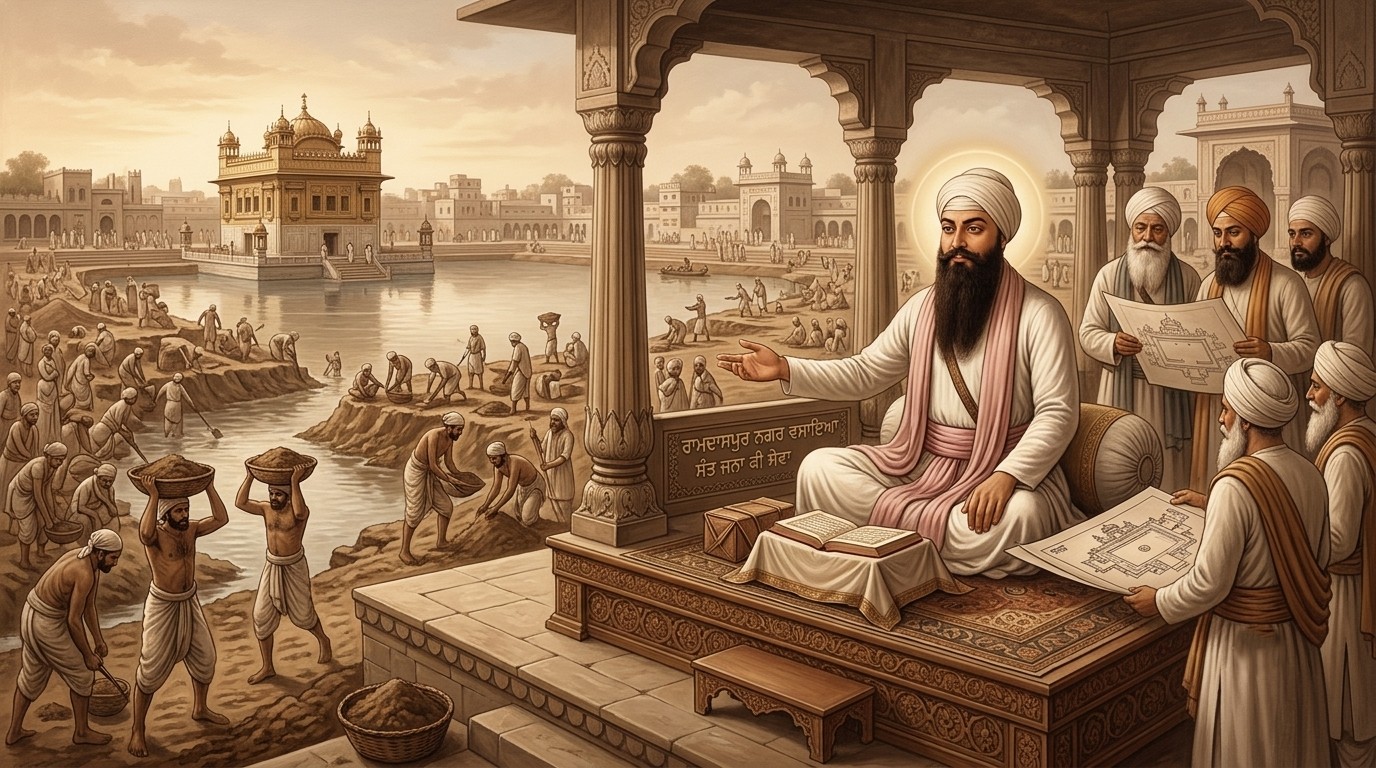
The establishment of Ramdaspur (later Amritsar) was Guru Ram Das Ji’s most tangible legacy. Guru Amar Das had suggested the location near a sacred pond believed to have healing properties.
In 1577, Guru Ram Das purchased 500 bighas of land from the zamindars of Tung for 700 Akbari rupees. He invited 52 different types of tradesmen and artisans to settle, establishing a vibrant market known as Guru-ka-Bazaar. He began the massive project of excavating the Amrit Sarovar (The Pool of Nectar), working alongside the volunteers to show that physical labor for the community was as sacred as prayer.
6. Significant Teachings and the "Lavan"
Guru Ram Das Ji was a master poet whose verses in the Guru Granth Sahib (679 Shabads in 30 Ragas) are defined by an intense, emotional longing for the Divine.
The Lavan: The Four Vows
His most enduring liturgical contribution is the Lavan, the four hymns recited during the Sikh marriage ceremony (Anand Karaj).
- First Round: Emphasizes duty to family and the performance of righteous conduct (Dharma).
- Second Round: Describes the removal of the ego through the fear and love of God.
- Third Round: Signifies the stage of detachment from the world and filling the heart with Divine Love.
- Fourth Round: The final stage of Sahaj (intuitive poise) where the soul blends with God.
He redefined marriage as "one soul in two bodies," shifting it from a social contract to a joint spiritual odyssey.
7. The Final Transition: Guru Arjan Dev Ji
Guru Ram Das Ji had three sons: Prithi Chand (ambitious), Mahadev (a detached ascetic), and Arjan Dev (a soul of pure devotion).
The test of succession occurred when the Guru’s cousin invited him to a wedding in Lahore. The Guru could not go and asked his sons. Prithi Chand refused, fearing he would lose his chance at the throne. Arjan Dev, however, obeyed instantly. While in Lahore, Arjan’s longing manifested in a series of beautiful letters. The letters, later known as Shabd Hazare, were so full of devotion that Guru Ram Das declared Arjan his successor.
On September 1, 1581, Guru Ram Das Ji merged back into the Eternal Light in Goindwal Sahib, leaving his youngest son to build the Harmandir Sahib atop the foundation he had laid.
Timeline of Guru Ram Das Ji’s Life
- 1534: Born as Bhai Jetha in Chuna Mandi, Lahore (Sept 24).
- 1541: Orphaned at age 7; moves to Basarke with grandmother.
- 1546: Relocates to Goindwal Sahib at age 12 to serve Guru Amar Das.
- 1553: Marries Bibi Bhani Ji.
- 1570: Lays foundation of Chak Ramdas (Amritsar).
- 1574: Bestowed with Guruship; becomes the Fourth Nanak (Sept 1).
- 1577: Formally founds Amritsar and starts Amrit Sarovar excavation.
- 1581: Appoints Guru Arjan Dev as successor and departs the physical world (Sept 1).
Life Lessons That Still Inspire the World
- Radical Humility: He taught that the more we lower our ego, the higher our spirit rises. His act of wiping the dust from Baba Sri Chand’s feet is the ultimate blueprint for servant-leadership.
- The Spirituality of the Householder: He proved that one does not need to be a forest-dwelling yogi to find God. By balancing family, work, and prayer, one achieves "Raj Yog".
- Universal Equality: By establishing a city where 52 different trades lived together, he broke the caste-based occupational silos of medieval India.
Frequently Asked Questions (FAQ)
Q1: Why is Guru Ram Das Ji called "Lord of Miracles"?
He is often invoked as Dhan Dhan Ram Das Gur, the one who makes the impossible possible. His life itself was a miracle—from an orphan selling grams to a King of the Spirit.
Q2: Did he buy the land for Amritsar?
Yes. While some traditions say it was a gift from Emperor Akbar, historical records indicate he purchased 500 bighas of land for 700 Akbari rupees from the local zamindars.
Q3: What are the "Lavan"?
They are four stanzas composed by Guru Ram Das Ji that describe the soul's journey toward God. They are used today in the Sikh marriage ceremony to symbolize the couple's shared spiritual path.
Narrative Conclusion: The Eternal Servant
The legacy of Guru Ram Das Ji lives on in every ripple of the Amrit Sarovar. He taught us that no job is too lowly and no person is too small to be touched by the Divine. He remains the bridge between the ascetic and the householder, the king and the servant.
As the sunset paints the Golden Temple in hues of amber, we are reminded that this entire sanctuary was built by an orphan who knew that the only way to "take" (Lehna) from God is first to "give" (Seva) to man.