Gurus and Bhagats, Bani Contributors · Origins & Gurus · Guru Tegh Bahadur Ji
Guru Tegh Bahadur Ji
Martyred defending religious freedom for all faiths; founded Anandpur Sahib.
Hymns in Guru Granth Sahib: 116
The Shield of Humanity: The Immersive Life and Divine Sacrifice of Guru Tegh Bahadur JiIn the grand, often violent theater of seventeenth-century India, a period defined by the iron-fisted rule of Aurangzeb and the narrowing of religious horizons, there stood a figure whose very existence challenged the nature of power. Most leaders of that era sought to protect their own; Guru Tegh Bahadur Ji chose to die for the rights of those whose faith was not even his own.
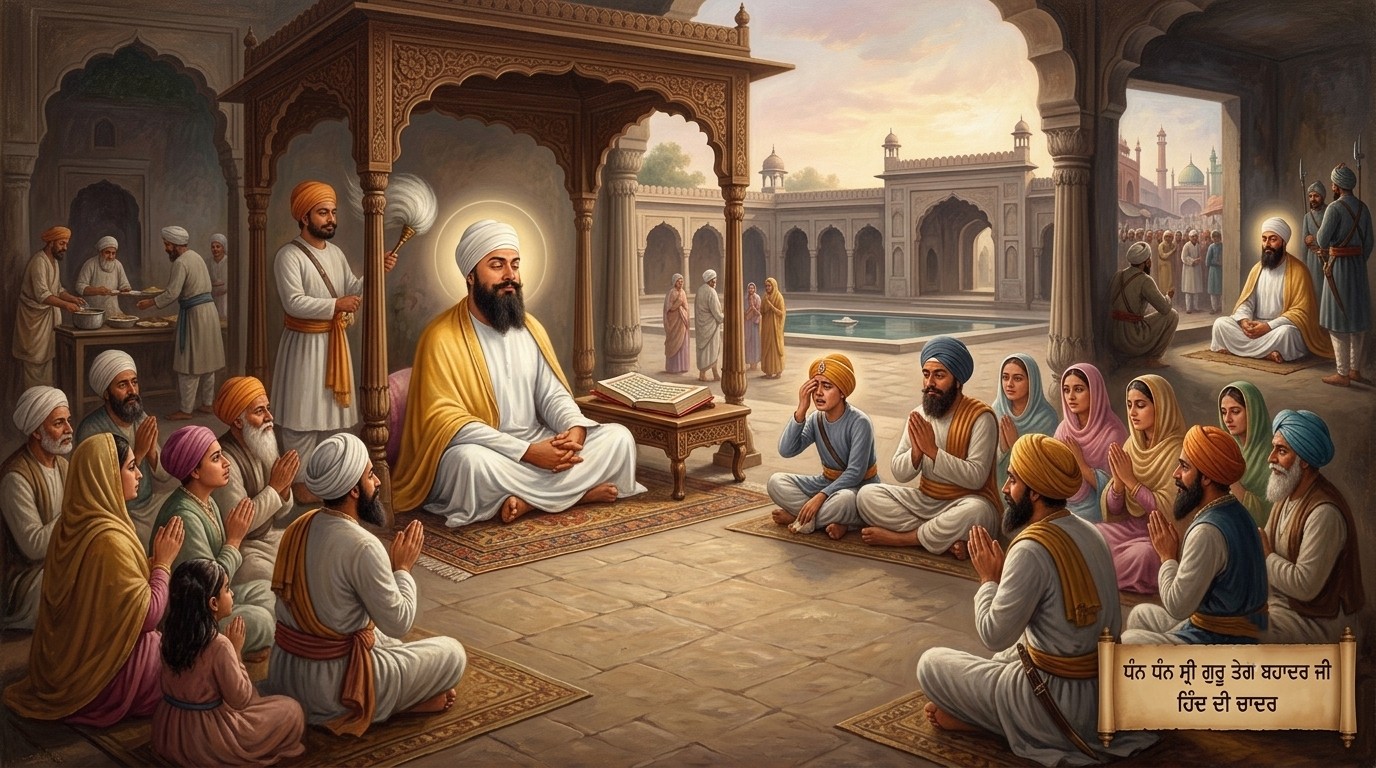
He was the "Master of Renunciation" who carried a sword of steel. He was the silent meditator who traveled thousands of miles to build bridges of peace. He was the "Hind Di Chadar"—the Shield of India—whose martyrdom in the heart of Delhi changed the course of history forever. This is not just a biography; it is a spiritual odyssey into the heart of courage, compassion, and the ultimate defense of the human conscience.
1. The Master of Renunciation: Birth and Childhood in Amritsar
The story begins in the early hours of April 1, 1621, in the holy city of Amritsar. Born to the Sixth Master, Guru Hargobind Sahib Ji, and the pious Mata Nanaki Ji, the child was named Tyag Mal (The Master of Renunciation).
From his earliest breath, Tyag Mal was a study in contrasts. He was the youngest of five brothers, growing up in a household that had recently embraced the dual authority of Miri (temporal power) and Piri (spiritual authority).
While the Guru's court echoed with the sound of war drums (nagaras) and the neighing of steeds, the young prince was often found in silent corners, his eyes closed in deep contemplation.
The Training of a Prince
Guru Hargobind prioritized his son's education, ensuring he was balanced in every sense. Under the venerable Bhai Gurdas, Tyag Mal studied the ancient classics, Gurbani, and various languages including Sanskrit and Persian.
Simultaneously, the legendary Baba Buddha Ji trained him in the arts of the warrior: archery, horsemanship, and swordsmanship.
The child was kept in a simple robe, reflecting his naturally ascetic nature. His father often looked at him with a secret knowing, aware that this quiet, inward-looking boy would one day need the heart of a lion and the patience of a mountain.
2. Earning the Title: The Battle of Kartarpur
The transition from Tyag Mal to Tegh Bahadur (Brave Wielder of the Sword) occurred on the battlefield.
In April 1635, when he was just fourteen years old, a Mughal force led by the defector Painde Khan attacked the Sikhs at Kartarpur.
Amidst the chaos of clashing steel and whistling arrows, the young Tyag Mal fought with such abandon and skill that even seasoned warriors were left breathless.
After the victory, Guru Hargobind embraced his son and declared, "You are no longer Tyag Mal. You are Tegh Bahadur".
Despite this baptism of fire, Tegh Bahadur did not develop a thirst for conquest. He remained the "Master of Renunciation," preferring to be called Deg Bahadur— the master of hospitality and service to the needy.
3. The Silence of Bakala: Twenty Years of Meditation
Following the physical departure of Guru Hargobind in 1644, Tegh Bahadur, accompanied by his mother and his wife, Mata Gujri Ji (whom he had married in 1632), moved to the quiet village of Bakala, his mother's native home.
For the next twenty years, nine months, and thirteen days, Guru Tegh Bahadur Ji lived a life of deep meditation and spiritual discipline.
He constructed a bhora (a cool, underground meditation cell) in his house. There, away from the politics of the world and the growing tensions of the Mughal court, he sat in solitude immersed in Naam Simran (remembrance of the Divine Name).
This was not an escape from reality, but a tempering of the soul.
4. "Guru Ladho Re": The Revelation of the Ninth Nanak
In 1664, the Eighth Guru, Guru Har Krishan Ji, lay on his deathbed in Delhi. Before merging into the Eternal Light, he whispered two cryptic words: "Baba Bakale".
Suddenly, twenty-two self-proclaimed "gurus" appeared in Bakala, each demanding offerings from the confused Sangat.
The Shipwreck Vow
The revelation came through Bhai Makhan Shah Labana, a wealthy Sikh trader.
During a violent storm at sea, he had vowed to offer 500 gold coins to the Guru if he survived.
Arriving in Bakala, he offered only two coins to each claimant. Every false guru accepted them happily.
When he finally visited Tegh Bahadur Ji, the Guru smiled gently and said: "Bhai Sahib, you promised 500 gold coins, but you are offering only two?"
Overjoyed, Makhan Shah ran to the rooftop and shouted: "Guru ladho re! Guru ladho re!" (The True Guru has been found!)
On August 11, 1664, Guru Tegh Bahadur Ji was formally anointed as the Ninth Sikh Guru.
5. The Eternal Wanderer: Travels Across the East
Guru Tegh Bahadur Ji traveled extensively across the Gangetic plains, Bihar, Bengal, and Assam, strengthening the spiritual fabric of the country.
The Peace in Assam
In 1568, he reached Assam alongside Raja Ram Singh of Amber, who had been sent by Aurangzeb to suppress a rebellion.
The Guru mediated peace between the Ahom King and Raja Ram Singh, preventing bloodshed.
A commemorative mound called Teghpur (Tegh Parbat) was later built as a symbol of peace.
The Birth of a Legend in Patna
While the Guru journeyed eastward, his family stayed in Patna.
It was there, in December 1661, that his only son, Gobind Das (the future Guru Gobind Singh Ji), was born.
6. The City of Bliss: Founding Anandpur Sahib
In 1665, Guru Tegh Bahadur Ji purchased land near the Shivalik foothills from the ruler of Bilaspur.
He named the settlement Chak Nanki in honor of his mother, though it would later become Anandpur Sahib—the City of Bliss.
Here, the Guru composed many of his soul-stirring hymns, including the 115 Saloks included in the Guru Granth Sahib.
7. The Shield of India: The Plea of the Kashmiri Pandits
By 1675, Aurangzeb's policies had become increasingly oppressive. The Kashmiri Pandits faced forced conversions and persecution.
A delegation led by Pandit Kirpa Ram arrived at Anandpur Sahib, seeking protection.
Guru Tegh Bahadur Ji reflected deeply and declared that only the sacrifice of a great soul could stop the oppression.
At that moment, his young son Gobind Rai said: "Who could be holier than you, my respected father?"
The Guru instructed the Pandits to tell Aurangzeb: "If you can convert Guru Tegh Bahadur to Islam, we will all convert after him."
8. The Iron Cage and the Three Martyrs
On July 12, 1675, Guru Tegh Bahadur Ji was arrested and brought to Delhi in an iron cage.
Aurangzeb offered him three choices:
- Perform a miracle
- Convert to Islam
- Face death
The Guru refused every demand.
The Sacrifice of the Companions
- Bhai Mati Das Ji was sawn in half while reciting Japji Sahib.
- Bhai Dayala Ji was boiled alive while immersed in remembrance of God.
- Bhai Sati Das Ji was wrapped in oil-soaked cotton and burned alive.
Guru Tegh Bahadur Ji watched with divine calm, blessing his companions for their unwavering faith.
9. The Supreme Sacrifice: Chandni Chowk
On November 11, 1675, Guru Tegh Bahadur Ji was executed in Chandni Chowk, Delhi.
Sitting beneath a banyan tree, he recited Japji Sahib before bowing his head before the executioner.
Tradition says that as the sword fell, a fierce dust storm swept across Delhi.
The Recovery of the Mortal Remains
- Bhai Jaita Ji carried the Guru’s severed head through forests to Anandpur Sahib.
- Bhai Lakhi Shah Vanjara hid the Guru’s body beneath cotton and hay and cremated it by setting his own house on fire.
Significant Teachings: Wisdom for the Soul
Teaching Practical Application Fearlessness "Frighten no one and fear no one." Detachment (Vairagya) Living in the world but remaining unattached. Naam Simran Constant remembrance of God. Acceptance (Hukam) Accepting Divine Will with peace. Universal Human Rights Protecting freedom of conscience and religion.Timeline of Guru Tegh Bahadur Ji’s Life
- 1621: Birth in Amritsar (April 1).
- 1635: Battle of Kartarpur; renamed "Tegh Bahadur".
- 1644–1664: Years of meditation in Bakala.
- 1664: Proclaimed Ninth Guru (August 11).
- 1665: Founded Anandpur Sahib.
- 1665–1670: Missionary travels across eastern India.
- 1675: Kashmiri Pandits seek help at Anandpur.
- 1675: Martyrdom at Chandni Chowk, Delhi (November 11).
Why Guru Tegh Bahadur Ji Still Matters Today
Guru Tegh Bahadur Ji remains one of history’s greatest defenders of religious freedom.
He sacrificed his life not for power or territory, but for the universal right of every human being to follow their conscience.
His life teaches that spirituality is not withdrawal from the world, but the courage to stand for truth and protect the oppressed.
Frequently Asked Questions (FAQ)
Q1: Why is he called "Hind Di Chadar"?
It means "The Shield of India." He earned this title by sacrificing his life to protect religious freedom.
Q2: What is the significance of Gurdwara Sis Ganj Sahib?
It stands at the site in Chandni Chowk where Guru Tegh Bahadur Ji was executed.
Q3: Who was Makhan Shah Labana?
He was the Sikh trader who identified Guru Tegh Bahadur Ji as the true Guru in Bakala.
Q4: Did Guru Tegh Bahadur Ji compose Gurbani?
Yes. He composed 115 Saloks included in the Guru Granth Sahib.
Search Engine Optimization (SEO)
Suggested Meta Title: The Life of Guru Tegh Bahadur Ji: The Shield of Humanity
Suggested Meta Description: Explore the immersive life story of Guru Tegh Bahadur Ji, from his meditation in Bakala to his supreme sacrifice for religious freedom.
Keywords: Guru Tegh Bahadur Ji, Hind di Chadar, Sikh history, Kashmiri Pandits, martyrdom, Anandpur Sahib, religious freedom.
Narrative Conclusion: The Victory of the Headless
Guru Gobind Singh Ji later wrote: "He gave up his head, but not his resolve."
The Mughals believed they had extinguished the Sikh spirit, but his martyrdom instead became the spark that transformed the Sikh community forever.
Today, every struggle for human rights and religious freedom echoes the spirit of Guru Tegh Bahadur Ji.