Sikh Legends · Empire & Struggle
Jassa Singh Ahluwalia
A brilliant commander of the Dal Khalsa, he was instrumental in defeating Afghan invaders, capturing Lahore in 1761, and officially declaring Sikh sovereignty in 1765. He is revered for both his deep spirituality and his unmatched military strategy.
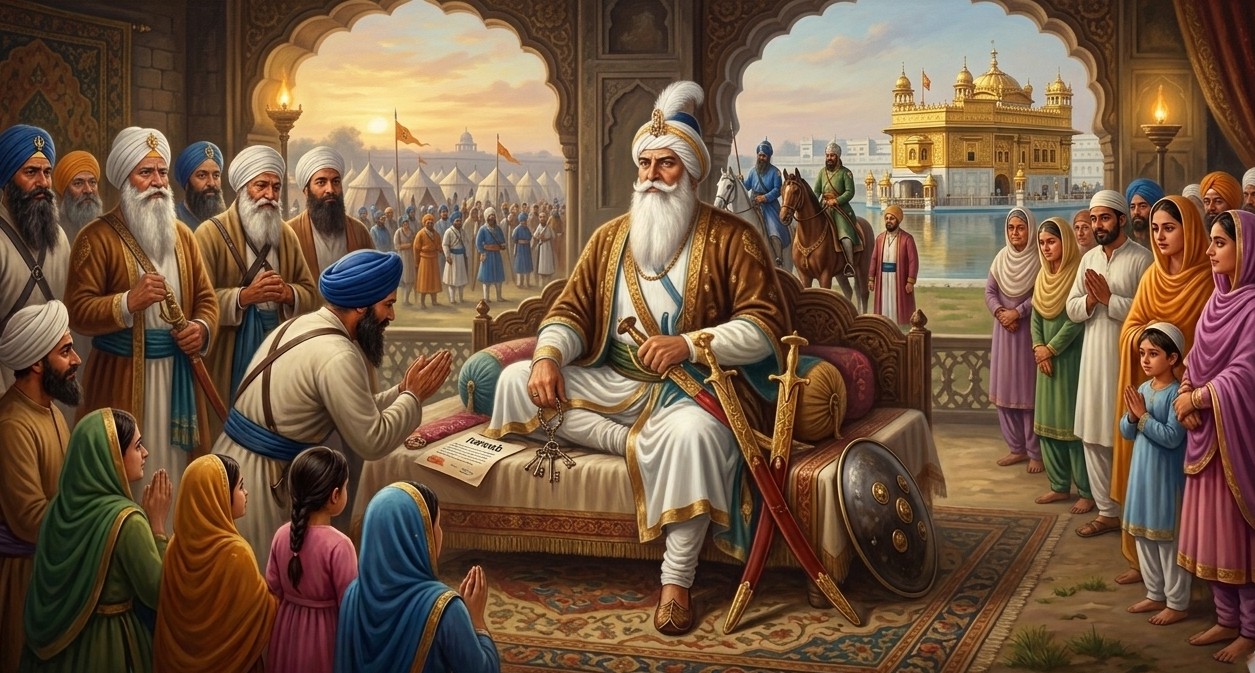
Jassa Singh Ahluwalia: The Spiritual Warrior Who Proclaimed Sikh Sovereignty
Among the towering figures of eighteenth-century Sikh history, few command the same level of admiration and reverence as Jassa Singh Ahluwalia. Remembered as a fearless military commander, an astute statesman, and a deeply spiritual leader, he occupies a unique position in the collective memory of the Sikh Panth. During one of the most turbulent periods in the history of Punjab, when Afghan invasions repeatedly devastated the region and the Sikh community faced systematic persecution, Jassa Singh Ahluwalia emerged as a unifying force capable of transforming scattered bands of resistance fighters into a disciplined political and military power. His leadership helped lay the foundations for Sikh sovereignty and prepared the ground for the eventual rise of the Sikh Empire under Maharaja Ranjit Singh.
The story of Jassa Singh Ahluwalia is not merely a tale of military victories and political achievements. It is the story of a man who embodied the Sikh ideal of the Sant-Sipahi, the Saint-Soldier. He combined spiritual humility with martial courage, maintaining unwavering devotion to the teachings of the Gurus while confronting some of the most powerful military forces of his era. His life demonstrates how faith, discipline, and collective purpose enabled the Sikhs to survive repeated attempts at extermination and emerge as a sovereign people.
The Historical Landscape of Eighteenth-Century Punjab
To appreciate the significance of Jassa Singh Ahluwalia, one must first understand the extraordinary challenges facing the Sikh community during the eighteenth century. The death of Guru Gobind Singh Ji in 1708 and the subsequent martyrdom of Banda Singh Bahadur in 1716 ushered in a prolonged period of persecution. Mughal authorities regarded the Sikhs as a dangerous political and military threat. Rewards were offered for Sikh heads, entire villages were punished for sheltering them, and countless Sikhs were forced to seek refuge in forests, deserts, and remote regions of Punjab.
The political situation became even more volatile as Mughal authority weakened. Into this power vacuum entered Ahmad Shah Durrani, also known as Ahmad Shah Abdali, whose repeated invasions of India transformed Punjab into a perpetual battleground. Cities were plundered, populations displaced, and economic stability shattered. Yet amid this chaos, the Sikh community demonstrated remarkable resilience. The Khalsa survived not because it possessed superior resources or numbers, but because it developed an adaptive system of decentralized resistance supported by deep spiritual conviction.
It was within this crucible of conflict and survival that Jassa Singh Ahluwalia rose to prominence. His leadership would prove instrumental in transforming Sikh resistance into a coherent political movement capable of challenging imperial powers.
Early Life and Formation
Jassa Singh Ahluwalia was born in 1718 in the village of Ahlu near Lahore, from which his family derived the surname Ahluwalia. His father, Badar Singh, passed away when Jassa Singh was still young. Following this loss, his mother brought him to the court of Mata Sundari Ji, the widow of Guru Gobind Singh Ji. This decision would profoundly influence his development and future destiny.
Under the guidance of Mata Sundari Ji, the young Jassa Singh received both spiritual and practical instruction. He grew up immersed in the traditions of the Khalsa, absorbing the values of discipline, humility, courage, and service. The environment nurtured not only his martial abilities but also his understanding of Sikh theology and history. Unlike many military leaders whose reputations rest solely upon battlefield achievements, Jassa Singh's foundation was deeply rooted in spiritual education.
This formative period shaped the character that would later distinguish him from many contemporary rulers. He never viewed political authority as a means of personal enrichment. Instead, he regarded leadership as a sacred responsibility entrusted to him by the Panth. This perspective would guide his decisions throughout his life and earn him widespread respect among Sikhs of diverse backgrounds.
The Rise of the Dal Khalsa
One of the defining developments of eighteenth-century Sikh history was the emergence of the Dal Khalsa, the collective military force of the Sikh community. As persecution intensified, the Sikhs developed organizational structures that enabled them to coordinate their activities more effectively. What had once been scattered guerrilla bands gradually evolved into a sophisticated military network capable of mounting large-scale operations.
Jassa Singh Ahluwalia played a central role in this transformation. His ability to unite leaders with differing regional interests and military priorities made him uniquely qualified for the task. He understood that survival required cooperation and that the Khalsa could not afford internal divisions while facing powerful external enemies.
The Sarbat Khalsa gatherings at Amritsar became important forums where collective decisions were made. During these assemblies, leaders from different Sikh groups deliberated on matters affecting the entire community. Jassa Singh emerged as one of the most influential voices within this system, consistently advocating unity and coordinated action.
His leadership style was notable for its balance between authority and consultation. Rather than imposing decisions through force, he sought consensus and encouraged participation. This approach reflected Sikh traditions of collective governance and contributed significantly to the cohesion of the Dal Khalsa.
The Formation of the Sikh Misls
As Sikh power expanded, the need for a more structured military and administrative framework became apparent. This led to the development of the Sikh Misls, autonomous confederacies that controlled specific territories while remaining part of the broader Khalsa commonwealth.
Jassa Singh Ahluwalia was instrumental in organizing and coordinating these Misls. Although each Misl maintained its own leadership and operational independence, they shared common religious values and frequently cooperated in military campaigns. This flexible system allowed the Sikhs to adapt quickly to changing circumstances while preserving local autonomy.
| Institution | Purpose |
| Dal Khalsa | Unified military force of the Sikh community |
| Sarbat Khalsa | Collective assembly for major decisions |
| Misls | Regional military and political confederacies |
| Gurmata | Collective resolutions accepted as binding |
The Misl system proved remarkably effective. It enabled the Sikhs to expand their influence across Punjab while maintaining resilience against external attacks. Even when individual Misls suffered setbacks, the overall structure remained intact. This decentralized model became one of the greatest strengths of eighteenth-century Sikh political organization.
The Capture of Lahore in 1761
Among Jassa Singh Ahluwalia's most celebrated achievements was the capture of Lahore in 1761. The city held immense symbolic and strategic importance. As one of the principal urban centers of Punjab, control of Lahore represented far more than a military victory; it signified the emergence of Sikh power as a major political force.
The opportunity arose following one of Ahmad Shah Durrani's invasions. As Afghan forces withdrew, the Sikhs moved swiftly to exploit the resulting power vacuum. Under Jassa Singh's leadership, they entered Lahore and established control over the city.
This achievement sent shockwaves throughout the region. For decades, the Sikhs had been hunted and persecuted. Now they were occupying one of the most prestigious cities in northern India. The capture demonstrated that the balance of power was shifting and that the Khalsa had become a force capable of challenging established empires.
Although control of Lahore would fluctuate in subsequent years, the event marked a turning point in Sikh history. It provided tangible evidence that the dream of self-rule was becoming a reality.
The Defeat of Afghan Dominance
Throughout his career, Jassa Singh Ahluwalia was deeply involved in efforts to resist Afghan incursions into Punjab. Ahmad Shah Durrani's repeated invasions inflicted enormous suffering upon the population. Yet each invasion also strengthened Sikh determination to defend their homeland.
Jassa Singh understood that direct confrontation with superior forces was not always practical. He employed flexible tactics that combined mobility, intelligence gathering, and strategic strikes. Sikh warriors frequently disrupted supply lines, harassed retreating armies, and targeted vulnerable positions. These methods gradually eroded Afghan control and demonstrated the effectiveness of unconventional warfare.
His campaigns helped establish the Sikhs as the dominant indigenous military power in Punjab. Over time, Afghan authority weakened while Sikh influence expanded. The cumulative effect of these efforts fundamentally altered the political landscape of the region.
The Declaration of Sikh Sovereignty in 1765
The year 1765 occupies a special place in Sikh history. It was during this period that Sikh leaders formally asserted their sovereignty over Punjab. This declaration represented the culmination of decades of struggle, sacrifice, and perseverance.
Jassa Singh Ahluwalia stood at the forefront of this historic moment. Under his leadership, Sikh authority was no longer defined solely by military resistance. It now possessed a political dimension characterized by governance, administration, and public legitimacy.
One of the most significant expressions of this sovereignty was the issuance of coins in the name of Guru Nanak Dev Ji and Guru Gobind Singh Ji. These coins symbolized the unique nature of Sikh rule. Rather than glorifying individual rulers, they emphasized spiritual authority and collective identity.
This act reflected Jassa Singh's conviction that political power must remain subordinate to spiritual principles. Sovereignty was not viewed as personal property but as a sacred trust held on behalf of the Panth.
A Leader of Spiritual Depth
While military accomplishments often dominate discussions of Jassa Singh Ahluwalia, his spiritual character deserves equal attention. Contemporary accounts consistently portray him as a man of humility and devotion. Despite commanding armies and influencing major political decisions, he remained deeply committed to the values of Sikhism.
He regularly participated in religious observances, sought guidance through collective deliberation, and demonstrated genuine concern for the welfare of ordinary people. His leadership reflected the Sikh belief that authority must be exercised through service rather than domination.
This spiritual foundation distinguished him from many rulers of his era. Whereas others pursued personal glory, Jassa Singh measured success in terms of collective advancement and fidelity to the teachings of the Gurus.
The Legacy of Jassa Singh Ahluwalia
The legacy of Jassa Singh Ahluwalia extends far beyond his lifetime. The institutions he helped strengthen, the territories he helped secure, and the principles he embodied all contributed to the eventual emergence of the Sikh Empire. His efforts demonstrated that a persecuted minority could evolve into a sovereign political community without abandoning its ethical foundations.
Modern historians recognize him as one of the principal architects of Sikh political power during the eighteenth century. Yet his significance cannot be measured solely through territorial gains or military victories. His true achievement lay in his ability to harmonize spirituality, governance, and military leadership into a coherent vision for the future of the Panth.
Today, Jassa Singh Ahluwalia remains an enduring symbol of courage, wisdom, and service. His life continues to inspire Sikhs around the world, reminding them that lasting success is achieved not merely through strength but through unwavering commitment to higher principles.
Key Contributions at a Glance
| Contribution | Historical Impact |
| Leadership of the Dal Khalsa | Unified Sikh military efforts during critical periods |
| Organization of the Misls | Created an effective framework for governance and defense |
| Capture of Lahore (1761) | Demonstrated the rise of Sikh political power |
| Declaration of Sovereignty (1765) | Established Sikh authority in Punjab |
| Defense against Afghan invasions | Protected Punjab and weakened foreign domination |
| Promotion of collective governance | Strengthened Sikh institutions and unity |
Frequently Asked Questions (FAQ)
1. Who was Jassa Singh Ahluwalia?
Jassa Singh Ahluwalia was an eighteenth-century Sikh commander, statesman, and spiritual leader who played a central role in the rise of Sikh political power in Punjab.
2. Why is he called Ahluwalia?
The title Ahluwalia comes from his ancestral village, Ahlu, near Lahore.
3. What was his role in the Dal Khalsa?
He served as one of its most influential leaders and helped coordinate military and political activities among various Sikh groups.
4. What were the Sikh Misls?
The Misls were autonomous Sikh confederacies that controlled territories while remaining connected through shared religious and political institutions.
5. Why was the capture of Lahore important?
It marked a major milestone in the emergence of Sikh political authority and demonstrated the decline of external control over Punjab.
6. What happened in 1765?
In 1765, Sikh leaders formally asserted sovereignty over Punjab and began governing territory under Sikh authority.
7. How did Jassa Singh fight Afghan invaders?
He used flexible military tactics, coordinated campaigns, and strategic operations that gradually weakened Afghan influence in Punjab.
8. Was he only a military leader?
No. He was also a respected statesman and deeply spiritual figure who emphasized service, humility, and collective decision-making.
9. What is his connection to Sikh sovereignty?
He was one of the foremost leaders responsible for transforming the Sikh community from a resistance movement into a sovereign political power.
10. Why is Jassa Singh Ahluwalia still remembered today?
He is remembered for his military brilliance, spiritual integrity, diplomatic wisdom, and his pivotal role in establishing Sikh self-rule during one of the most challenging periods in Sikh history.