Sikh Legends · Empire & Struggle
Mai Bhago
The brave woman who shamed 40 deserters into returning to the Guru's side and led them in the Battle of Muktsar.
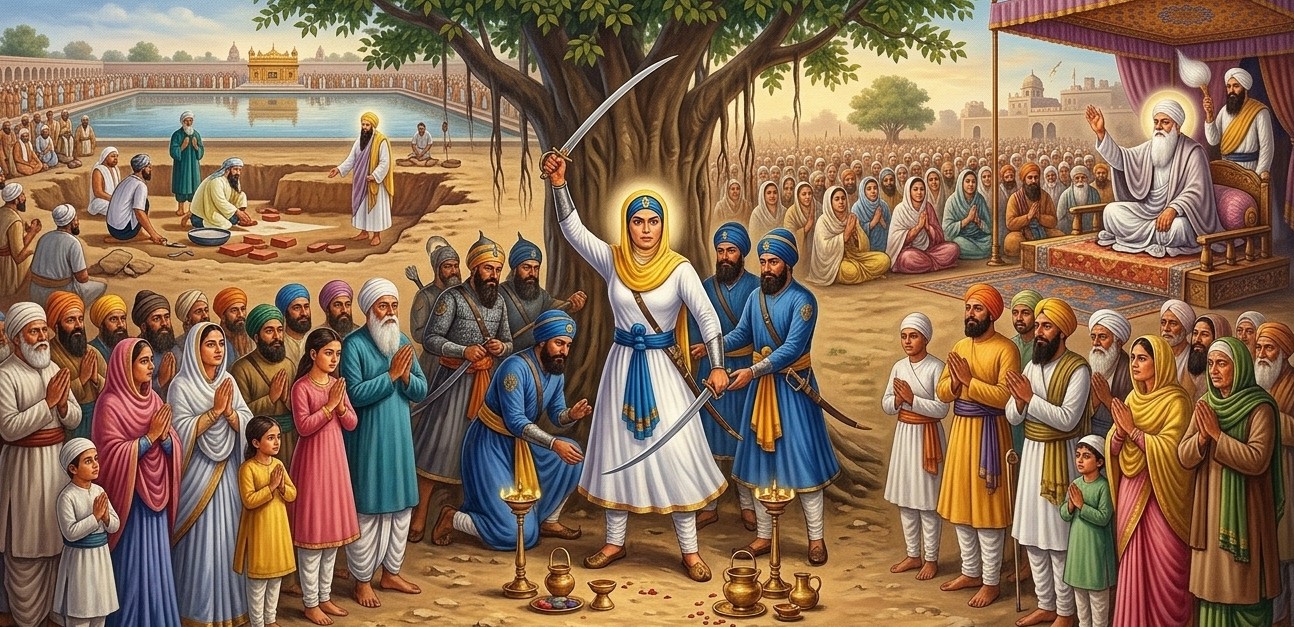
Mai Bhago: The Warrior-Saint Who Rekindled the Spirit of the Khalsa
Among the towering figures of Sikh history, few command as much admiration and reverence as Mai Bhago, also known as Mata Bhag Kaur. Her story emerges from one of the most turbulent chapters in the history of the Khalsa, when survival itself seemed uncertain and the Sikh community faced overwhelming military pressure from the Mughal state and its allies. In an era dominated by kings, generals, and imperial administrators, Mai Bhago stands apart as a remarkable example of courage, conviction, and spiritual authority. She was not merely a participant in history; she altered its course. Her intervention transformed despair into resistance, restored honor to those who had abandoned their sacred commitments, and helped create one of the most celebrated episodes in Sikh memory: the Battle of Muktsar and the redemption of the Forty Liberated Ones, the Chali Mukte.
The significance of Mai Bhago extends far beyond her battlefield achievements. She represents the practical realization of Guru Gobind Singh Ji's revolutionary vision of equality. At a time when many societies relegated women to narrow domestic roles, the Sikh Gurus consistently emphasized spiritual equality and human dignity irrespective of gender. Mai Bhago embodied these teachings in their fullest form. She became a warrior, leader, preacher, and defender of the faith. Her life demonstrates that the Sikh ideal of the Saint-Soldier was never restricted by gender. Instead, it was a universal calling that demanded courage, devotion, and readiness to sacrifice for righteousness. Through her actions, she left an enduring legacy that continues to inspire Sikhs and non-Sikhs alike.
The Historical Landscape of Crisis and Resistance
To fully appreciate the significance of Mai Bhago, one must first understand the circumstances that produced her. The closing years of the seventeenth century witnessed immense upheaval in northern India. Emperor Aurangzeb's policies had intensified tensions across the subcontinent, while the growing influence of the Khalsa challenged existing political and religious structures. Guru Gobind Singh Ji had founded the Khalsa in 1699, creating a community dedicated to spiritual discipline, social equality, and resistance against tyranny. This new order inspired thousands, but it also attracted powerful enemies.
The city of Anandpur Sahib became the focal point of a prolonged military confrontation. Mughal forces, joined by several hill chiefs, laid repeated sieges against the Guru and his followers. Conditions inside Anandpur grew increasingly difficult. Food supplies dwindled, resources became scarce, and relentless pressure tested the resolve of even the most committed Sikhs. The siege evolved into not only a military struggle but also a psychological one. The enemy hoped that starvation and exhaustion would accomplish what battlefield victories could not.
It was during this period that a group of forty Sikhs from the Majha region lost confidence in their ability to endure. Under immense hardship, they formally renounced their allegiance to Guru Gobind Singh Ji through a written declaration. This document, known historically as the Bedava, effectively severed their connection to the Guru. Having abandoned the struggle, they returned to their villages believing they had escaped certain destruction. Yet their decision would soon confront them with a different challenge: the judgment of their own conscience and the unwavering moral clarity of Mai Bhago.
The Early Life and Formation of Mai Bhago
Mai Bhago was born into a family deeply rooted in Sikh tradition and martial culture. Raised in the village of Jhabal Kalan in present-day Punjab, she grew up hearing accounts of Guru Nanak Dev Ji, Guru Hargobind Ji, and the sacrifices made by earlier Sikh generations. Her father, Bhai Malo Shah, was himself a devoted Sikh who ensured that his daughter received not only spiritual instruction but also training in horsemanship, weaponry, and physical discipline. Such an upbringing was entirely consistent with the Sikh emphasis on cultivating both spiritual wisdom and practical capability.
From an early age, Mai Bhago developed a profound sense of commitment to the Sikh faith. She internalized the teachings of the Gurus regarding justice, equality, and service. Unlike many historical figures whose greatness emerges suddenly during moments of crisis, Mai Bhago's heroism was the culmination of years of preparation. Her courage on the battlefield was inseparable from her spiritual foundation. She understood that true bravery arose not from anger or ambition but from unwavering faith in divine purpose.
As news of the hardships faced by Guru Gobind Singh Ji spread throughout Punjab, Mai Bhago followed developments closely. She recognized the extraordinary sacrifices being made by the Guru and his followers. Consequently, when the forty deserters returned to their homes after abandoning Anandpur Sahib, she viewed their actions not merely as a personal failure but as a betrayal of the principles that defined the Khalsa.
The Rebuke That Changed History
The return of the deserters to the Majha region created a moment of profound moral reckoning. These men had once proudly identified themselves as Sikhs of Guru Gobind Singh Ji. They had accepted the discipline of the Khalsa and pledged loyalty to their spiritual leader. Yet faced with hardship and danger, they had chosen self-preservation over commitment. While many communities might have welcomed them back without question, Mai Bhago responded differently.
Historical traditions describe how she confronted the deserters with fierce honesty and uncompromising conviction. She reminded them of the sacrifices made by Guru Tegh Bahadur Ji, who had given his life in defense of religious freedom. She spoke of the Guru's unwavering dedication despite relentless persecution. Most importantly, she challenged the men to examine their own conduct. If they truly considered themselves Sikhs, how could they abandon the very person who had dedicated his life to protecting them?
Her words struck with extraordinary force. Mai Bhago did not appeal merely to emotion; she appealed to honor, conscience, and spiritual responsibility. She exposed the contradiction between the men's identity and their actions. Through her leadership, the deserters began to recognize the gravity of their decision. Shame gradually transformed into determination. The same individuals who had fled from adversity resolved to return to Guru Gobind Singh Ji and seek redemption through action rather than words.
This moment remains one of the most remarkable examples of moral leadership in Sikh history. Mai Bhago accomplished what armies and political authorities could not. She reignited courage within hearts that had succumbed to fear. Her influence demonstrates that leadership often depends less on formal authority than on personal integrity and conviction.
The March Toward Redemption
Having inspired the forty men to reclaim their honor, Mai Bhago undertook an even more extraordinary step. She did not simply encourage them and remain behind. Instead, she armed herself, mounted her horse, and personally led the group back toward the Guru. This decision transformed her from a critic of failure into a participant in the struggle. She accepted the same risks and dangers that she demanded others face.
The journey carried profound symbolic significance. The returning Sikhs were not merely moving across physical terrain; they were undertaking a spiritual pilgrimage from fear to courage, from separation to reconciliation. Mai Bhago served as both guide and inspiration throughout this process. Her presence continually reminded them of the ideals they sought to reclaim.
Meanwhile, Guru Gobind Singh Ji was engaged in a series of difficult movements across Punjab following the evacuation of Anandpur Sahib. The loss of his four sons and countless companions had not diminished his resolve. Despite immense personal tragedy, he continued to embody the resilience that characterized the Khalsa spirit. It was within this broader context of suffering and perseverance that the paths of the Guru, Mai Bhago, and the returning Sikhs converged near Khidrana, later known as Muktsar.
The Battle of Muktsar
The Battle of Muktsar occupies a unique place in Sikh history because it was simultaneously a military engagement and a spiritual drama. As Mughal forces pursued Guru Gobind Singh Ji, the forty returning Sikhs positioned themselves to confront the advancing army. Their objective was clear: they would stand and fight, allowing the Guru to remain protected. Every participant understood that survival was unlikely.
Mai Bhago fought among them with exceptional courage. Contemporary traditions and later chronicles consistently portray her as an active combatant who inspired those around her through personal example. Mounted and armed, she entered the battlefield not as an observer but as a warrior fully committed to the cause. Her presence challenged conventional assumptions regarding gender and warfare while demonstrating the practical reality of Sikh teachings on equality.
The battle itself was fierce and chaotic. Vastly outnumbered, the Sikhs relied on determination, tactical positioning, and intimate knowledge of the terrain. One by one, the forty warriors fell. Yet their resistance inflicted significant losses upon the pursuing forces and disrupted enemy plans. Most importantly, their sacrifice fulfilled their desire for redemption. Through their actions, they erased the shame associated with the Bedava and reaffirmed their loyalty to the Guru.
When the fighting ended, the battlefield was strewn with the bodies of the fallen. Among the survivors was Mai Bhago, severely wounded but alive. The Guru moved among the dying warriors, offering comfort and blessings. According to Sikh tradition, one of the final requests made by the mortally wounded Bhai Mahan Singh was that the Bedava be forgiven and destroyed. Guru Gobind Singh Ji granted this request, tearing the document and declaring the fallen warriors liberated. From that moment, they became known as the Chali Mukte, the Forty Liberated Ones.
The Spiritual Meaning of Muktsar
The significance of Muktsar extends far beyond military history. The very name means "Pool of Liberation," reflecting the belief that the forty warriors attained spiritual freedom through their sacrifice and renewed devotion. Their story illustrates a central principle within Sikh thought: human beings are not defined permanently by their failures. Redemption remains possible when individuals confront their mistakes honestly and act courageously to correct them.
Mai Bhago occupies a central position within this narrative because she made that redemption possible. Without her intervention, the deserters might have remained trapped by regret and self-deception. Instead, she challenged them to embrace responsibility and reclaim their honor. In this sense, her role was not merely military but profoundly spiritual. She became an instrument through which transformation occurred.
The episode also reveals the Sikh understanding of leadership. True leaders do not simply command others; they awaken dormant virtues within them. Mai Bhago demonstrated this principle perfectly. Her courage inspired courage. Her faith strengthened faith. Her willingness to sacrifice encouraged others to do the same.
Life After the Battle
Following Muktsar, Mai Bhago continued to serve Guru Gobind Singh Ji. Historical traditions suggest that she accompanied him during subsequent journeys and remained a trusted companion. Unlike many warriors whose significance ends with a single battle, Mai Bhago continued to embody the ideals of the Khalsa through her ongoing dedication and service.
Eventually, she settled in the Deccan region of southern India, where Guru Gobind Singh Ji spent the final years of his life. There she devoted herself to meditation, remembrance of the Divine, and the preservation of Sikh teachings. This later phase of her life is particularly important because it demonstrates the balance between action and contemplation that lies at the heart of Sikh spirituality. Having proven herself on the battlefield, she embraced a life of devotion without abandoning the values that had defined her earlier years.
Traditions associated with Janwada in present-day Karnataka preserve memories of her final years. The site remains an important place of remembrance, attracting those who seek inspiration from her extraordinary journey.
The Enduring Legacy of Mai Bhago
More than three centuries after her death, Mai Bhago continues to occupy a unique position within Sikh collective memory. She represents courage without arrogance, strength without cruelty, and leadership without self-interest. Her story challenges simplistic assumptions about gender roles while affirming the universal accessibility of spiritual greatness.
For Sikh women, she serves as a powerful reminder that participation in religious, social, and political life has deep historical roots within the tradition. For Sikh men, she stands as an example of integrity and accountability. For all people, regardless of background, her life demonstrates the transformative power of conviction and moral courage.
In an age often characterized by compromise and expediency, Mai Bhago's example remains strikingly relevant. She reminds us that principles matter, that courage can be contagious, and that one determined individual can alter the course of history. The fields of Muktsar may have fallen silent centuries ago, but the lessons of her life continue to resonate across generations.
Frequently Asked Questions (FAQ)
1. Who was Mai Bhago?
Mai Bhago, also known as Mata Bhag Kaur, was a Sikh warrior and spiritual leader who inspired forty deserters to return to Guru Gobind Singh Ji and fight at the Battle of Muktsar.
2. Why is Mai Bhago important in Sikh history?
She demonstrated extraordinary courage, led warriors into battle, and played a central role in the redemption of the Chali Mukte, making her one of the most respected figures in Sikh tradition.
3. What was the Bedava?
The Bedava was a written declaration signed by forty Sikhs stating that they were no longer followers of Guru Gobind Singh Ji during the siege of Anandpur Sahib.
4. How did Mai Bhago influence the forty deserters?
Through powerful moral and spiritual persuasion, she challenged their actions and inspired them to return to the Guru's side and reclaim their honor.
5. What was the Battle of Muktsar?
It was a significant battle fought in 1705 in which the forty returning Sikhs sacrificed their lives while defending Guru Gobind Singh Ji from pursuing Mughal forces.
6. Why are the forty warriors called the Chali Mukte?
Guru Gobind Singh Ji declared them spiritually liberated after they redeemed themselves through courage, sacrifice, and renewed devotion.
7. Did Mai Bhago survive the Battle of Muktsar?
Yes, although she was wounded during the battle, she survived and continued serving Guru Gobind Singh Ji afterward.
8. Where was Mai Bhago born?
She was born in the village of Jhabal Kalan in the Majha region of Punjab.
9. What happened to Mai Bhago later in life?
She spent her later years in devotion and meditation, particularly in the Deccan region of India, where traditions preserve memories of her spiritual life.
10. What is Mai Bhago's legacy today?
Mai Bhago remains a symbol of bravery, equality, faith, and leadership. She is remembered as one of the greatest examples of the Sikh Saint-Soldier ideal and continues to inspire people around the world.
Guru Gobind Singh Ji (1666–1708)
The brave woman who shamed 40 deserters into returning to the Guru's side and led them in the Battle of Muktsar.
- Role
- Warrior Woman
- Group
- Allies & Devotees
- Period
- Guru Gobind Singh Ji (1666–1708)