Panthic Personalities · Origins & Gurus · Guru Amar Das Ji
Mai Sewan
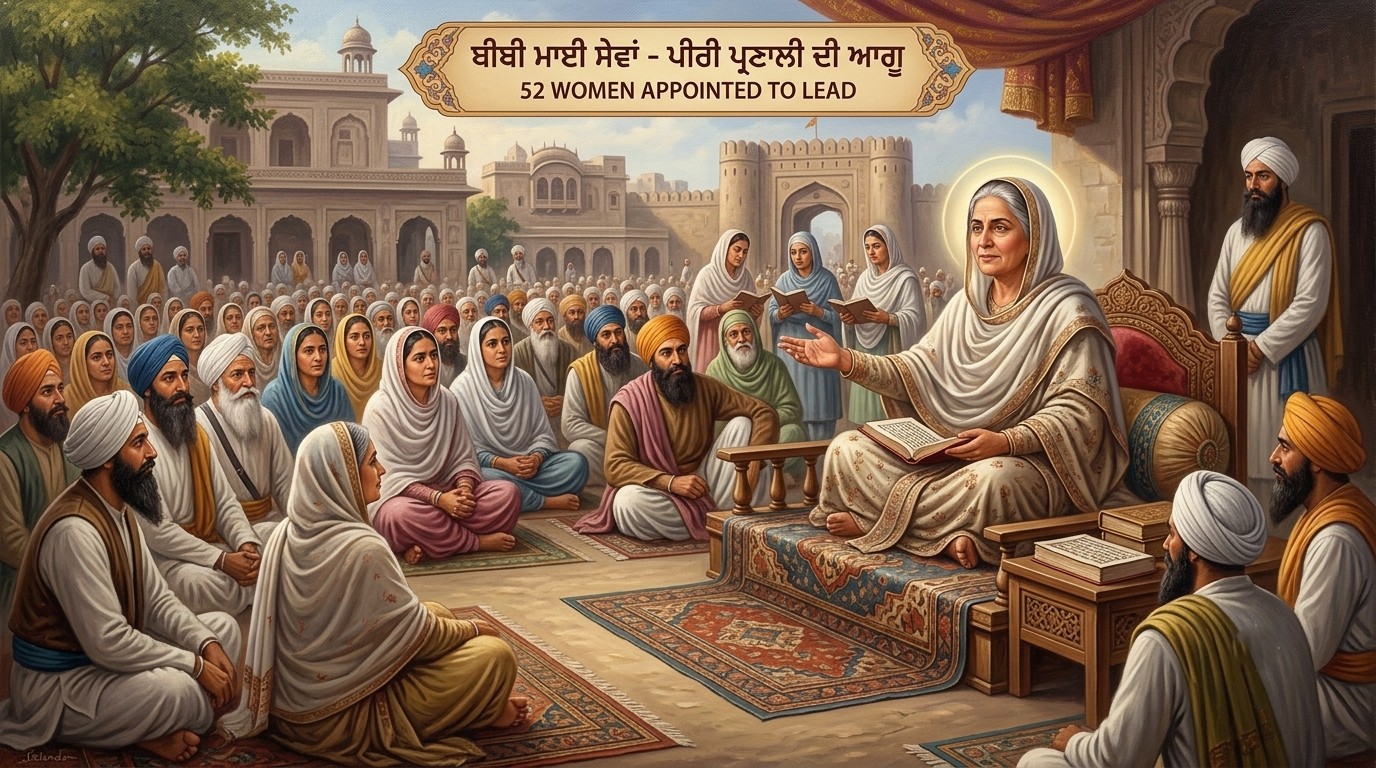
One of the 52 women appointed to lead the 'Piri' system, empowering women to preach and lead congregations.
Apostles of the Silk Road and the Soil: Mai Sewan and the Sovereignty of the Piri System
To study the mid-sixteenth century under the mastership of Guru Amar Das Ji is to witness the deliberate, structural dismantling of medieval India’s deeply entrenched social and spiritual hierarchies. While the secular world was dominated by the military-administrative machinations of the expanding Mughal Empire, a quiet, parallel commonwealth was being organized from the banks of the Beas River at Goindwal Sahib. This commonwealth, the fledgling Sikh Panth, faced a critical existential juncture. The divine light of Guru Nanak Dev Ji had revealed a path of radical equality, but translating this transcendent theology into a durable, trans-regional society required profound structural innovation. The response of the third Master was the creation of the Manji (wooden cot) and Piri (low wooden seat) systems. While the Manjis have occupied a significant portion of mainstream historical focus, it is the Piri system—specifically designed to empower women to lead, preach, and govern congregations—that represents perhaps the most radical gender-equality movement of the medieval world. Among the luminous pioneers of this system, Mai Sewan stands as a monumental figure whose leadership bridged the agrarian heartlands of Punjab with the cosmopolitan trade hubs of the Silk Road.
The Piri System: The Gender-Equal Revolution of early Sikhi
The establishment of the Piri system cannot be understood in isolation from the bleak socio-religious landscape of sixteenth-century South Asia. Under the weight of Brahmanical orthodoxy and Islamic feudalism, women were subjected to systematic dehumanization. Practices such as Sati (widow burning), Purdah (mandatory veiling), female infanticide, and the absolute denial of spiritual and educational agency were not merely cultural anomalies; they were institutionalized norms. Women were viewed as spiritually deficient, inherently unclean, and incapable of achieving liberation without being reborn as men. Guru Amar Das Ji aggressively confronted these pathologies. He refused audience to any queen who approached his court veiled, banned the practice of Sati within the Sikh fold, encouraged widow remarriage, and actively promoted the education of women. Yet, the Guru understood that true empowerment required more than protective edicts; it demanded the institutionalization of female authority.
Thus, alongside the twenty-two Manjis, Guru Amar Das Ji established fifty-two Piris. The term 'Piri' refers to a small, low wooden cot or stool, matching the conceptual utility of the 'Manji' but specifically serving as the seat of spiritual authority for female missionaries. These fifty-two women were not secondary assistants to their male counterparts; they were sovereign regional leaders. They were formally invested with the authority to initiate seekers into the Sikh faith, interpret the Guru's compositions (Gurbani), collect and manage communal tithes (Dasvandh), and govern regional Sangats. This was an unprecedented development in world history, predating Western women's suffrage and ecclesiastical ordination by centuries. Under this revolutionary framework, female missionaries traveled across the subcontinent and beyond, establishing spiritual strongholds where women sat on raised platforms to preach to mixed-gender audiences of men and women alike.
Mai Sewan of Gardnoh: Cultivating Devotion in the Patiala Plains
Among the primary appointments to the Piri system, historical chronicles record the name of Mai Sewan (sometimes transliterated as Mai Sevan), who was assigned to establish her missionary seat at the village of Gardnoh in the Patiala region. The Malwa plains of Punjab at this time were socially fragmented, marked by tribal rivalries, deep-seated caste divisions, and a general suspicion of new religious developments. Into this challenging environment, Mai Sewan arrived not merely as an emissary of Goindwal Sahib, but as the living embodiment of the Guru's sovereignty. Sitting upon her designated Piri, she established a vibrant center of spiritual discourse, community care, and social liberation.
Mai Sewan’s ministry was characterized by a profound synthesis of deep theology and practical, hands-on community service (Sewa). She did not preach an ascetic withdrawal from the world; instead, she taught the local agrarian population how to live as householders while keeping their consciousness anchored in the Divine Name (Naam Simran). She organized the local communal kitchen (Langar), ensuring that the proud Jat landholders, the marginalized artisans, and the untouchable weavers sat side-by-side on the floor (Pangat) to break bread. This simple act of eating together shattered the ritual purity laws that sustained the caste system. Mai Sewan also became a critical advocate for local women, establishing safe spaces where they could discard their veils, learn to read and write the newly developed Gurmukhi script, and actively participate in congregational singing (Kirtan). Her home and administrative center in Gardnoh became a sanctuary of hope, drawing thousands into the egalitarian fold of Sikhism and turning the Malwa region into a fortress of the faith.
The Cosmic Mystery of Kabul: Mai Sewan as the Anonymous Apostle
Sikh historiography contains fascinating, overlapping narratives regarding the identity of Mai Sewan, with classical texts like the Mahima Prakash by Sarup Das Bhalla and inscriptions at Goindwal Sahib weaving her legacy with the legendary figure of 'Mai Kabul Wali' (the mother from Kabul). According to these records, a deeply devoted woman from the distant city of Kabul (in modern-day Afghanistan) traveled to Goindwal Sahib during the excavation of the sacred stepwell, the Baoli Sahib. Embracing the concept of 'Gupt Sewa' (anonymous, selfless service), she worked tirelessly day and night carrying heavy baskets of earth on her head, never seeking recognition, speaking to no one, and focusing her mind entirely on the Shabad. She slept on the bare earth and ate only the simplest leftovers from the Langar.
One day, Guru Amar Das Ji stopped the congregation and pointed to this silent, dust-covered laborer. The Guru revealed to the amazed assembly that this woman was from Kabul and had, through her absolute surrender and intense devotion, attained the highest state of spiritual enlightenment (Brahm Gyan). The Guru formally named her Mai Sewan—commemorating her unmatched spirit of selfless service (Sewa)—and appointed her to lead the Sikh mission in Kabul. Returning to Afghanistan, Mai Sewan established a prominent Piri in Kabul, which was then a crucial, bustling hub of the international Silk Road. From her seat of authority in Kabul, she governed a massive, diverse congregation of merchants, travelers, and locals, demonstrating that the spiritual empire of Guru Nanak knew no geographic, cultural, or gender boundaries. Whether Mai Sewan of Gardnoh and Mai Sevan of Kabul were the same legendary soul or two distinct giants of the Piri system, their shared name across historical records underscores a singular truth: the early Panth was built on the backs of incredibly strong, spiritually realized women who commanded absolute respect from the Gurus and the community.
Comparative Analysis of Medieval Socio-Spiritual Systems
To fully appreciate the radical nature of Mai Sewan’s authority under the Piri system, it is useful to contrast the early Sikh structural design with the contemporary imperial, orthodox, and monastic frameworks of the sixteenth century:
| Socio-Spiritual Dimension | The Sikh Piri System | The Orthodox Hindu Clerical Order | The Imperial Mughal / Islamic Feudal Order | Contemporary European Monasticism |
| Source & Scope of Female Authority | Divine commission from the Guru; full spiritual and administrative authority to preach, initiate, and collect tithes. | Non-existent; women barred from reading Vedic scriptures, performing rituals, or holding clerical rank. | Strictly domestic and private; public life and leadership reserved exclusively for men under patriarchal norms. | Restricted to isolated convents; nuns had no authority over men or the wider public ecclesiastical structure. |
| Socio-Cultural Requirements | Active rejection of the veil (Purdah), complete bodily and spiritual sovereignty, and promotion of widow remarriage. | Strict adherence to caste boundaries, ritual purity laws, and the systemic enforcement of Sati and widow isolation. | Enforcement of the harem system, strict veiling, and the total subordination of women to male guardians. | Vows of celibacy and absolute cloistering; separation from active participation in general society. |
| Economic and Regional Influence | Active householders managing local economies, organizing trans-regional community kitchens, and directing regional tithes. | Economic dependence on male relatives; no institutional control over temple lands or financial resources. | Imperial women occasionally held property, but administrative and political decision-making was strictly male-dominated. | Abbeys held land, but ultimate administrative and theological control was maintained by the male papal hierarchy. |
The Theological Mechanics of the Piri: Paving the Way for Miri-Piri
From a theological perspective, the Piri system was not merely a social reform program; it was a profound externalization of Gurmat metaphysics. Guru Nanak Dev Ji’s compositions repeatedly challenge the patriarchal assumptions of his era, asking, 'Why call her bad, from whom kings and leaders are born?' Early Sikh theology posits that the human soul (Atma) has no gender; all souls are inherently feminine in relation to the ultimate, formless Creator (Paramatma), who is the sole Husband-Lord (Khasam). Therefore, to deny a woman the right to preach, lead, or initiate was to commit a cosmic error, artificially restricting the flow of divine grace based on temporary physical vessels. By placing Mai Sewan on the Piri, Guru Amar Das Ji was declaring that the divine wisdom (Bibek Budh) of the Shabad could shine with equal, unhindered brilliance through any human form.
Furthermore, the Piri system laid the crucial conceptual groundwork for the integrated doctrine of 'Miri-Piri' (temporal and spiritual sovereignty) that would be formally declared by the sixth Master, Guru Hargobind Sahib Ji, in the seventeenth century. The very word 'Piri' carries double meaning in Sikh history: it refers both to the physical low wooden seat of the female missionaries and to the Persian word 'Pir' (spiritual authority). By establishing the Piri system, the early Gurus demonstrated that spiritual sovereignty (Piri) was not a quietist, passive state of meditation, but an active, organized, and socially transformative power. Mai Sewan, sitting on her Piri, was not just a quiet saint; she was a sovereign administrator of the Guru's court, resolving disputes, managing resources, and defending the human rights of her congregation against the overreach of local feudal lords.
The Living Legacy of Mai Sewan
The historical memory of Mai Sewan and the fifty-two Piris is a vital, revolutionary inheritance that continues to challenge the modern Sikh Panth. The work of these pioneer women created a cultural shift that made the later, heroic chapters of Sikh history possible. Without the foundational, intellectual, and administrative work of the Piris, we would not have the fierce military leadership of Mai Bhago, the political statecraft of Rani Sada Kaur, or the resilient, quiet leadership of Mata Sundri Ji during the turbulent decades of the eighteenth century. Mai Sewan proved that a woman could command the respect of battle-hardened warriors, navigate the complex trade networks of Kabul, and establish enduring spiritual institutions in the dusty villages of Malwa.
For the modern historian and seeker alike, Mai Sewan’s life remains a radiant beacon. Her legacy is a powerful reminder that gender equality is not a modern, Western import to Sikhism, but an ancient, foundational pillar of the faith, established by the Gurus themselves through revolutionary structures like the Piri system. As we look back across the centuries, the image of Mai Sewan—whether carrying baskets of earth in Goindwal or sitting in majestic, calm authority on her Piri in Patiala or Kabul—demands that we continue to strive for a world where every soul, regardless of vessel, has the absolute freedom to lead, to serve, and to soar as a supreme swan of the spiritual realm.
Guru Amar Das Ji (1479–1574)
One of the 52 women appointed to lead the 'Piri' system, empowering women to preach and lead congregations.
- Role
- Women's Leader
- Group
- Institutional Leaders (Manjis)
- Period
- Guru Amar Das Ji (1479–1574)