Historical Turning Points · Empire & Struggle
March 1846 Treaty of Lahore
The defeated empire was forced to cede the fertile Jalandhar Doab and Jammu & Kashmir to the British. A British Resident was installed to control the minor Maharaja Duleep Singh.
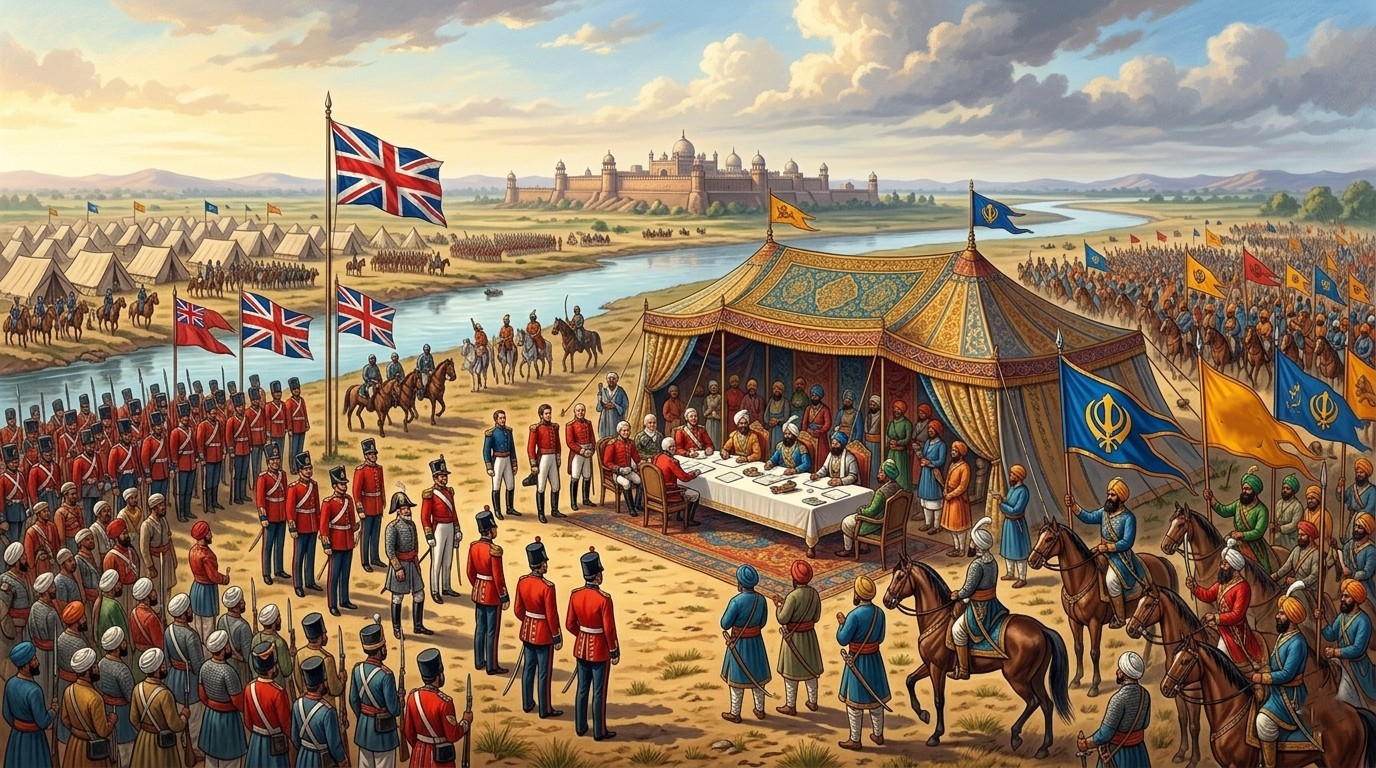
March 1846 CE – The Treaty of Lahore: The Humiliation of a Conquered Empire and the Beginning of British Control Over Punjab
The Treaty of Lahore, signed in March 1846 following the conclusion of the First Anglo-Sikh War, stands as one of the most consequential and painful turning points in Sikh history. It was more than a diplomatic agreement between the Sikh Empire and the British East India Company; it was a document that symbolized the collapse of the political order established by Maharaja Ranjit Singh and the beginning of direct British interference in the affairs of Punjab. For the Sikh nation, the treaty represented a moment of profound loss. The empire that had once stretched from the Khyber Pass to the Sutlej River, respected by foreign powers and feared by its enemies, was now forced to accept humiliating terms dictated by a victorious imperial power. The Treaty of Lahore marked the transition of the Sikh Kingdom from an independent sovereign state to a weakened and dependent regime increasingly controlled by British officials. It also laid the foundation for the eventual annexation of Punjab in 1849 and permanently altered the political destiny of North India.
The circumstances surrounding the treaty were rooted in the tragic events of the First Anglo-Sikh War. Following the death of Maharaja Ranjit Singh in 1839, the Sikh Empire entered a period of instability characterized by palace intrigues, assassinations, factional rivalries, and weakening central authority. Despite this political turmoil, the Khalsa Army remained a formidable military force. During the war of 1845–1846, Sikh soldiers fought with extraordinary courage at Mudki, Ferozeshah, Aliwal, and Sobraon. Even British commanders acknowledged the bravery and discipline of the Khalsa. However, the war was fatally undermined by failures of leadership and allegations of betrayal involving senior commanders such as Lal Singh and Tej Singh. The devastating defeat at Sobraon in February 1846 shattered organized Sikh resistance and opened the road to Lahore, leaving the British East India Company in a position to impose its will upon the defeated kingdom.
The Road to Lahore After Sobraon
Following the bloody Battle of Sobraon on 10 February 1846, British forces advanced toward Lahore with little effective opposition. The destruction of a significant portion of the Khalsa Army had left the Sikh state vulnerable. Although many Sikh soldiers remained willing to fight, the political leadership in Lahore recognized that continuing the war without a coherent military command structure would likely result in complete destruction. The British East India Company, led by Governor-General Sir Henry Hardinge and Commander-in-Chief Sir Hugh Gough, understood that they had achieved a strategic victory. However, they also recognized that Punjab remained a potentially dangerous region. The memory of Sikh military strength was fresh, and the British sought a settlement that would weaken the Sikh state without immediately provoking renewed resistance.
Negotiations took place under conditions that heavily favored the victors. British troops occupied strategic positions, and the Lahore Darbar possessed little bargaining power. The resulting treaty reflected this imbalance. It was not a treaty negotiated between equals but a settlement imposed by a victorious empire upon a defeated kingdom. Every major provision of the agreement was designed to reduce Sikh military power, diminish territorial resources, and increase British influence within Punjab.
The Terms of the Treaty
The Treaty of Lahore was formally signed on 9 March 1846. Its provisions imposed severe burdens upon the Sikh state. The Lahore Darbar was required to recognize British supremacy in the region and accept significant territorial losses. The Sikh government was also obligated to pay a massive war indemnity amounting to one and a half crore rupees, an enormous sum that exceeded the financial capabilities of the weakened state. Since the treasury could not fully meet this obligation, territory became the currency through which compensation would be extracted.
The treaty dramatically reduced the military capacity of the Sikh Kingdom. The Khalsa Army, once the pride of Maharaja Ranjit Singh's empire, was subjected to strict limitations. Large portions of the army were disbanded, artillery was surrendered, and military strength was curtailed. The British understood that the Khalsa represented both the military and political backbone of Sikh sovereignty. Weakening the army meant weakening the state's ability to resist future interference.
Most significantly, the treaty granted the British a direct role in Punjab's internal affairs. Although the Sikh Kingdom formally remained in existence, genuine independence had been compromised. British influence would no longer be exerted solely from beyond the frontier; it would now be embedded within the machinery of government itself.
The Loss of the Jalandhar Doab
Among the most painful provisions of the treaty was the cession of the Jalandhar Doab to the British East India Company. This fertile region lay between the Beas and Sutlej rivers and constituted one of the most productive agricultural zones of the Sikh Empire. Rich farmland, thriving settlements, and strategic communication routes made the area economically valuable and politically important. Its loss represented a significant blow to the financial and territorial integrity of the kingdom.
The British understood the strategic importance of the Jalandhar Doab. By acquiring this territory, they secured greater control over the approaches to Punjab and strengthened their position in northern India. The annexation also deprived the Sikh state of valuable revenue at a time when financial resources were already strained. For the people of Punjab, the transfer of authority represented the first major territorial dismemberment of the empire created by Maharaja Ranjit Singh.
From a Sikh historical perspective, the loss of the Jalandhar Doab symbolized the beginning of the systematic erosion of Sikh sovereignty. Land that had been defended through decades of sacrifice and state-building was now surrendered as the price of defeat. The cession served as a visible reminder that the balance of power in northern India had shifted dramatically in favor of the British.
The Separation of Jammu and Kashmir
The fate of Jammu and Kashmir following the Treaty of Lahore remains one of the most debated aspects of the settlement. Because the Lahore Darbar could not fully pay the indemnity demanded by the British, additional territorial concessions became necessary. Under subsequent arrangements, the region of Jammu and Kashmir was separated from the Sikh Kingdom and effectively transferred under British authority before being conveyed to Gulab Singh through the Treaty of Amritsar in March 1846.
This development carried profound historical significance. Kashmir had been incorporated into the Sikh Empire through military campaigns conducted during the reign of Maharaja Ranjit Singh. Its mountains, valleys, and strategic position contributed greatly to the prestige and territorial reach of the Sikh state. The loss of Kashmir represented not merely a territorial adjustment but the dismantling of a major component of the empire's geopolitical structure.
Many contemporaries viewed the transfer as a deeply controversial transaction. An entire region, along with its population, became the subject of political bargaining between imperial powers and local rulers. For the Sikh Empire, the separation of Jammu and Kashmir highlighted the extent to which defeat had reduced its ability to control its own destiny. A kingdom that had once dictated terms across the northwest now found its territories redistributed by foreign decision-makers.
Maharaja Duleep Singh: A Child on the Throne
At the center of these developments stood Maharaja Duleep Singh, the youngest son of Maharaja Ranjit Singh. Born in 1838, Duleep Singh was only a child when he became ruler of the Sikh Kingdom. Following years of political instability and dynastic conflict, he occupied the throne during one of the most dangerous periods in Punjab's history. Yet despite his royal status, real power increasingly lay elsewhere.
The Treaty of Lahore recognized Duleep Singh as Maharaja, but this recognition came with severe limitations. His minority allowed the British to justify intervention in the governance of Punjab. The kingdom's rulers could no longer make decisions independently. Instead, British officials gradually positioned themselves as guardians, advisors, and supervisors of the state. The existence of a child monarch provided the ideal pretext for extending foreign influence while maintaining the appearance of continuity.
For many Sikhs, the image of the young Maharaja symbolized the vulnerability of the kingdom itself. Just as Duleep Singh lacked the power to control events around him, so too did the Sikh state find itself increasingly unable to determine its own future. The throne survived, but sovereignty was steadily slipping away.
The Installation of a British Resident
Perhaps the most significant political consequence of the Treaty of Lahore was the installation of a British Resident at Lahore. Officially presented as an advisor and representative of British interests, the Resident quickly became the most influential figure in the administration of Punjab. Through this office, the British gained direct access to state affairs and the ability to shape government policy from within.
The presence of the Resident transformed the nature of Sikh governance. Decisions that had once been made by the Lahore Darbar increasingly required British approval. Administrative appointments, military matters, financial policies, and diplomatic initiatives all came under growing scrutiny. Although Punjab technically remained an independent kingdom, its autonomy was now severely constrained.
The Resident's influence extended beyond formal administration. By cultivating alliances within the court, gathering intelligence, and advising regents, British officials ensured that their interests remained protected. The arrangement effectively created a system of indirect control. Without formally annexing Punjab, the British exercised enormous influence over its political life.
To Sikh observers, the installation of a Resident represented a direct assault upon sovereignty. The court founded by Maharaja Ranjit Singh had once negotiated with foreign powers as an equal. Now a foreign official sat at the heart of government, monitoring and directing the affairs of the kingdom.
The Impact on the Khalsa Army
The Treaty of Lahore also had devastating consequences for the Khalsa Army. Under Maharaja Ranjit Singh, the army had been the embodiment of Sikh military power and national pride. It had defended the frontiers of the empire, deterred foreign invasions, and projected strength across the region. The treaty sought to dismantle this institution by reducing troop numbers, confiscating artillery, and limiting military capabilities.
For thousands of soldiers, the reductions meant unemployment, uncertainty, and humiliation. Many veterans believed that the army had not been defeated through lack of courage but through treachery and political mismanagement. The forced weakening of the Khalsa created widespread resentment throughout Punjab. These grievances would contribute significantly to the tensions that later erupted during the Second Anglo-Sikh War.
The British regarded the Khalsa Army as both a military threat and a political force. By diminishing its power, they hoped to prevent future resistance. Yet the memory of the army's achievements remained deeply embedded within Sikh society, ensuring that its legacy would survive long after its formal reduction.
The Beginning of the End for Sikh Sovereignty
Although the Treaty of Lahore did not immediately abolish the Sikh Kingdom, it marked the beginning of the end of Sikh political independence. The territorial losses, financial burdens, military restrictions, and political supervision imposed by the treaty fundamentally altered the balance of power. Punjab remained nominally independent, but its ability to act as a sovereign state was increasingly compromised.
The years that followed demonstrated how effectively the treaty advanced British objectives. Political influence expanded, internal divisions deepened, and British involvement became more intrusive. By 1849, after the Second Anglo-Sikh War, the Sikh Kingdom was formally annexed into the British Empire. The process that culminated in annexation began not in 1849 but in March 1846 with the signing of the Treaty of Lahore.
For Sikh historians, the treaty occupies a central place in understanding the decline of the Sikh Empire. It illustrates how military defeat, internal instability, and imperial ambition combined to dismantle one of the most powerful indigenous states in South Asia. Yet it also serves as a reminder of the resilience of Sikh identity. While political sovereignty was lost, the spirit, traditions, and collective memory of the Sikh people endured.
Historical Legacy of the Treaty of Lahore
The legacy of the Treaty of Lahore extends far beyond the events of 1846. It reshaped the political geography of northern India, altered the destiny of Punjab, and influenced the future of Jammu and Kashmir. It transformed Maharaja Duleep Singh from a sovereign ruler into a symbolic monarch under foreign supervision. It converted the Lahore Darbar from an independent government into an institution operating under British oversight. Most importantly, it marked the moment when the empire founded by Maharaja Ranjit Singh ceased to function as a fully sovereign power.
In Sikh historical memory, the treaty remains a symbol of both loss and warning. It demonstrates the dangers of internal disunity and the consequences of political betrayal. At the same time, it highlights the extraordinary achievements of the Sikh Empire, whose strength was so formidable that even after military defeat the British proceeded cautiously rather than immediately annexing Punjab. The story of the Treaty of Lahore is therefore not only a story of imperial triumph but also a reflection on the fragility of political power and the enduring significance of national unity.
Frequently Asked Questions (FAQ)
1. What was the Treaty of Lahore?
The Treaty of Lahore was an agreement signed on 9 March 1846 between the Sikh Empire and the British East India Company after the First Anglo-Sikh War.
2. Why was the treaty signed?
The treaty was imposed after the defeat of the Sikh Empire in the First Anglo-Sikh War, particularly following the decisive Battle of Sobraon.
3. What territory did the Sikh Empire lose under the treaty?
The empire ceded the fertile Jalandhar Doab to the British and subsequently lost Jammu and Kashmir through related post-war arrangements.
4. What was the Jalandhar Doab?
The Jalandhar Doab was the fertile region between the Beas and Sutlej rivers and was one of the most economically productive areas of the Sikh Kingdom.
5. Why was Jammu and Kashmir separated from the Sikh Empire?
The Lahore Darbar could not fully pay the indemnity demanded by the British, leading to territorial concessions that ultimately resulted in the transfer of Jammu and Kashmir.
6. Who was Maharaja Duleep Singh?
Duleep Singh was the youngest son of Maharaja Ranjit Singh and became Maharaja of the Sikh Kingdom as a child during a period of intense political instability.
7. What was the role of the British Resident?
The British Resident acted as the British representative at Lahore and exercised significant influence over the administration and policies of the Sikh state.
8. How did the treaty affect the Khalsa Army?
The treaty reduced the size of the army, restricted military capabilities, and required the surrender of significant military resources.
9. Did the Treaty of Lahore end the Sikh Kingdom?
No. The Sikh Kingdom continued to exist after 1846, but its sovereignty was severely weakened and it came under increasing British control.
10. Why is the Treaty of Lahore important in Sikh history?
The treaty marked the beginning of the final decline of Sikh political independence and paved the way for the British annexation of Punjab in 1849.