Panthic Personalities · Origins & Gurus · Guru Angad Dev Ji
Mata Khivi Ji
The only woman mentioned by name in the Guru Granth Sahib; she managed the Langar with immense maternal love.
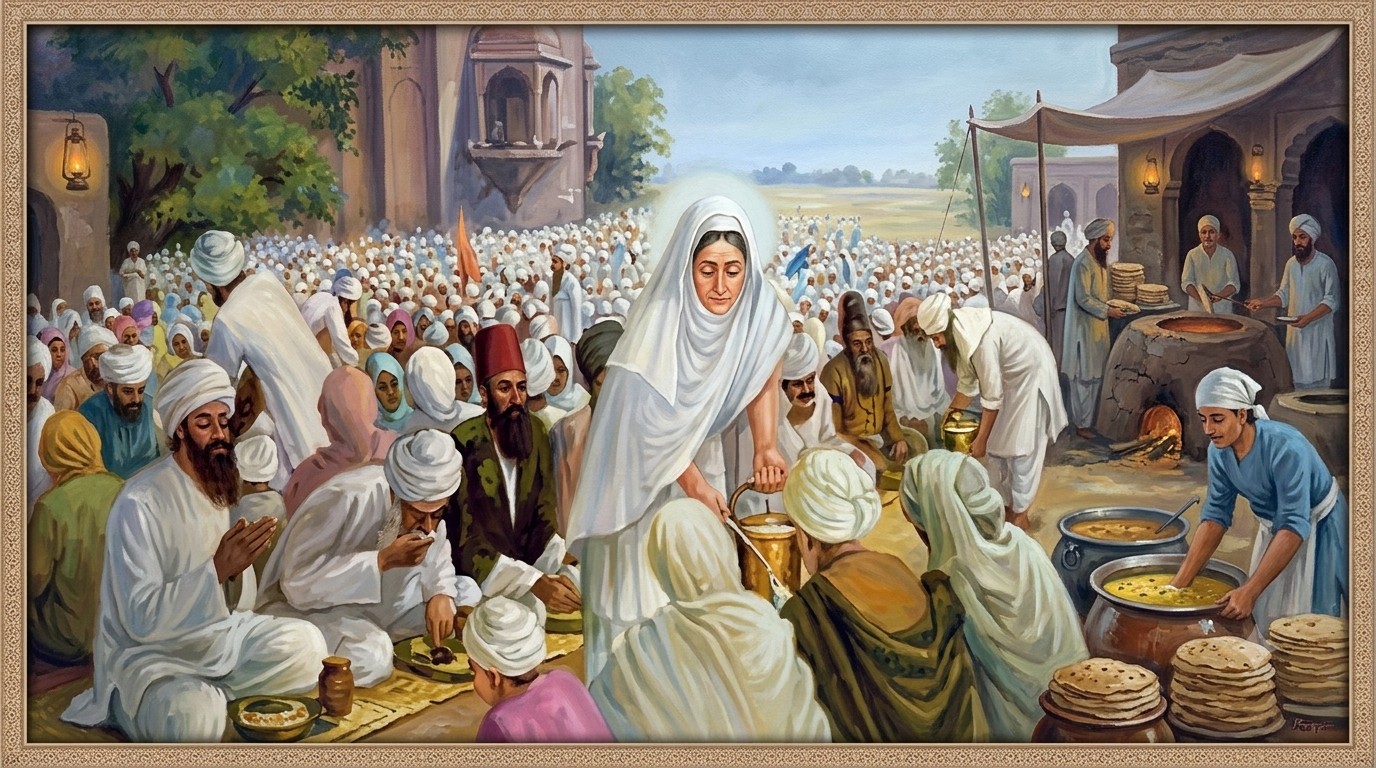
The Sovereign Matriarch: Mata Khivi Ji
In the sacred, revolutionary history of the Sikh path, women have never been passive onlookers or mere domestic companions to the Gurus; rather, they have stood as co-founders, spiritual anchors, and institutional builders of the sovereign order. Among these foundational figures, Mata Khivi Ji occupies a position of peerless spiritual and historical eminence. She remains the only woman in Sikh history to be explicitly mentioned by name within the eternal, living embodiment of the Gurus' word, the Sri Guru Granth Sahib. Born in the early sixteenth century into a highly respected Marwah Khatri family in the historic town of Khadur Sahib, Mata Khivi Ji’s life spanned a critical century of spiritual awakening, institutional consolidation, and socio-political upheaval. As the beloved consort of Bhai Lehna Ji—who would later undergo a profound spiritual transformation to become Guru Angad Dev Ji, the second Sovereign of the Sikhs—she was not merely a supportive wife, but a dynamic, visionary leader who single-handedly institutionalized, managed, and sanctified the egalitarian space of Guru-ka-Langar (the Guru's free kitchen).
For a Sikh historian, Mata Khivi Ji is a subject of profound study because she represents the practical operationalization of the high spiritual ideals preached by Guru Nanak Dev Ji. While the Gurus articulated the metaphysical and moral boundaries of the new faith, it was Mata Khivi Ji who translated these abstract concepts of radical equality, unconditional compassion, and selfless service (Seva) into a daily, living reality for thousands of seekers, outcasts, and travelers. Her management of the Langar was not a simple culinary endeavor; it was a profound socio-political subversion of the rigid, discriminatory caste hierarchies of medieval India. By ensuring that king and peasant, Brahmin and outcaste, sat side by side on the floor (Pangat) to receive the same wholesome food served with maternal love, she laid the social foundations of a classless, casteless society. Her life serves as the ultimate historical proof that in the house of Guru Nanak, the kitchen and the congregation (Langar and Sangat) are twin pillars of equal spiritual majesty, and she was the undisputed sovereign of the former.
Early Alliances and the Alchemy of Devotion
To fully appreciate the spiritual journey of Mata Khivi Ji, one must examine her early life and her marriage to Bhai Lehna Ji. Born in 1506 to Bhai Devi Chand, a prominent merchant in the town of Sanghar, near Khadur Sahib, Khivi Ji was raised in an environment that valued ethical living, traditional hospitality, and religious piety. Her marriage to Bhai Lehna Ji in 1519 united two individuals of deep spiritual sensitivity and intellectual capability. In the initial years of their marriage, the couple lived in the village of Matte-di-Sarai, the ancestral home of Bhai Lehna’s father, Bhai Pheru Mal Ji. During this period, the household was deeply anchored in the traditions of Shaktism, with Bhai Lehna leading annual pilgrimages to Jawalamukhi. Mata Khivi Ji was a vital partner in these endeavors, managing the extensive logistics of hosting pilgrims, preparing travel provisions, and cultivating an atmosphere of deep devotional warmth that defined their household.
The turning point in their lives occurred following the brutal sacking of Matte-di-Sarai by invading forces, which forced the family to relocate to Khadur Sahib, the ancestral home of Mata Khivi’s maternal family. It was here that Bhai Lehna heard the sublime hymns of Guru Nanak Dev Ji and traveled to Kartarpur, where he surrendered himself completely to the path of the Gurus. Throughout the intense years of Bhai Lehna’s discipleship—characterized by demanding spiritual trials and long absences from home—Mata Khivi Ji bore the immense responsibility of raising their children (Bhai Dasu Ji, Bhai Datu Ji, and Bibi Amro Ji) and managing the family’s economic survival. Rather than opposing her husband’s total surrender to Guru Nanak, she embraced the revolutionary path herself, preparing her household and her own consciousness for the monumental destiny that awaited them. When Guru Nanak bypassed his own sons to appoint Bhai Lehna as his successor, renaming him "Angad"—the very limb of the Guru—Mata Khivi Ji stood ready to ascend alongside him, not as a shadow, but as the active, nurturing mother of the newly born Sikh community.
The Institutionalization of Langar: A Radical Social Subversion
Upon Guru Angad Dev Ji's ascension to the spiritual throne of Guru Nanak, the center of the Sikh path shifted to Khadur Sahib. It was here that the institution of Guru-ka-Langar underwent its first major systematic development under the direct oversight of Mata Khivi Ji. In the medieval Indian subcontinent, the act of eating was highly politicized and restricted by complex, oppressive rules of ritual purity, untouchability, and caste segregation. High-caste individuals would never share food with low-caste individuals, let alone eat from the same vessel or sit on the same level of ground. Mata Khivi Ji dismantled this deeply entrenched societal rot by making the Langar a mandatory prerequisite for meeting the Guru. Under her administration, the Langar became an active spiritual laboratory where the doctrine of equality was practiced twice daily.
Mata Khivi Ji’s approach to Langar was characterized by a rare combination of flawless logistical organization and intense, maternal love (Matri Bhao). She personally supervised the entire process: the sourcing of high-quality grains, vegetables, and dairy from ethical local farmers; the maintenance of absolute cleanliness and hygiene in the cooking areas; and the distribution of food with her own hands. She did not delegate the labor to servants; she worked alongside the volunteers, teaching them that chopping vegetables, fetching water, and scrubbing pots were acts of high meditation. Her presence in the Langar hall brought a sense of divine comfort to the weary, the destitute, and the social outcasts who had been rejected by mainstream society. Through her radical hospitality, she proved that the kitchen of the Guru was not merely a place to satisfy physical hunger, but a sacred sanctuary where human dignity was restored and celebrated.
Scriptural Immortality: The Exegesis of Satta and Balwand’s Testimony
The historical and spiritual significance of Mata Khivi Ji is permanently preserved in the central scripture of the Sikhs, the Sri Guru Granth Sahib, on Ang 967. Within the highly revered composition known as the Var of Satta and Balwand—a historical ballad written by the court minstrels of the Gurus—her contributions are immortalized in verses of exquisite beauty and theological depth. The minstrels sing: "Balwand says that Khivi is a noble woman, who provides leafy, soothing shade to all. In her Langar, wealth is distributed; the nectar-like Kheer (rice pudding) cooked in milk and ghee is served." This scriptural reference is historically unique, as it is the only instance where a woman is celebrated by name for her specific administrative and spiritual service within the sacred text.
For a Sikh historian, this verse is loaded with profound theological meaning. The metaphor of Mata Khivi Ji as a "leafy, soothing shade" (chaa-o patree-aalee) elevates her to the status of a spiritual protector, resembling a great, nurturing tree under which the tired travelers of the world find refuge and peace from the scorching heat of existential suffering. Furthermore, the explicit mention of Kheer (rice pudding cooked with milk and clarified butter/ghee) is highly significant. In the cultural context of sixteenth-century Punjab, simple flatbreads and lentils were the standard fare for the poor, while rich foods like Kheer were reserved exclusively for the wealthy elite. By serving Kheer daily in the Guru’s Langar, Mata Khivi Ji was declaring that the poor and the marginalized were worthy of the finest, most luxurious nourishment. She shattered the economic boundaries of charity, establishing that the Guru's house does not distribute meager scraps, but the richest, sweet nectar of the earth, served with unconditional dignity and love.
The Golden Thread of Continuity: Guiding Future Generations of Gurus
Mata Khivi Ji’s impact on the Sikh Panth extends far beyond the reign of her husband, Guru Angad Dev Ji. Following the physical departure of the second Guru in 1552, she lived for several decades, surviving well into her nineties. During this long, blessed lifetime, she served as the ultimate elder matriarch, the golden thread of continuity and memory that linked the early days of Guru Nanak’s direct disciples to the expansive, structured Panth of the late sixteenth century. She played a pivotal role during the succession of Guru Amar Das Ji, the third Sovereign, using her immense moral authority to settle potential family disputes and ensuring that the community remained unified behind the true spiritual light of Guru Nanak. Her home in Khadur Sahib remained a sacred pilgrimage site where successive Gurus, including Guru Ram Das Ji and Guru Arjan Dev Ji, traveled to seek her maternal blessings, counsel, and historical wisdom.
Her pedagogical influence on the future leadership of the Sikh community was immense. Her daughter, Bibi Amro Ji, was raised in this atmosphere of intense devotion and administrative excellence, eventually becoming a highly respected missionary (Masand) appointed by Guru Amar Das Ji to lead spiritual congregations in Punjab. It was Bibi Amro Ji’s singing of Gurbani that originally drew Bhai Amar Das (later Guru Amar Das Ji) to the path of Sikhism, showing the profound ripple effect of Mata Khivi Ji's maternal guidance. Furthermore, Mata Khivi Ji personally witnessed the installation of Guru Arjan Dev Ji, the fifth Guru, and actively participated in the developmental phases of the sacred pool at Amritsar. Her long life was a masterclass in resilient, steady leadership, demonstrating how a householder-matriarch could remain completely anchored in the Divine while acting as the bedrock of a revolutionary socio-religious movement through multiple generations of succession.
Historical and Theological Dimensions of Mata Khivi Ji’s Legacy
To systematically evaluate the profound, multi-dimensional impact of Mata Khivi Ji on the development of early Sikh institutions, theology, and social structures, we can analyze the following matrix:
| Dimension of Analysis | Historical Actions & Institutional Practice | Theological & Sociological Transformation |
| Subversion of Caste (Pangat) | Enforced communal seating on the floor for all visitors, regardless of caste, creed, gender, or social status. | Dismantled the concepts of ritual impurity (Chhut-Chhat) and established radical social equality as a core Sikh practice. |
| Dignity of Labor (Seva) | Personally engaged in cooking, cleaning, and managing the daily logistics of the community kitchen. | Elevated domestic, physical labor into a path of high spiritual attainment, merging physical action with divine contemplation. |
| Economic Democratization | Distributed rich, high-quality foods like Kheer made with milk and ghee to the poorest sections of society. | Redefined charity from a patronizing gift of scraps to a celebration of human dignity, sharing the finest natural bounties equally. |
| Institutional Continuity | Guided the Panth through successive transitions from Guru Nanak to Guru Arjan Dev Ji over a span of several decades. | Served as the ultimate guardian of early Sikh history, oral traditions, and the pure, uncompromised lineage of Guruship. |
| Female Empowerment | Managed the central, most critical public institution of the early Sikh Panth independently and with complete authority. | Established women as equal spiritual and administrative leaders, culminating in her unique, eternal praise in Gurbani. |
The Eternal Light of the Motherly Shade
In the final analysis, Mata Khivi Ji’s legacy is a shining beacon that continues to illuminate the core values of the Sikh faith. She was not a passive recipient of grace, but a dynamic, self-luminous force who shaped the very culture of the Panth. Her life beautifully demonstrates that true spirituality is not found in ascetic isolation, mountain retreats, or intellectual debates, but in the noisy, warm, smoky confines of a communal kitchen where the hungry are fed, the broken are healed, and all are welcomed with unconditional love. Through her flawless administration, her unyielding resilience through displacement and family transitions, and her profound maternal devotion, she set an eternal standard for householder spirituality. As modern seekers sit in Langar halls across the globe, from Amritsar to London, eating hot meals served by volunteers, they are participating in an unbroken, living liturgy of love that was designed, perfected, and breathed into life by Mata Khivi Ji—the sovereign mother who forever remains the soothing, green shade of the Sikh nation.
Frequently Asked Questions
1. Who was Mata Khivi Ji, and why is she uniquely famous in Sikh history?
Mata Khivi Ji was the wife of Guru Angad Dev Ji, the second Sikh Guru, and a pivotal institutional leader of the early Sikh Panth. She is uniquely famous because she is the only woman in Sikh history whose name is explicitly recorded and celebrated in the eternal Sikh scripture, the Sri Guru Granth Sahib (on Ang 967), where she is praised for her noble character and her exceptional management of the Guru’s Langar.
2. What was Mata Khivi Ji’s primary contribution to the institution of Langar?
While Guru Nanak Dev Ji initiated the concept of Langar (the free community kitchen), it was Mata Khivi Ji who systematically institutionalized, expanded, and managed it at Khadur Sahib. She took complete charge of its daily operations, ensuring that high-quality, nutritious food was prepared under strict standards of hygiene and served with immense love, dignity, and radical equality to all visitors.
3. What does the Sri Guru Granth Sahib say about Mata Khivi Ji?
In the Var of Satta and Balwand (Ang 967), the sacred minstrels sing that Mata Khivi Ji is a noble person who provides "leafy, soothing shade" to all who seek her refuge. The scripture records that she generously distributes the "nectar-like Kheer" (rice pudding prepared with milk and ghee) in her Langar, symbolizing her rich hospitality and her maternal, nourishing grace.
4. Why was the serving of "Kheer" in Mata Khivi Ji’s Langar historically significant?
In sixteenth-century India, rich, sweet foods like Kheer made with milk, sugar, and ghee were luxury items reserved exclusively for the wealthy, high-caste elite, while the poor ate basic dry flatbreads. By serving Kheer daily in the Langar, Mata Khivi Ji radically democratized food, asserting that the poor and marginalized were worthy of receiving the finest, most delicious nourishment with absolute dignity.
5. Who were the family members of Mata Khivi Ji?
Mata Khivi Ji was born to Bhai Devi Chand, a respected Marwah Khatri merchant in Khadur Sahib. She married Bhai Lehna Ji (who later became Guru Angad Dev Ji) in 1519. Together, they had three children: two sons, Bhai Dasu Ji and Bhai Datu Ji, and a deeply pious daughter, Bibi Amro Ji, who also became an influential leader and spiritual missionary in her own right.
6. How did Mata Khivi Ji help her husband during his transition to becoming the Guru?
During the intense, testing years when Bhai Lehna Ji was completely surrendered to the service of Guru Nanak Dev Ji in Kartarpur, Mata Khivi Ji managed the entire household, raised their young children, and maintained the family's economic survival. Her quiet strength, complete faith, and support allowed Bhai Lehna Ji to fulfill his immense spiritual destiny without domestic distractions, preparing them both to lead the Panth together.
7. What role did Mata Khivi Ji play in the succession of the Gurus after Guru Angad Dev Ji?
Mata Khivi Ji lived to a very advanced age of 93, witnessing the spiritual reigns of five Gurus. After the passing of Guru Angad Dev Ji, she served as the elder matriarch and moral anchor of the Panth. She used her immense spiritual authority to ensure a peaceful transition of Guruship to Guru Amar Das Ji, guiding the community through potential rifts and maintaining the institutional unity of the Sikh nation.
8. How did Mata Khivi Ji's work empower women in early Sikh society?
By independently leading and managing the Langar—which was the central, most prominent social and public institution of the early Sikh community—Mata Khivi Ji shattered the medieval patriarchal norms that confined women to silent domestic roles. She demonstrated that women are fully capable of spiritual, administrative, and public leadership, setting a powerful precedent of gender equality that remains a core tenet of Sikhism.
9. How is the concept of "Seva" (selfless service) reflected in Mata Khivi Ji’s life?
Mata Khivi Ji did not merely supervise the Langar from a distance; she actively participated in the physical labor of cooking, serving, cleaning, and caring for the guests. She taught that no task is menial and that physical labor performed in the service of humanity is the highest form of active meditation, transforming the kitchen into a classroom for spiritual humility.
10. Where can modern visitors connect with the legacy of Mata Khivi Ji today?
The legacy of Mata Khivi Ji is vividly alive today in her historic home village of Khadur Sahib in Punjab, India, where historical shrines preserve her memory. More universally, her legacy is active in every single Gurdwara across the globe, where the daily practice of Langar continues to run on the exact principles of radical equality, maternal warmth, and generous nourishment that she established five centuries ago.
Guru Angad Dev Ji (1504–1552)
The only woman mentioned by name in the Guru Granth Sahib; she managed the Langar with immense maternal love.
- Role
- Wife
- Group
- Family & Lineage
- Period
- Guru Angad Dev Ji (1504–1552)