Historical Turning Points · Empire & Struggle
May 1746 Chhota Ghallughara / The Lesser Holocaust
Mughal forces under Lakhpat Rai ambushed and massacred an estimated 7,000 to 10,000 Sikhs in the dense marshes of Kahnuwan.
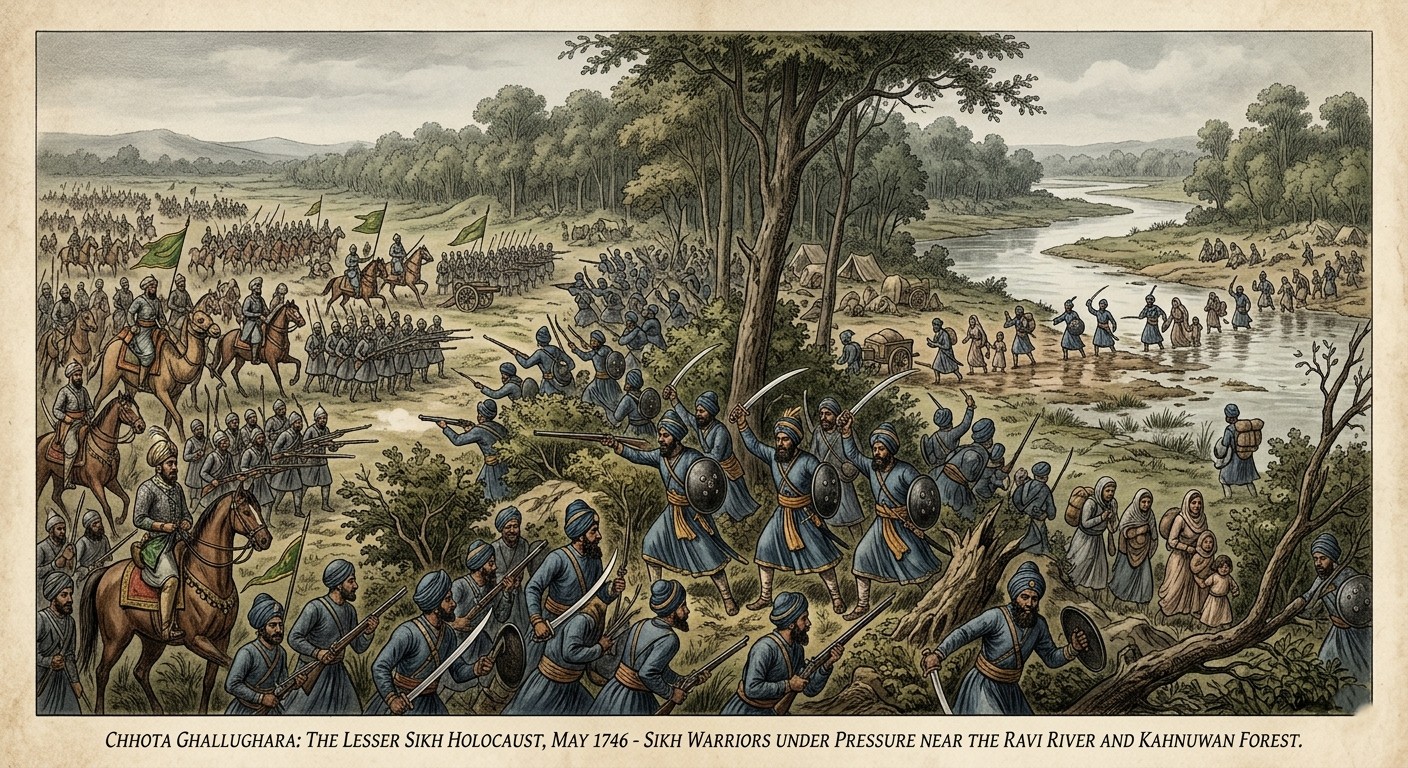
May 1746 CE: Chhota Ghallughara (The Lesser Holocaust) – Persecution, Survival, and the Resilience of the Khalsa
The year 1746 occupies a painful yet profoundly important place in Sikh history. Known as the Chhota Ghallughara, or the Lesser Holocaust, the massacre represented one of the darkest episodes endured by the Sikh community during the eighteenth century. In May 1746, Mughal forces led by Lakhpat Rai launched a relentless campaign against the Sikhs, culminating in the mass killing of thousands in and around the forests and marshlands of Kahnuwan near Gurdaspur. Historical estimates vary, but many accounts suggest that between 7,000 and 10,000 Sikhs were killed during the operation, while thousands more were captured, imprisoned, and executed. The tragedy occurred during a period when the Sikhs, already weakened by decades of persecution following the martyrdom of Banda Singh Bahadur and his companions, struggled to survive amidst relentless state-sponsored violence. Yet, despite the immense loss of life, Chhota Ghallughara ultimately became a defining moment of resilience. The massacre failed to destroy the Sikh Panth. Instead, it strengthened Sikh identity, deepened communal solidarity, and reinforced the conviction that faith, justice, and freedom were worth defending at any cost.
As a Sikh historian, one must approach the Chhota Ghallughara not simply as a story of victimhood but as a chapter that reveals the extraordinary endurance of a community facing systematic attempts at eradication. The massacre emerged from a complex political environment characterized by Mughal decline, regional instability, and growing Sikh resistance. Although the immediate consequences were devastating, the long-term impact was quite different. The memory of those who perished became a source of inspiration, shaping Sikh consciousness and contributing to the eventual rise of Sikh power in Punjab. The tragedy serves as a reminder that the survival of the Sikh community was not inevitable but was achieved through immense sacrifice and unwavering commitment to the principles established by the Gurus.
The Political Landscape of Punjab in the Mid-Eighteenth Century
To understand the origins of the Chhota Ghallughara, it is essential to examine the political conditions prevailing in Punjab during the decades following the execution of Banda Singh Bahadur in 1716. The Mughal Empire, though still formally dominant, was experiencing significant decline. Imperial authority weakened as regional governors pursued their own interests, military resources became stretched, and administrative control deteriorated across large areas of northern India.
At the same time, the Sikh community was undergoing a remarkable transformation. Despite severe persecution, the Khalsa survived and gradually rebuilt itself. Small groups of Sikhs operated throughout Punjab, maintaining religious practices, preserving communal institutions, and defending local populations from oppression. These groups frequently lived in forests, deserts, and remote regions to avoid detection by hostile authorities.
For Mughal officials, the persistence of Sikh resistance represented a continuing challenge. Although they had executed Banda Singh Bahadur and many of his followers, the movement had not disappeared. Instead, it adapted and evolved, becoming increasingly decentralized and difficult to suppress. This situation created an atmosphere of tension and confrontation that ultimately contributed to the events of 1746.
The Rise of Lakhpat Rai
Among the most significant figures associated with the Chhota Ghallughara was Lakhpat Rai, a powerful Mughal official in Lahore. His hostility toward the Sikhs intensified following the death of his brother, Jaspat Rai, who was killed during a confrontation involving Sikh forces. The incident transformed a political conflict into a deeply personal vendetta.
Lakhpat Rai responded with extraordinary determination. He vowed to eliminate the Sikh community and employed the resources of the provincial administration to pursue this objective. His campaign extended beyond military operations and included efforts to suppress Sikh religious practices and symbols.
The determination displayed by Lakhpat Rai reflected broader patterns of persecution that had characterized relations between Sikh communities and certain Mughal authorities for decades. Yet the intensity of his campaign would elevate it into one of the most severe episodes of violence in Sikh history.
The Sikhs in Hiding
By the mid-1740s, many Sikhs lived under extremely difficult conditions. Continuous persecution forced them to seek refuge in forests, jungles, hills, and marshlands. Large permanent settlements were often impossible because of the risk of military attacks. Instead, Sikh groups developed highly mobile lifestyles that allowed them to evade capture while maintaining communal cohesion.
The forests of Kahnuwan became one of the important refuges for Sikh populations. Dense vegetation, difficult terrain, and limited accessibility provided a degree of protection against hostile forces. However, these same features could also become traps if large military forces succeeded in surrounding the area.
The Sikhs who inhabited these regions were not merely hiding from danger. They continued practicing their faith, organizing their communities, and preserving the traditions of the Khalsa. Their determination ensured that Sikh identity survived despite relentless attempts at suppression.
The Decision to Launch a Major Campaign
Determined to eradicate Sikh resistance, Lakhpat Rai organized a large-scale military operation targeting Sikh concentrations in the Kahnuwan region. Mughal forces were assembled from multiple sources and coordinated with local allies familiar with the terrain.
The objective was straightforward but devastating: surround the Sikh groups, prevent escape, and eliminate as many individuals as possible. Unlike conventional military campaigns aimed at defeating organized armies, this operation targeted a broader population that included non-combatants alongside fighters.
The scale of preparation reflected the seriousness with which Mughal authorities viewed the Sikh presence. They hoped that a decisive operation would finally end Sikh resistance and restore uncontested control over the region.
The Marshes and Forests of Kahnuwan
The geography of Kahnuwan played a crucial role in the events of 1746. The area consisted of dense forests, marshlands, and difficult terrain that had long provided refuge for Sikhs seeking safety from persecution. These natural features made military operations challenging but also created significant risks for those trapped within them.
As Mughal forces advanced, the Sikhs found themselves increasingly constrained. Escape routes narrowed, supplies became difficult to secure, and the possibility of organized resistance diminished. The very landscape that had previously offered protection now contributed to the unfolding tragedy.
The forests and marshes of Kahnuwan would become permanently associated with one of the most traumatic events in Sikh memory.
The Chhota Ghallughara Begins
In May 1746, Mughal forces launched their assault. Sikh groups attempting to evade encirclement encountered overwhelming opposition. Fighting erupted across the region as the Khalsa sought to protect families, maintain cohesion, and find avenues of escape.
The confrontation quickly evolved into a massacre. The numerical superiority of the Mughal forces, combined with their ability to coordinate operations across a wide area, placed the Sikhs at a severe disadvantage. Thousands were killed during the pursuit and subsequent engagements.
Historical estimates vary, but many traditional and scholarly accounts suggest that between 7,000 and 10,000 Sikhs lost their lives during the campaign. Thousands more were captured and later subjected to imprisonment or execution.
The Human Cost of the Massacre
The human consequences of the Chhota Ghallughara were immense. Entire families were affected by the violence. Communities that had already endured decades of persecution suffered another devastating blow. The loss of so many lives created profound grief and uncertainty throughout the Sikh population.
Yet the tragedy extended beyond numerical estimates. Each victim represented a unique individual with personal relationships, aspirations, and contributions to the community. The massacre disrupted social networks, weakened local institutions, and left lasting emotional scars.
For surviving Sikhs, the experience reinforced the reality that their faith carried significant risks but also deepened their commitment to preserving the values for which so many had sacrificed.
The Capture and Execution of Prisoners
Not all victims of the Chhota Ghallughara died during the initial assault. Many Sikhs were captured and transported to urban centers where public executions were conducted. These spectacles were intended to intimidate the broader population and discourage future resistance.
Historical narratives emphasize the remarkable courage displayed by many prisoners. Despite facing certain death, they remained committed to their beliefs and refused to abandon their identity. Their conduct reflected a tradition of martyrdom that stretched back through the sacrifices of Guru Arjan Dev Ji, Guru Tegh Bahadur Ji, Banda Singh Bahadur, and countless others.
The executions therefore became not only acts of repression but also powerful demonstrations of spiritual resilience.
Theological Meaning Within Sikh Tradition
Within Sikh historical consciousness, the Chhota Ghallughara occupies a place comparable to other major episodes of collective suffering. It is remembered not simply as a military defeat but as a test of faith and commitment. The victims are honored as martyrs who remained steadfast under extraordinary circumstances.
Sikh theology places significant emphasis on the concept of accepting hardship while remaining devoted to truth and justice. The events of 1746 are often interpreted through this lens. The suffering endured by the victims is viewed as part of a larger narrative of resistance against oppression.
This perspective has contributed to the enduring significance of the Chhota Ghallughara within Sikh memory.
The Failure of the Mughal Objective
Although the Mughal campaign inflicted devastating losses, it ultimately failed to achieve its central objective. The Sikh community survived. New leaders emerged, institutions adapted, and the spirit of resistance continued.
The inability of Mughal authorities to eliminate the Sikhs reflected the resilience of the Khalsa and the decentralized nature of Sikh organization. Even when individual groups were destroyed, the broader movement endured through networks of faith, kinship, and shared identity.
In many respects, the Chhota Ghallughara demonstrated the limits of coercion. Military force could kill individuals, but it could not eradicate deeply held beliefs.
The Reorganization of the Sikh Community
Following the massacre, surviving Sikhs undertook the difficult task of rebuilding their communities. This process required extraordinary determination. Leaders worked to restore communication, reorganize defensive capabilities, and provide support for affected families.
The experience reinforced the importance of collective institutions and mutual assistance. Sikh groups became increasingly adept at adapting to changing circumstances and responding to threats. These developments would prove crucial in subsequent decades.
The lessons learned from the Chhota Ghallughara contributed significantly to the evolution of Sikh political and military organization.
From Persecution to Power
One of the most remarkable aspects of Sikh history is the transformation that occurred in the decades following repeated episodes of persecution. Despite enduring massacres, executions, and military campaigns, the Sikhs gradually expanded their influence throughout Punjab.
The eighteenth century witnessed the emergence of the Misls, confederacies that combined military effectiveness with local governance. These organizations drew strength from traditions of resilience forged during periods of hardship such as the Chhota Ghallughara.
Eventually, the foundations established by these developments contributed to the rise of the Sikh Empire under Maharaja Ranjit Singh. Thus, a community targeted for destruction became a major political force within a few generations.
Remembering the Martyrs
The memory of those who perished during the Chhota Ghallughara continues to occupy an important place in Sikh historical consciousness. Their sacrifices are remembered not only as evidence of suffering but also as examples of courage, commitment, and faith.
Commemorations, historical writings, and oral traditions ensure that the experiences of 1746 remain part of the collective memory of the Panth. These acts of remembrance connect contemporary Sikhs with earlier generations and reinforce awareness of the sacrifices that contributed to the survival of the community.
The martyrs of Kahnuwan are therefore remembered not as passive victims but as individuals whose endurance helped shape the future of Sikh history.
The Historical Legacy of Chhota Ghallughara
The Chhota Ghallughara remains one of the defining tragedies of the eighteenth century. It illustrates the severity of the persecution faced by Sikhs during the decline of Mughal authority while also highlighting the extraordinary resilience of the Khalsa. The massacre revealed the lengths to which opponents would go in attempting to suppress Sikh identity, but it also demonstrated the inability of violence to destroy a community united by faith and shared purpose.
The lessons of 1746 extend beyond Sikh history. They speak to broader themes concerning human dignity, religious freedom, resistance to oppression, and the capacity of communities to survive immense adversity. The story of the Chhota Ghallughara remains relevant because it illustrates both the destructive potential of intolerance and the enduring power of resilience.
Conclusion
The Chhota Ghallughara of May 1746 stands as one of the most tragic yet inspiring chapters in Sikh history. Under the leadership of Lakhpat Rai, Mughal forces launched a massive campaign against Sikhs sheltering in the forests and marshes of Kahnuwan, resulting in the deaths of an estimated 7,000 to 10,000 individuals and the capture of many more. The massacre inflicted profound suffering upon the Sikh community, yet it failed to achieve its ultimate objective. Rather than disappearing, the Sikhs emerged from the tragedy with renewed determination and a strengthened sense of identity. The sacrifices of those who perished became a source of inspiration for future generations, contributing to the eventual rise of Sikh political power across Punjab. Today, the Chhota Ghallughara remains a powerful reminder of the resilience of the Khalsa and the enduring commitment of Sikhs to faith, justice, and freedom.
Frequently Asked Questions (FAQ)
1. What does Chhota Ghallughara mean?
Chhota Ghallughara means “The Lesser Holocaust” and refers to the mass killing of Sikhs in May 1746.
2. When did the Chhota Ghallughara occur?
The massacre took place in May 1746 during a major Mughal campaign against the Sikhs.
3. Who led the Mughal forces?
The operation was directed by Lakhpat Rai, a powerful Mughal official in Lahore.
4. Where did the massacre occur?
It occurred primarily in the forests and marshlands of Kahnuwan near Gurdaspur in Punjab.
5. How many Sikhs were killed?
Historical estimates generally range between 7,000 and 10,000 Sikh deaths.
6. Why were the Sikhs living in forests and marshes?
Continuous persecution forced many Sikhs to seek refuge in remote areas to avoid arrest and execution.
7. Were Sikhs captured during the campaign?
Yes. Thousands were captured and many were later executed by Mughal authorities.
8. Did the massacre destroy the Sikh community?
No. Despite devastating losses, the Sikh community survived and eventually grew stronger.
9. Why is Chhota Ghallughara important in Sikh history?
It symbolizes both the severity of persecution faced by Sikhs and the extraordinary resilience of the Khalsa.
10. How is the Chhota Ghallughara remembered today?
It is commemorated as a major tragedy and as a testament to the courage, faith, and sacrifice of the Sikh martyrs who perished in 1746.