Sikh Legends · Origins & Gurus · Guru Arjan Dev Ji · Guru Hargobind Sahib Ji
Mian Mir
A close friend of the Guru who was invited to lay the foundation stone of the Harmandir Sahib in Amritsar. He later offered to intercede during the Guru's torture, but the Guru asked him to accept God's Will.
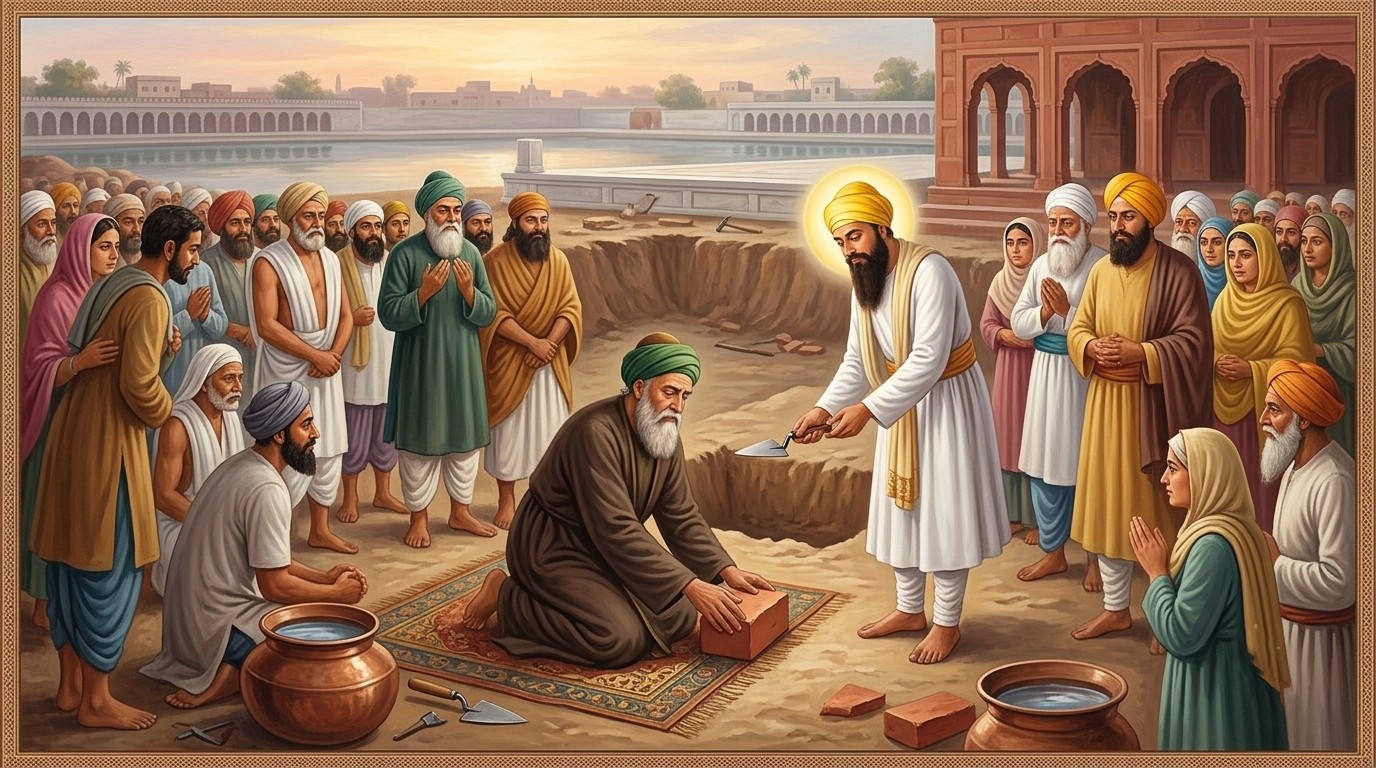
Mian Mir and Guru Arjan Dev ji
In the sixteenth and seventeenth centuries, the dusty plains of Punjab became the crucible for a remarkable spiritual revolution. While the ruling elites of the Mughal Empire asserted their temporal authority through military conquest, land administration, and institutionalized taxation, a parallel, quiet sovereignty was taking root among the masses. This parallel authority was built not upon the sword of conquest, but upon the shared mystical language of the Sikh Gurus and the Sufi dervishes. At the absolute center of this cross-religious synthesis stood the profound friendship between Hazrat Mian Mir, a highly revered Sufi saint of the Qadiriyya order, and Guru Arjan Dev Ji, the fifth spiritual sovereign of the Sikhs. For a modern Sikh historian, examining the relationship between these two giant souls is not merely a study in historical interfaith diplomatic relations; it is an investigation into a shared metaphysical plane. It reveals how the early Sikh Panth actively engaged with the broader Islamic world, recognizing the common thread of the formless Divine (referred to as Akal Purakh in Gurmat and Allah in Sufism) while maintaining the distinct, uncompromised sovereignty of Guru Nanak's theological revelation.
Hazrat Mian Mir, born Mir Mohammed Muayyinul Islam in 1550 in Sindh, migrated to Lahore in his youth to seek higher spiritual learning and eventually established himself in the neighborhood of Dharampura. Unlike the orthodox state-sponsored clergy (the Qazis and Mullas) who sought political patronage and enforced strict social and religious segregation, Mian Mir championed the path of absolute detachment, deep meditation, and radical humility. He was a master of the Qadiriyya Sufi silsila, which emphasized the direct, experiential realization of God through love and self-effacement. This theological approach aligned perfectly with the Gurmat philosophy established by Guru Nanak, which rejected ritualistic externalism, caste hierarchies, and clerical mediation in favor of direct union with the Creator through the remembrance of the Divine Word (Naam Simran). When Guru Arjan Dev Ji ascended the spiritual throne of the Sikhs in 1581, his court in Amritsar and his travels in Lahore naturally drew him to Mian Mir. The two spiritual masters immediately recognized each other as kindred spirits, initiating a multi-decade friendship that would fundamentally shape the history, architecture, and martyrdom narrative of the early Sikh nation.
The Cornerstone of Universalism: Laying the Foundation of Sri Harmandir Sahib (1589)
The physical manifestation of this deep spiritual alliance occurred in the winter of 1589 during a moment that defined the architectural and theological identity of the Sikh faith. Guru Arjan Dev Ji was in the process of designing and constructing Sri Harmandir Sahib (later known to the world as the Golden Temple) in the center of the holy pool of Amritsar. Unlike the temples of the Hindus, which were traditionally built on elevated platforms with a single entrance reserved for the high castes, the Guru designed the Harmandir Sahib to be built at a level lower than the surrounding ground, requiring devotees to step down in humility to enter. Furthermore, he designed the sanctum to have four doors, facing North, South, East, and West, symbolizing that the sanctuary was open to all four castes and all religions of the world. To cement this radical vision of universal brotherhood, Guru Arjan Dev Ji sent a special delegation of Sikhs to Lahore to invite his close friend, the Sufi dervish Hazrat Mian Mir, to lay the foundation stone (Pani or Mehar) of the temple.
On the historic day of the foundation ceremony, Hazrat Mian Mir traveled from Lahore to the sacred pool of Amritsar. Surrounded by thousands of devout Sikhs and under the direct guidance of Guru Arjan Dev Ji, the Sufi saint stepped into the excavated muddy bed of the pool and placed the very first brick of the foundation. While some later chroniclers have debated the exact administrative logistics of this event—proposing alternative accounts where the Guru himself laid the brick—the enduring, mainstream historical memory within the Sikh Panth has always celebrated Mian Mir's involvement as an absolute historical truth. This act was a calculated, brilliant theological statement by Guru Arjan Dev Ji. By having a renowned Muslim saint lay the foundation stone of the central shrine of Sikhism, the Guru was declaring that the house of Nanak did not belong to any single community, tribe, or religious sect. The brick laid by Mian Mir was not merely a physical piece of clay; it was the cornerstone of a pluralistic, sovereign spiritual commonwealth that challenged the sectarian and exclusionary political climate of medieval India.
The Dialogue of the Mystics: Spiritual Discourse in Lahore and Amritsar
Throughout the final decades of the sixteenth century, the interaction between Guru Arjan Dev Ji and Hazrat Mian Mir flourished through frequent visits and deep, philosophical dialogues. The Guru spent significant periods of time in Lahore, particularly during the construction of the Baoli (stepped well) at Dabbi Bazaar and during times of famine, when he organized intensive relief work for the suffering population. During these visits, the Guru and Mian Mir would spend hours in quiet contemplation and theological discussion at Mian Mir's hermitage. These conversations were recorded in the memory of their close disciples and eventually found their way into later Sikh historical texts, such as the Gur Bilas and the Suraj Parkash. The central theme of their discussions was the absolute surrender of the human ego to the Divine Will, a concept known as Raza in Sufi terminology and Bhana in Gurmat theology.
Despite their deep mutual affection and shared appreciation for spiritual internalization, the historical records show that both masters maintained a clear, honest understanding of the distinct paths they represented. Guru Arjan Dev Ji’s philosophy was anchored in the householder’s path (Garihasth Jeevan), which rejected the radical monastic asceticism practiced by many Sufis. The Guru taught that true spiritual liberation was to be achieved while living actively in the world—earning an honest living, raising a family, and serving the community. Mian Mir, though an ascetic himself, deeply respected this aspect of the Guru’s teaching, recognizing that the Sikh community was establishing a brand-new social paradigm that successfully integrated mystical absorption with social responsibility. Their relationship demonstrated that true interfaith dialogue does not require the dilution of one's unique identity; rather, it is built upon a profound, mutual recognition of the divine light operating within different historical frameworks.
The Gathering Storm: Political Transition and the Martyrdom of the Fifth Sovereign
The peaceful, constructive era of early Sikh institutional development came to an abrupt, tragic end with the death of Mughal Emperor Akbar in 1605. Akbar had practiced a policy of religious tolerance (Sulh-i-kul) and had even visited Guru Arjan Dev Ji at Goindwal, expressing deep admiration for the Guru's spiritual compilation of the Adi Granth and the egalitarian institution of Langar. However, Akbar's successor, Emperor Jahangir, was highly insecure and sought the political support of the orthodox Islamic revivalist factions, led by figures like Shaikh Ahmad Sirhindi of the Naqshbandi order, who viewed the rapid growth of the Sikh movement with intense hostility. In his personal memoirs, the Tuzuk-i-Jahangiri, Jahangir explicitly recorded his paranoia regarding Guru Arjan Dev Ji, writing that the Guru "had captured many of the simple-hearted Hindus, and even of the ignorant and foolish followers of Islam, by his ways and manners," and that he had long wanted to "put a stop to this vain affair or bring him into the assembly of the people of Islam."
Using the false pretext that Guru Arjan Dev Ji had blessed the rebel prince Khusrau during his flight through Punjab, Jahangir ordered the Guru’s immediate arrest and the confiscation of his property. The Guru was brought to Lahore, where he was handed over to the provincial governor and the imperial diwan, Chandu Shah. Over a period of five agonizing days in the scorching heat of May 1606, Guru Arjan Dev Ji was subjected to brutal, inhuman torture. He was made to sit on a red-hot iron plate, burning sand was poured over his naked body, and he was boiled in a massive copper cauldron. This systematic torture was designed not only to execute the Guru but to break his spirit, forcing him to either renounce his faith, accept Islam, or alter the hymns of the Adi Granth to please the imperial court. Throughout this ordeal, the Guru remained completely serene, his mind anchored in the continuous remembrance of the formless Creator.
The Searing Encounter: Mian Mir’s Tears and the Offer of Intercession
As the news of the Guru’s horrific torture spread through the streets of Lahore, Hazrat Mian Mir was filled with profound shock and overwhelming grief. Unable to bear the agony of his beloved friend, the Sufi saint rushed to the site of the torture. When he arrived, he was confronted with a sight that broke his heart: the physical body of Guru Arjan Dev Ji was covered in massive, weeping blisters, the skin blackened by the hot sand and the searing iron plates. Tears streamed down the face of the aged Sufi master as he looked at the Guru. Mian Mir, who was believed by his followers to possess immense spiritual powers (Karamat) and high mystical influence, cried out in anguish, asking the Guru for permission to intercede. Mian Mir declared that he could no longer stand by and watch this cruelty, offering to invoke his spiritual powers to destroy the city of Lahore, overthrow the tyrannical Mughal oppressors, and bring down the imperial court of Jahangir.
This moment is one of the most dramatically charged and philosophically profound standoffs in the history of religion. On one side stood the Sufi saint, representing the natural human impulse to respond to injustice and suffering through the deployment of defensive spiritual power. On the other side sat Guru Arjan Dev Ji, serene amid the flames, representing the ultimate, unshakeable pinnacle of spiritual sovereignty. The Guru looked at the weeping saint with absolute compassion and calmly declined his offer of intercession. He asked Mian Mir to look up at the heavens. According to historical tradition, the Guru granted Mian Mir a spiritual vision, revealing that the angels of heaven were weeping at the sight, and that the cosmic forces were fully prepared to destroy the oppressors at a single command from the Guru. Yet, the Guru remained completely still, choosing instead to voluntarily undergo the torture to establish an eternal, revolutionary standard of faith and surrender for the generations to follow.
The Sweetness of the Flame: The Divine Philosophy of accepting God's Will
With absolute poise, Guru Arjan Dev Ji delivered a spiritual lesson to Hazrat Mian Mir that redefined the theological boundary of human endurance. The Guru recited his own divine verse, which would become the eternal anthem of the Sikh martyrs: "Tera Kiya Meetha Lage, Har Nam Padarth Nanak Mange" (Thy Will is sweet to me; Nanak begs only for the treasure of the Divine Name). The Guru explained to the Sufi master that the physical body is merely a temporary vessel, subject to decay, pain, and death, but the soul is eternal and untouched by fire or water. He explained that if he were to use supernatural powers or political manipulation to escape his fate, he would be violating the fundamental spiritual law of *Bhana*—the unconditional acceptance of the Divine Will.
For a Sikh historian, the Guru's discourse to Mian Mir is a critical turning point in the evolution of the Sikh Panth. The Guru was teaching that true spiritual power lies not in the performative exhibition of miracles to escape suffering, but in the internal strength to accept whatever God ordains with joy and equanimity. He explained that the seed of the Sikh faith needed to be watered by the blood of its leader to grow into a mighty, unshakeable tree that could withstand the storms of future political tyranny. By accepting the torture without a single cry of pain or anger, the Guru was demonstrating the complete victory of the spirit over the flesh. Shaken by the depth of the Guru's wisdom, Hazrat Mian Mir bowed his head in absolute surrender to the Guru’s words, realizing that he was witnessing a spiritual state that transcended even the highest reaches of Sufi mysticism.
The Confluence of Divine Will: A Comparative Analysis of Spiritual Paradigms
To help us systematically understand the alignment and subtle differences between the Sufi concept of surrender and the Sikh doctrine of accepting the Divine Will as demonstrated during this historic encounter, let us examine the following matrix:
| Theological Dimension | The Sufi Qadiriyya Paradigm (Raza / Fana) | The Gurmat Sikh Paradigm (Bhana / Hukam) |
| Primary Objective | Annihilation of the individual self (Fana) in the divine essence through mystical love. | Living in active, continuous alignment with the cosmic order (Hukam) as a householder. |
| Response to Suffering | Patience (Sabr) and passive acceptance of trials sent by the Beloved. | Active, joyful embrace of the Divine Will (Bhana) as inherently sweet and purposeful. |
| View on Miracles (Karamat/Parcha) | Recognized as a valid manifestation of spiritual proximity, though sometimes warned against. | Rejected as an act of egoistic interference with the perfect, natural laws of the Creator. |
| Socio-Political Stance | Varying from complete monastic withdrawal to quietist advice to temporal rulers. | Active resistance to tyranny, defense of human rights, and building sovereign institutions. |
| Ultimate Symbolism in Martyrdom | The mystic's ecstatic union with God, often viewed through the lens of romantic longing. | The ultimate sacrifice for the preservation of truth, justice, and the sovereignty of the Word. |
The Living Legacy: Nurturing the Sixth Throne and Post-Martyrdom Alliances
On May 30, 1606, after days of systematic torture, Guru Arjan Dev Ji was taken to the banks of the River Ravi, which then flowed near the Lahore Fort. He took a dip in the cold waters, recited the *Japji Sahib*, and quietly left his physical frame, his soul merging into the eternal light of the Creator. The martyrdom of the Fifth Sovereign marked an immediate, dramatic paradigm shift within the Sikh Panth. As his son, Guru Hargobind Sahib, ascended the spiritual throne at the age of eleven, he wore the two swords of *Miri* (temporal authority) and *Piri* (spiritual authority), formally establishing an armed, sovereign force to defend the weak and resist imperial oppression. Throughout this intense transition, Hazrat Mian Mir remained a staunch defender and close counselor of the young Sixth Guru, acting as a critical political and spiritual buffer between the Sikh court and the Mughal administration in Delhi.
When Jahangir imprisoned the young Guru Hargobind Sahib in the Gwalior Fort out of fear of his rising military power, it was Hazrat Mian Mir who used his immense spiritual influence over the Emperor to advocate for the Guru's release. Mian Mir constantly reminded Jahangir of the great injustice committed against Guru Arjan Dev Ji, warning him that the spiritual health of his empire was in grave danger if he continued to persecute the house of Guru Nanak. His intercession was pivotal in securing the release of Guru Hargobind Sahib alongside fifty-two captive Rajput kings—an event celebrated by Sikhs globally as *Bandi Chhor Divas*. Until his passing in 1635, Mian Mir maintained a relationship of profound reverence with Guru Hargobind Sahib, proving that the bond forged in the mud of the Harmandir Sahib and the fire of Lahore was eternal, transcending the temporary political and religious divisions of the world.
My dear young friends, the story of Hazrat Mian Mir and Guru Arjan Dev Ji is a powerful, urgent message for our contemporary world. Today, we live in a fragmented society where religious differences are often exploited to construct high walls of hatred, prejudice, and political polarization. In the midst of this darkness, the image of the Sufi saint laying the foundation of the Golden Temple stands as a brilliant beacon of hope and universalism. It teaches us that true strength lies not in building high walls to exclude others, but in opening our doors in all four directions to welcome humanity. It challenges us to build our lives upon the unshakeable foundation of *Bhana*—cultivating the internal resilience to face the fires and hot plates of modern life with grace, humility, and an absolute, ecstatic surrender to the Divine Will. Let us honor the legacy of this divine friendship by standing firmly in our own values, while remaining forever ready to stretch out our hands in love and solidarity to our brothers and sisters of all faiths.
Frequently Asked Questions
1. Who was Hazrat Mian Mir, and what was his religious background?
Hazrat Mian Mir (1550–1635) was a highly revered Muslim Sufi saint belonging to the Qadiriyya order. Born in Sindh, he spent most of his life in Lahore (modern-day Pakistan), where he became famous for his asceticism, deep spiritual realization, and absolute detachment from worldly wealth and political power. He was a close friend of both Guru Arjan Dev Ji and Guru Hargobind Sahib.
2. Why did Guru Arjan Dev Ji invite Mian Mir to lay the foundation stone of the Harmandir Sahib?
Guru Arjan Dev Ji designed the Harmandir Sahib (Golden Temple) as a universal shrine open to people of all castes, creeds, and religions. To visually and historically cement this radical vision of universal brotherhood, he invited his close friend, the Muslim Sufi saint Hazrat Mian Mir, to lay the foundation stone in 1589, demonstrating that the house of Nanak was open to all of humanity.
3. Where is the foundation stone laid by Mian Mir located today?
The foundation stone laid by Hazrat Mian Mir is located at the lowest level of the sanctum sanctorum of Sri Harmandir Sahib in Amritsar, Punjab, India. It remains the physical and spiritual anchor of the entire temple complex, symbolizing the eternal interfaith foundation of the Sikh path.
4. What is the historical debate regarding who laid the foundation stone of the Harmandir Sahib?
While mainstream Sikh tradition and classical historical texts (such as later chroniclers and the SGPC records) strongly state that Hazrat Mian Mir laid the foundation stone, some early accounts suggest that Guru Arjan Dev Ji himself may have laid it. However, the involvement of Mian Mir is universally celebrated in Sikh discourse as a powerful symbol of the interfaith synthesis and universalism of Guru Nanak's court.
5. Why was Guru Arjan Dev Ji arrested and tortured by Emperor Jahangir?
Guru Arjan Dev Ji was arrested under the orders of Emperor Jahangir, who was deeply paranoid about the rapid growth and parallel socio-political sovereignty of the Sikh Panth. Using the false excuse that the Guru had assisted his rebel son, Prince Khusrau, Jahangir ordered the Guru's arrest, the confiscation of his property, and his execution under the supervision of Chandu Shah in Lahore in 1606.
6. What did Hazrat Mian Mir offer to do when he visited the Guru during his torture?
When Hazrat Mian Mir saw the horrific torture of Guru Arjan Dev Ji—who was made to sit on hot iron plates and had hot sand poured over his body—he was filled with immense grief and tears. Mian Mir offered to use his spiritual powers (Karamat) to destroy the city of Lahore and overthrow the Mughal oppressors to end the Guru's suffering.
7. What was Guru Arjan Dev Ji’s response to Mian Mir’s offer of intercession?
Guru Arjan Dev Ji calmly declined Mian Mir's offer. He explained that using supernatural powers to escape physical pain would violate the fundamental spiritual principle of *Bhana* (accepting the Divine Will). He told Mian Mir that the physical body is temporary and that he accepted the torture as the sweet will of the Creator, reciting: "Tera Kiya Meetha Lage" (Thy Will is sweet to me).
8. What is the difference between the Sufi concept of "Raza" and the Sikh concept of "Bhana"?
While both concepts emphasize surrender to the Divine Will, Sufi *Raza* is often associated with passive, patient endurance (Sabr) and the mystical annihilation of the ego in God's love. Sikh *Bhana*, on the other hand, is an active, joyful alignment with the cosmic order (Hukam) while living as an engaged householder, accepting life's challenges as purposeful and sweet without resorting to miracles to change them.
9. How did Mian Mir assist Guru Hargobind Sahib after the martyrdom of Guru Arjan Dev Ji?
Hazrat Mian Mir maintained a close, protective relationship with the sixth Guru, Guru Hargobind Sahib. When the Emperor Jahangir imprisoned the young Guru in the Gwalior Fort, Mian Mir used his immense spiritual influence over the Emperor to secure the Guru's release, paving the way for the historic release of the Guru and fifty-two Rajput kings on Bandi Chhor Divas.
10. What is the modern relevance of the friendship between Mian Mir and Guru Arjan Dev Ji?
The friendship serves as an eternal blueprint for interfaith harmony, mutual respect, and religious pluralism. In a world marked by religious polarization, their relationship proves that different faith communities can stand firmly in their unique identities while uniting on a shared plane of love, service, and the defense of human dignity against tyranny.
Guru Arjan Dev Ji (1563–1606)
A close friend of the Guru who was invited to lay the foundation stone of the Harmandir Sahib in Amritsar. He later offered to intercede during the Guru's torture, but the Guru asked him to accept God's Will.
- Role
- Sufi Saint
- Group
- Interfaith & Spiritual Figures
- Period
- Guru Arjan Dev Ji (1563–1606)
Guru Hargobind Sahib Ji (1595–1644)
Maintained a deep spiritual friendship with the Guru, as he had with his father. He played a key role in advocating for the Guru's release from Gwalior Fort.
- Role
- Sufi Saint
- Group
- Interfaith Relations & Mystics
- Period
- Guru Hargobind Sahib Ji (1595–1644)