Sikh Legends · Empire & Struggle
Nawab Kapur Singh
The foundational architect of the Dal Khalsa. He provided crucial leadership during the darkest hours of Sikh history, unifying scattered guerilla bands into the Buddha Dal and Taruna Dal, organizing the 18th Century Sikh Misls, and demonstrating unparalleled grace and diplomacy.
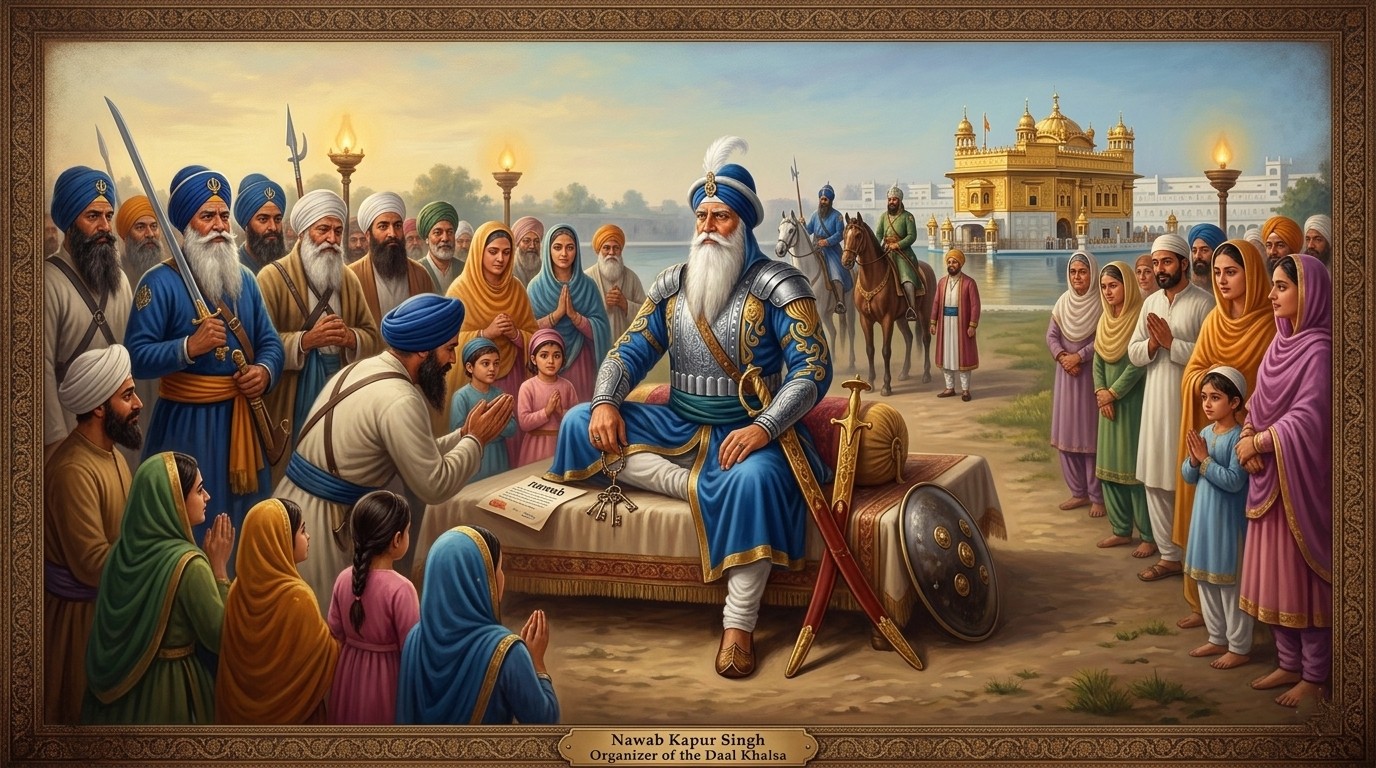
Nawab Kapur Singh: The Foundational Architect of the Dal Khalsa and the Survival of the Sikh Nation
Among the towering figures who shaped the destiny of the Sikh Panth during its most vulnerable century, few possess the historical significance of Nawab Kapur Singh. While later generations would celebrate the military brilliance of Jassa Singh Ahluwalia, the statecraft of Maharaja Ranjit Singh, and the extraordinary sacrifices of Baba Deep Singh Ji and countless martyrs, it was Nawab Kapur Singh who stood at the critical crossroads between survival and extinction. At a time when the Sikh community faced systematic persecution, relentless military campaigns, and repeated attempts at annihilation by the Mughal administration, he emerged as the leader who transformed scattered bands of hunted warriors into a disciplined, organized, and resilient national force. His achievements were not merely military. They were institutional, administrative, diplomatic, and spiritual. Without Nawab Kapur Singh, it is difficult to imagine how the Sikh community could have evolved from fragmented guerrilla groups into the powerful confederacy that would eventually dominate Punjab.
The story of Nawab Kapur Singh is not simply the biography of an individual. It is the story of how a persecuted people reorganized themselves under visionary leadership. His life illuminates one of the most remarkable chapters in South Asian history: the transformation of the Khalsa from a hunted minority into a sovereign political force. He achieved this not through personal ambition or dynastic aspirations, but through humility, collective decision-making, and unwavering commitment to the principles established by Guru Gobind Singh Ji. As a historian examining the eighteenth century, one repeatedly encounters the fingerprints of Nawab Kapur Singh upon nearly every major institutional development that ensured Sikh survival.
The Historical Landscape After Guru Gobind Singh Ji
To understand the significance of Nawab Kapur Singh, one must first appreciate the desperate circumstances confronting the Sikhs in the early eighteenth century. Following the passing of Guru Gobind Singh Ji in 1708 and the subsequent martyrdom of Banda Singh Bahadur in 1716, the Sikh community entered one of the darkest periods in its history. Mughal authorities viewed the Khalsa as a direct threat to imperial stability. Successive governors of Lahore and regional administrators launched systematic campaigns to eliminate Sikh influence from Punjab.
Rewards were offered for Sikh heads. Entire villages suspected of providing shelter to Sikhs were punished. Public executions became commonplace. The forests of Punjab, the deserts of Rajasthan, and the remote hills of the Shivaliks became sanctuaries for those who refused to abandon their faith. Sikh families lived under constant threat, often separated for years at a time. The community existed in a state of perpetual mobility, surviving through remarkable adaptability and resilience.
It was during this era of persecution that the need for coherent leadership became increasingly urgent. The Khalsa remained spiritually united through the teachings of the Gurus, but organizationally it was fragmented into numerous independent jathas, or armed bands. While these groups displayed immense courage and determination, their lack of centralized coordination limited their effectiveness. The emergence of Nawab Kapur Singh provided the solution that Sikh history desperately required.
The Early Life of Kapur Singh
Kapur Singh was born in 1697 into a Virk Jat Sikh family in the village of Kaloke near Sheikhupura in Punjab. Raised within a deeply religious environment, he developed a strong commitment to Sikh values from an early age. Like many members of his generation, he grew up witnessing the profound sacrifices made by the Sikh community. The memory of Guru Gobind Singh Ji's struggles, the martyrdom of the Sahibzadas, and the execution of Banda Singh Bahadur profoundly shaped his worldview.
What distinguished Kapur Singh was not merely physical bravery but an exceptional capacity for leadership. Contemporary and near-contemporary accounts consistently describe him as possessing extraordinary judgment, patience, and diplomacy. Unlike many military commanders whose influence rests solely upon battlefield achievements, Kapur Singh excelled at building consensus among fiercely independent leaders. This talent would prove invaluable during a period when Sikh unity was essential for survival.
His rise within the Khalsa was gradual and rooted in merit. He earned respect through service, wisdom, and personal integrity rather than inheritance or political maneuvering. By the 1720s, he had emerged as one of the most trusted leaders among the Sikhs, recognized for his ability to balance military necessity with spiritual responsibility.
The Granting of the Title "Nawab"
One of the most fascinating episodes in Sikh history occurred in 1733 when the Mughal government attempted a policy of reconciliation. Recognizing that decades of persecution had failed to eliminate Sikh resistance, the authorities offered a compromise. The Sikhs were promised a jagir, or land grant, and the honorary title of "Nawab" in exchange for peace.
The offer created considerable debate within the Sikh community. Many remained deeply skeptical of Mughal intentions, given the long history of betrayal and oppression. When the Sarbat Khalsa gathered to deliberate, a remarkable decision was reached. Rather than allowing personal ambition to dominate the discussion, the assembled Sikhs unanimously selected Kapur Singh as the recipient of the title.
What makes this event extraordinary is Kapur Singh's initial reluctance. He did not seek honor or prestige. The title was accepted not as a personal reward but as a strategic instrument for the benefit of the Panth. This episode illustrates one of the defining characteristics of his leadership: an ability to subordinate personal considerations to collective welfare.
Although the truce would eventually collapse and hostilities would resume, the title of Nawab remained attached to Kapur Singh's name. More importantly, the episode enhanced his authority and provided additional legitimacy for the institutional reforms he would soon undertake.
The Creation of the Dal Khalsa
Nawab Kapur Singh's greatest achievement was the creation and organization of the Dal Khalsa. Prior to his reforms, Sikh military activity was conducted through numerous independent groups operating across Punjab. While these bands demonstrated remarkable effectiveness in guerrilla warfare, their lack of coordination limited their ability to respond collectively to large-scale threats.
Kapur Singh recognized that survival required unity without sacrificing flexibility. His solution was revolutionary. He organized the disparate Sikh jathas into a broader confederated structure known as the Dal Khalsa. This arrangement preserved local autonomy while enabling strategic cooperation. It provided the institutional framework necessary for collective decision-making, resource sharing, and coordinated military action.
The significance of this development cannot be overstated. The Dal Khalsa transformed the Sikhs from a loose collection of resistance groups into a coherent national force. It created structures that could survive the deaths of individual leaders and adapt to changing circumstances. In many respects, it represented the earliest foundations of Sikh political organization in the eighteenth century.
The Division into Buddha Dal and Taruna Dal
Perhaps the most innovative aspect of Nawab Kapur Singh's organizational genius was his division of the Dal Khalsa into two principal formations: the Buddha Dal and the Taruna Dal. This reform reflected both practical military considerations and a sophisticated understanding of community dynamics.
The Buddha Dal consisted primarily of veteran warriors and experienced leaders. These men possessed deep knowledge of Sikh traditions, military tactics, and community administration. They served as custodians of religious institutions, protectors of sacred sites, and mentors for younger generations.
The Taruna Dal, by contrast, consisted largely of younger and more mobile warriors. Organized into multiple units, it functioned as the operational arm of the Khalsa, conducting military campaigns, gathering intelligence, and responding rapidly to emerging threats. The youthful energy of the Taruna Dal complemented the wisdom and stability of the Buddha Dal.
This division created an effective balance between continuity and innovation. Experienced elders preserved institutional memory while younger leaders gained opportunities to develop their skills. The model proved remarkably successful and influenced Sikh military organization for decades.
The Birth of the Sikh Misls
As the Sikh population expanded and military activity intensified, Nawab Kapur Singh oversaw another transformative development: the emergence of the Sikh Misls. These confederated political-military units would eventually become the dominant power structures of eighteenth-century Punjab.
The Misls were not simply military organizations. They functioned as regional administrative entities responsible for governance, defense, and economic management. By allowing capable leaders to exercise authority within defined territories while maintaining allegiance to the broader Khalsa community, Kapur Singh created a system that balanced decentralization with unity.
The twelve major Misls that emerged during this period laid the groundwork for Sikh political expansion. Leaders such as Jassa Singh Ahluwalia, Charat Singh Sukerchakia, and others would later build upon the institutional framework established under Kapur Singh's guidance. The eventual rise of the Sikh Empire can be traced directly to these foundational developments.
Leadership During the Darkest Years
The true measure of Nawab Kapur Singh's leadership becomes apparent when examining the crises he navigated. During his lifetime, Sikhs faced repeated campaigns of extermination. Mughal governors such as Zakariya Khan pursued relentless policies aimed at crushing Sikh resistance. Large-scale military expeditions targeted Sikh strongholds, while economic sanctions sought to isolate the community.
Despite these challenges, Kapur Singh maintained unity among leaders with diverse personalities and regional interests. He encouraged collective consultation through the institution of the Sarbat Khalsa, ensuring that major decisions reflected the will of the community rather than the ambitions of individuals. This commitment to shared governance strengthened legitimacy and minimized internal divisions.
His leadership style was characterized by patience and strategic restraint. He understood that survival sometimes required avoiding direct confrontation while waiting for more favorable circumstances. This pragmatic approach preserved Sikh strength during periods when open warfare would have been disastrous.
Diplomacy, Grace, and Moral Authority
One of the most remarkable aspects of Nawab Kapur Singh's career was his ability to combine military resistance with diplomatic sophistication. Unlike many leaders who relied solely upon force, he appreciated the value of negotiation, alliance-building, and political flexibility.
Historical accounts repeatedly emphasize his humility and generosity. He treated allies and rivals alike with dignity, earning respect even from opponents. His moral authority stemmed not from coercion but from personal example. He lived simply, avoided displays of wealth, and consistently prioritized community welfare over personal advancement.
This grace proved particularly important during moments of internal disagreement. The Sikh community was composed of strong-willed individuals accustomed to independence. Maintaining unity under such conditions required exceptional interpersonal skills. Kapur Singh's ability to mediate disputes and foster cooperation remains one of his most underrated achievements.
The Legacy of Nawab Kapur Singh
When Nawab Kapur Singh passed away in 1753, he left behind far more than memories of personal leadership. He left institutions capable of sustaining the Sikh community through future challenges. The Dal Khalsa, the Buddha Dal, the Taruna Dal, and the Misl system all continued to evolve after his death, providing the foundation for Sikh political ascendancy.
His influence can be seen in the victories that followed. The Sikhs would survive the invasions of Ahmad Shah Durrani, expand their territorial control across Punjab, and eventually establish one of the most powerful states in South Asia under Maharaja Ranjit Singh. None of these achievements emerged in isolation. They were built upon structures that Nawab Kapur Singh helped create during an era when survival itself seemed uncertain.
Today, historians increasingly recognize him not merely as a military leader but as one of the greatest institutional architects in Sikh history. He understood that enduring success depends upon strong organizations rather than charismatic individuals alone. His genius lay in creating systems capable of outliving their founder.
Nawab Kapur Singh's life serves as a reminder that the most transformative leaders are often those who build foundations rather than monuments. While others may achieve greater fame through dramatic battles or royal splendor, his contributions were deeper and more enduring. He preserved the Sikh nation during its darkest hour and provided the organizational framework that allowed future generations to flourish. In doing so, he secured an immortal place among the greatest figures in Sikh history.
Frequently Asked Questions About Nawab Kapur Singh
1. Who was Nawab Kapur Singh?
Nawab Kapur Singh was an eighteenth-century Sikh leader who organized the Dal Khalsa, created the Buddha Dal and Taruna Dal, and helped establish the Sikh Misl system.
2. Why is Nawab Kapur Singh important in Sikh history?
He provided crucial leadership during a period of intense persecution and created institutions that ensured the survival and growth of the Sikh community.
3. When was Nawab Kapur Singh born?
He was born in 1697 in the village of Kaloke in Punjab.
4. Why was he given the title of Nawab?
The Mughal government offered the title in 1733 as part of a reconciliation effort, and the Sikh community selected Kapur Singh to receive it on behalf of the Panth.
5. What was the Dal Khalsa?
The Dal Khalsa was a unified Sikh military organization created to coordinate the activities of various Sikh fighting groups across Punjab.
6. What was the difference between the Buddha Dal and Taruna Dal?
The Buddha Dal consisted primarily of experienced veteran Sikhs, while the Taruna Dal was composed largely of younger warriors responsible for active military operations.
7. What role did Nawab Kapur Singh play in the formation of the Misls?
He helped organize and structure the early Sikh Misls, which later became the dominant political and military units of Punjab.
8. How did Nawab Kapur Singh contribute to Sikh unity?
He encouraged collective decision-making through the Sarbat Khalsa and successfully united diverse Sikh groups under common institutions.
9. Was Nawab Kapur Singh primarily a military leader?
No. While he was an effective military strategist, he was equally important as an administrator, diplomat, organizer, and institution builder.
10. What is Nawab Kapur Singh's lasting legacy?
His lasting legacy is the creation of organizational structures that enabled the Sikh community to survive persecution, expand its influence, and eventually establish political sovereignty in Punjab.