Historical Turning Points · Origins & Gurus
November 1675 Martyrdom of Guru Tegh Bahadur
Guru Tegh Bahadur, the ninth Guru, was publicly executed in Delhi by Emperor Aurangzeb. He sacrificed his life to defend the religious freedom of the Kashmiri Pandits, fundamentally altering the trajectory of the Sikh movement.
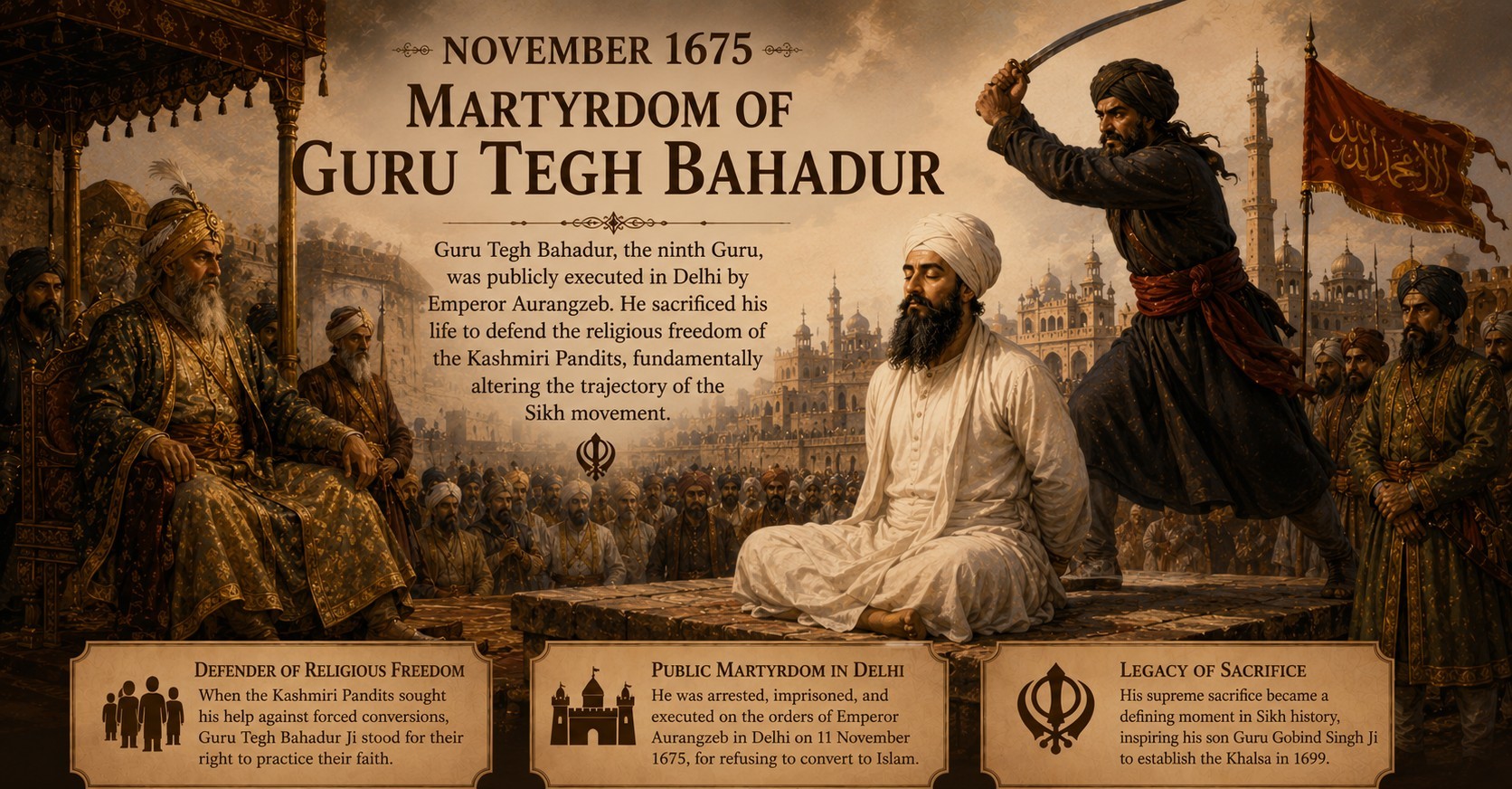
November 1675 CE: The Martyrdom of Guru Tegh Bahadur Ji and the Defense of Religious Freedom
The martyrdom of Guru Tegh Bahadur Ji in November 1675 CE stands among the most profound and consequential events in Sikh history and indeed in the broader history of human rights and religious liberty. As the Ninth Guru of the Sikhs, Guru Tegh Bahadur Ji sacrificed his life not for political power, territorial ambition, or personal gain, but for a principle that transcended religious boundaries: the right of every human being to practice and preserve their faith without coercion. His public execution in Delhi under the orders of Mughal Emperor Aurangzeb became a defining moment that fundamentally altered the trajectory of the Sikh movement. It transformed Sikh consciousness, deepened the Panth's commitment to defending the oppressed, and prepared the ideological foundation upon which Guru Gobind Singh Ji would later establish the Khalsa. More than three centuries later, Guru Tegh Bahadur Ji's sacrifice continues to be remembered not merely as a Sikh event but as a universal symbol of courage, conscience, and resistance against religious persecution.
As a Sikh historian, it is impossible to overstate the significance of this moment. Throughout the long history of religious traditions, countless individuals have suffered for defending their own beliefs. What makes Guru Tegh Bahadur Ji's martyrdom unique is that he willingly laid down his life to protect the religious rights of another community. He did not die defending Sikh institutions alone. He sacrificed himself to uphold the principle that every individual, regardless of faith, possesses an inherent right to spiritual freedom. In this sense, his martyrdom represents one of the earliest and most remarkable examples of interfaith solidarity and the defense of universal human rights in world history.
The Historical Background of Seventeenth-Century India
To fully appreciate the significance of Guru Tegh Bahadur Ji's martyrdom, one must understand the political and religious environment of seventeenth-century India. The Mughal Empire under Emperor Aurangzeb represented one of the most powerful states in the world. Its administrative reach extended across vast territories, and its military resources were immense. Yet beneath this apparent strength lay tensions concerning governance, religious policy, and regional autonomy.
Aurangzeb's reign marked a departure from some of the more accommodative approaches adopted by earlier Mughal rulers such as Akbar. While the precise nature and implementation of imperial policies varied across regions, many communities perceived increasing pressure regarding religious conformity and state authority. These developments generated concern among numerous religious groups, including Hindus, Sikhs, and others who valued freedom of worship and cultural autonomy.
Within this broader context, the Sikh Panth had already undergone significant transformation. The martyrdom of Guru Arjan Dev Ji in 1606 and the military reforms introduced by Guru Hargobind Sahib Ji had established a tradition of principled resistance against oppression. By the time Guru Tegh Bahadur Ji assumed leadership, the Sikh community had developed a strong sense of identity rooted in both spiritual devotion and moral responsibility.
The Life and Mission of Guru Tegh Bahadur Ji
Born in 1621 as Tyag Mal, Guru Tegh Bahadur Ji was the youngest son of Guru Hargobind Sahib Ji. His later title, "Tegh Bahadur," meaning "Brave Wielder of the Sword," reflected his courage and martial skill demonstrated during his youth. Yet despite this martial heritage, he became especially renowned for his contemplative nature, spiritual depth, humility, and commitment to meditation.
Throughout his life, Guru Tegh Bahadur Ji traveled extensively across northern and eastern India. These journeys allowed him to engage with diverse communities, spread Sikh teachings, and observe the social realities faced by ordinary people. His travels reinforced his commitment to justice, compassion, and the defense of human dignity.
The hymns of Guru Tegh Bahadur Ji, preserved within the Guru Granth Sahib, reveal a profound awareness of life's impermanence and the importance of spiritual resilience. His writings encourage detachment from fear, steadfastness in adversity, and unwavering devotion to the Divine. These teachings would later acquire even greater significance when viewed in light of his ultimate sacrifice.
The Crisis in Kashmir
One of the most important developments leading to Guru Tegh Bahadur Ji's martyrdom involved the plight of the Kashmiri Pandits. Historical Sikh traditions recount that a delegation of Kashmiri Brahmins approached the Guru seeking assistance in response to pressures they faced regarding their religious identity and practices. Deeply concerned about the future of their community, they sought guidance and protection from a leader whose reputation for courage and integrity was widely known.
The arrival of the Kashmiri delegation presented a profound moral challenge. The issue extended beyond the concerns of a single religious community. At stake was the broader principle of religious freedom itself. If one group could be deprived of its right to worship according to its conscience, then no community's freedoms were secure.
Guru Tegh Bahadur Ji recognized the significance of this moment. He understood that defending the rights of others was not separate from Sikh values but a direct expression of them. The Sikh commitment to justice demanded action, even when that action involved immense personal risk.
The Decision to Sacrifice
According to Sikh tradition, Guru Tegh Bahadur Ji reflected deeply upon the crisis. During discussions with his followers and family, including his young son Gobind Rai, who would later become Guru Gobind Singh Ji, the question arose as to who could effectively challenge the forces responsible for religious persecution. The answer, according to tradition, became clear: only a figure of extraordinary moral authority could make such a stand.
The Guru resolved to place himself at the center of the conflict. He declared that if he could be persuaded to abandon his faith, then others might follow. Conversely, if he remained steadfast despite persecution, it would demonstrate the inviolability of conscience and inspire resistance to coercion.
This decision reflected extraordinary courage. Guru Tegh Bahadur Ji fully understood the dangers involved. He did not act impulsively or recklessly. Rather, he consciously embraced the possibility of martyrdom in defense of a principle greater than himself.
The Arrest and Journey to Delhi
Following his decision, Guru Tegh Bahadur Ji was arrested by Mughal authorities and taken toward Delhi. Along the way, several of his devoted companions accompanied him, sharing his commitment to truth and justice. Their journey became a powerful demonstration of faith and solidarity.
Historical accounts describe repeated efforts to persuade the Guru to abandon his position. He was offered opportunities to save himself through compliance. Yet he remained unwavering. His refusal reflected not stubbornness but profound conviction. For Guru Tegh Bahadur Ji, freedom of conscience was not negotiable.
The Guru's composure during this period impressed even observers outside the Sikh community. He exhibited a remarkable calmness rooted in spiritual discipline and trust in the Divine Will. His conduct transformed his imprisonment into a moral victory long before the final outcome became known.
The Martyrdom of His Companions
Before Guru Tegh Bahadur Ji's own execution, several of his companions were subjected to brutal punishment. Bhai Mati Das, Bhai Sati Das, and Bhai Dayala became immortal figures in Sikh history through their extraordinary courage and unwavering faith.
The martyrdoms of these companions demonstrated the depth of commitment that existed within the Sikh community. Faced with unimaginable suffering, they refused to renounce their principles. Their sacrifices reinforced the message that truth and conscience could not be extinguished through fear or violence.
These events remain among the most moving chapters in Sikh historical memory. They illustrate how ordinary individuals, inspired by spiritual conviction, can display extraordinary courage in the face of overwhelming adversity.
The Public Execution in Delhi
In November 1675, Guru Tegh Bahadur Ji was publicly executed in Delhi. His martyrdom shocked contemporaries across religious and social boundaries. The execution of such a respected spiritual leader generated widespread reflection regarding justice, power, and religious freedom.
For the Sikh community, the loss was devastating. Yet it also became a source of profound inspiration. Guru Tegh Bahadur Ji's willingness to die rather than compromise his principles transformed him into a universal symbol of resistance against oppression.
His martyrdom did not achieve its significance through the manner of his death alone. Its enduring power derives from the cause for which he died. By sacrificing his life to protect the rights of others, he elevated the principle of religious liberty to a central place within Sikh identity and philosophy.
The Impact on the Young Gobind Rai
The martyrdom of Guru Tegh Bahadur Ji had a profound impact on his young son Gobind Rai, who was only nine years old at the time. Witnessing the sacrifice of his father fundamentally shaped his understanding of leadership, justice, and responsibility.
When Gobind Rai became Guru Gobind Singh Ji, he carried forward the lessons of 1675. He recognized that spiritual communities must be prepared not only to preach righteousness but also to defend it. The eventual creation of the Khalsa in 1699 can be understood, in part, as a response to the realities revealed by Guru Tegh Bahadur Ji's martyrdom.
The Ninth Guru's sacrifice provided the moral foundation upon which the Khalsa would be built. It demonstrated that courage, self-sacrifice, and the defense of human dignity were integral aspects of Sikh life.
The Transformation of the Sikh Movement
The events of 1675 fundamentally altered the trajectory of the Sikh movement. Before this period, the Sikh community had already begun developing institutions capable of defending itself. After the martyrdom of Guru Tegh Bahadur Ji, these developments accelerated.
The Panth increasingly embraced the understanding that religious freedom required active protection. Spiritual devotion remained central, but it was now accompanied by a heightened awareness of social and political responsibility. Sikhs came to view the defense of the oppressed as an essential component of their faith.
This transformation did not represent a departure from the teachings of Guru Nanak Dev Ji. Rather, it reflected their application under changing historical circumstances. The commitment to equality, justice, and human dignity remained constant, even as the methods for defending those values evolved.
The Universal Significance of the Martyrdom
Although rooted in a specific historical context, Guru Tegh Bahadur Ji's martyrdom possesses universal significance. His sacrifice transcends religious boundaries and speaks to fundamental questions concerning freedom, conscience, and human rights.
In an era when concepts such as religious liberty had not yet been formally articulated in modern political language, Guru Tegh Bahadur Ji demonstrated through his actions that every individual possesses the right to worship according to their beliefs. His martyrdom anticipated principles that would later become central to democratic societies and international human rights frameworks.
For this reason, he is often remembered not only as a Sikh Guru but also as a defender of humanity. His example continues to inspire people of many backgrounds who seek to uphold freedom and justice in their own communities.
The Legacy in Sikh Memory
Within Sikh collective memory, Guru Tegh Bahadur Ji occupies a unique place. He is remembered as "Hind di Chadar," the Shield of India, reflecting his role as a protector of religious freedom. His martyrdom is commemorated annually through prayer, reflection, and acts of service.
The Guru's teachings continue to guide Sikhs facing personal and collective challenges. His hymns encourage courage in adversity, detachment from fear, and trust in the Divine. These themes resonate deeply because they were embodied so completely in his life and death.
More than three centuries later, his sacrifice remains one of the defining moments in Sikh history and one of the most powerful examples of moral courage in world civilization.
Conclusion
The martyrdom of Guru Tegh Bahadur Ji in November 1675 CE represents one of the most extraordinary acts of self-sacrifice in human history. Faced with the persecution of the Kashmiri Pandits and broader threats to religious freedom, the Ninth Sikh Guru chose to place himself in harm's way rather than remain silent. His execution in Delhi transformed the Sikh movement, strengthened the Panth's commitment to justice, and prepared the ideological foundation for the creation of the Khalsa under Guru Gobind Singh Ji. Yet the significance of his sacrifice extends far beyond Sikh history. Guru Tegh Bahadur Ji died not for political ambition or sectarian interests but for the universal principle that every individual has the right to follow their conscience. His martyrdom remains a timeless reminder that true courage consists not in the pursuit of power but in the defense of truth, dignity, and freedom for all humanity.
Frequently Asked Questions (FAQ)
1. Who was Guru Tegh Bahadur Ji?
Guru Tegh Bahadur Ji was the Ninth Guru of the Sikhs and the father of Guru Gobind Singh Ji.
2. When was Guru Tegh Bahadur Ji martyred?
He was publicly executed in Delhi in November 1675 CE.
3. Why is Guru Tegh Bahadur Ji's martyrdom significant?
He sacrificed his life to defend the religious freedom of others, particularly the Kashmiri Pandits, making his martyrdom a unique example of interfaith solidarity.
4. Which Mughal emperor ordered his execution?
The execution occurred during the reign of Emperor Aurangzeb.
5. Who were the Kashmiri Pandits?
The Kashmiri Pandits were a Hindu community from Kashmir whose concerns regarding religious freedom played a key role in the events leading to the Guru's sacrifice.
6. What impact did the martyrdom have on Sikh history?
It transformed the Sikh movement, deepened its commitment to justice, and influenced the later creation of the Khalsa.
7. Who succeeded Guru Tegh Bahadur Ji?
His son, Guru Gobind Singh Ji, became the Tenth Sikh Guru.
8. Why is Guru Tegh Bahadur Ji called "Hind di Chadar"?
The title means "Shield of India" and reflects his role as a defender of religious freedom and human dignity.
9. What happened to the Guru's companions?
Several companions, including Bhai Mati Das, Bhai Sati Das, and Bhai Dayala, were martyred for refusing to abandon their faith.
10. What lessons do Sikhs draw from Guru Tegh Bahadur Ji's sacrifice?
Sikhs remember his courage, commitment to justice, defense of religious freedom, and willingness to sacrifice everything for the rights of others.