Sikh Legends · Origins & Gurus · Guru Nanak Dev Ji
Pandit Chatur Das
Met in Varanasi; the dialogue led to the composition of 'Dakhni Oankar'.
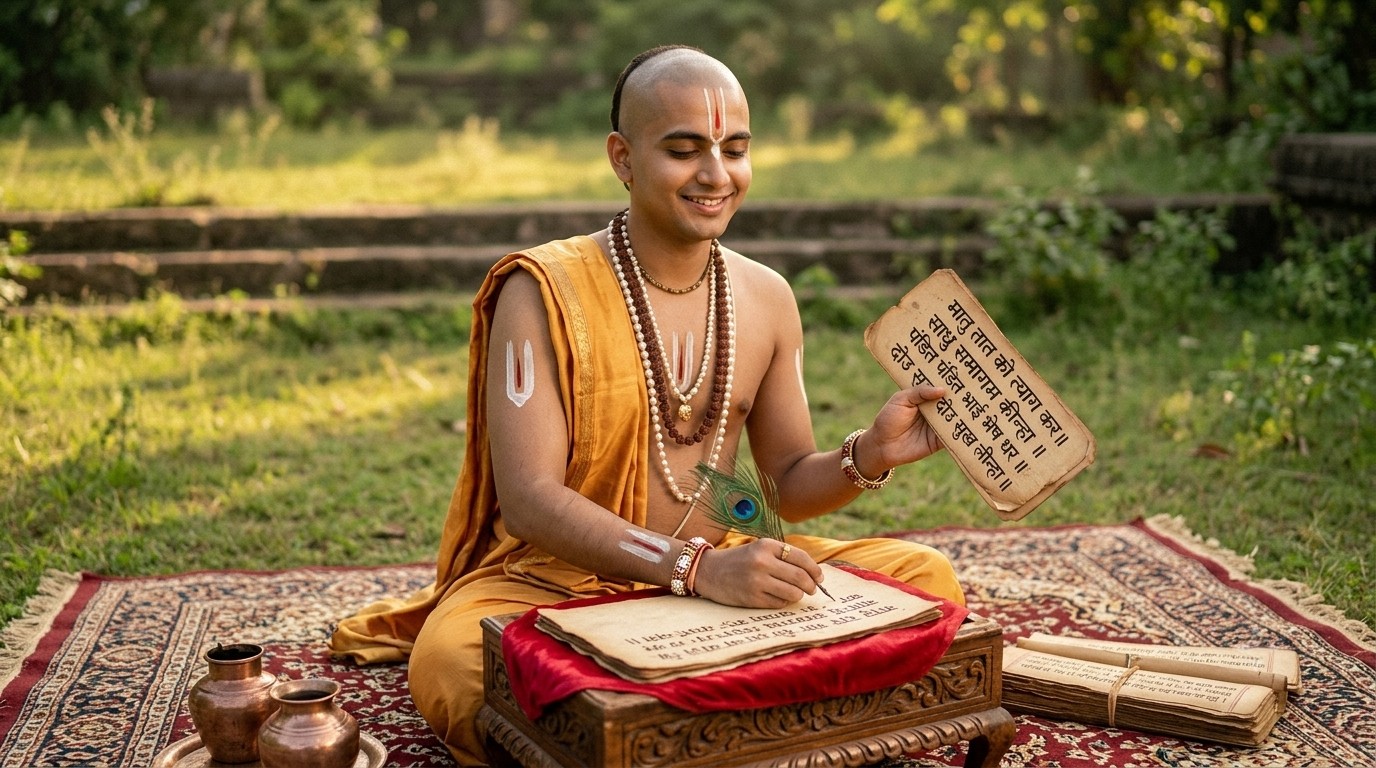
Pandit Chatur Das and the Birth of Dakhni Oankar: A Historic Dialogue in Varanasi
The history of Sikhism is not merely a sequence of journeys, institutions, and communities; it is equally a history of transformative conversations. Throughout his extensive travels across the Indian subcontinent and beyond, Guru Nanak Dev Ji engaged philosophers, ascetics, rulers, merchants, saints, and scholars in profound dialogues that challenged conventional assumptions and expanded humanity's understanding of the Divine. Among these encounters, the meeting between Guru Nanak and Pandit Chatur Das in the ancient city of Varanasi occupies a distinctive place. This conversation ultimately inspired the composition of Dakhni Oankar, one of the most philosophically rich and intellectually sophisticated compositions within Sikh scripture. More than a simple exchange of ideas, this encounter represented a meeting between two different approaches to religious knowledge: one rooted in scholastic learning and ritual tradition, and the other grounded in direct spiritual realization and universal divine truth.
For Sikh historians, Pandit Chatur Das emerges as an intriguing figure whose questions prompted Guru Nanak to articulate a profound meditation on the nature of creation, the meaning of the sacred syllable Oankar, and the relationship between God and the cosmos. While many historical personalities encountered by Guru Nanak appear briefly in traditional narratives, Pandit Chatur Das occupies a unique place because the dialogue associated with him gave rise to a major scriptural composition. Through this encounter, Sikh tradition preserves not only a historical memory but also a timeless philosophical discussion that continues to inspire seekers more than five centuries later.
Varanasi: The Intellectual Capital of Sacred India
To appreciate the significance of Guru Nanak's meeting with Pandit Chatur Das, one must first understand the environment in which it occurred. Varanasi, also known as Kashi or Banaras, was among the most celebrated centers of learning in the Indian subcontinent. For centuries, it had attracted scholars, philosophers, priests, and pilgrims from every corner of India. Its temples, schools, and debating halls served as the heart of Sanskrit learning and Brahmanical scholarship. Questions concerning metaphysics, cosmology, ritual practice, and liberation were discussed with extraordinary rigor in its intellectual circles.
By the late fifteenth and early sixteenth centuries, when Guru Nanak arrived during his travels, Varanasi had become a city where religious authority was often closely linked to textual expertise. Scholars devoted their lives to mastering the Vedas, Upanishads, Puranas, and various schools of philosophical thought. While this environment produced remarkable intellectual achievements, it also fostered tendencies toward exclusivity and ritual formalism. Many ordinary people found themselves distanced from spiritual knowledge because access to sacred learning was frequently restricted by caste, education, and social status. Into this world entered Guru Nanak, carrying a message that emphasized direct connection with the Divine through remembrance, ethical living, and spiritual awareness rather than ritual privilege.
Who Was Pandit Chatur Das?
Historical traditions identify Pandit Chatur Das as a learned scholar associated with the intellectual culture of Varanasi. Although surviving historical records provide only limited biographical information, his reputation as a respected pandit suggests deep familiarity with classical Hindu theology and philosophical traditions. He represented a scholarly class that had spent generations studying the mysteries of creation, the nature of ultimate reality, and the symbolic significance of sacred sounds and concepts. Like many intellectuals of his era, Pandit Chatur Das sought answers to profound metaphysical questions that had occupied Indian thinkers for centuries.
What makes his role particularly significant is not merely his scholarly status but the sincerity of his inquiry. The questions he posed to Guru Nanak were not superficial challenges designed to win a debate. They reflected genuine curiosity regarding the origin of existence, the meaning of Oankar, and the relationship between the Creator and creation. It was this spirit of inquiry that allowed the conversation to transcend polemics and become a vehicle for profound spiritual revelation.
The Encounter Between Guru Nanak and Pandit Chatur Das
When Guru Nanak arrived in Varanasi, his reputation as an insightful spiritual teacher had already begun to spread across northern India. His ability to engage scholars on their own intellectual terrain while simultaneously challenging established assumptions attracted considerable attention. Pandit Chatur Das, hearing of the Guru's wisdom, sought an opportunity to converse with him. The resulting dialogue centered on one of the most fundamental questions in human thought: how did creation come into existence, and what is the significance of the primal divine principle represented by Oankar?
The sacred syllable "Om" had long occupied a central place within various streams of Indian philosophy. Different schools interpreted it as the primordial sound, the essence of the Vedas, or the symbolic representation of ultimate reality. Pandit Chatur Das sought to understand Guru Nanak's perspective on this concept. Rather than offering a purely abstract philosophical explanation, Guru Nanak responded by unfolding a vision of cosmic creation rooted in divine will. His response became the foundation of Dakhni Oankar, a composition that examines not only the nature of Oankar but also the relationship between God, creation, knowledge, and liberation.
The Composition of Dakhni Oankar
Dakhni Oankar occupies a distinguished place within Sikh scripture due to its depth and complexity. Composed in the Ramkali measure, it addresses some of the most profound metaphysical questions imaginable. The work explores how creation emerges from the Divine, how language attempts to describe the indescribable, and how seekers may transcend ignorance through spiritual understanding. While many philosophical traditions focused on speculative theories regarding creation, Guru Nanak redirected attention toward the living presence of the Creator within creation itself.
The composition challenges the notion that intellectual mastery alone can reveal ultimate truth. Instead, Guru Nanak teaches that genuine understanding arises through divine grace, humility, and spiritual awakening. The Divine is not confined to symbols, rituals, or intellectual systems. Oankar represents the creative principle through which the universe comes into being, yet the Creator remains infinitely beyond human categories and conceptual limitations. This balance between transcendence and immanence lies at the heart of Sikh theology and is beautifully articulated throughout Dakhni Oankar.
The Meaning of Oankar in Sikh Thought
One of the most significant contributions of Dakhni Oankar is its reinterpretation of a concept already familiar within Indian religious discourse. Guru Nanak did not reject existing spiritual vocabulary; instead, he infused it with deeper universal meaning. Oankar is presented not as a mere syllable or ritual utterance but as an expression of the One Creator whose presence permeates all existence. The emphasis shifts from recitation to realization, from symbolism to direct awareness.
This teaching reflected a broader pattern within Guru Nanak's ministry. Rather than creating an entirely new religious language, he engaged existing concepts and revealed their deeper spiritual significance. By doing so, he made profound truths accessible to diverse audiences while simultaneously challenging rigid interpretations that obscured the universal reality of God. Pandit Chatur Das's questions provided the context through which these teachings could be articulated with remarkable clarity.
Scholarship and Spiritual Realization
The encounter between Guru Nanak and Pandit Chatur Das highlights a recurring theme throughout Sikh history: the relationship between learning and wisdom. Sikh tradition has always respected knowledge, literacy, and scholarship. However, it consistently distinguishes between intellectual accumulation and spiritual realization. A person may master countless texts and still remain trapped by ego, while another may possess little formal education yet attain profound awareness of the Divine.
Guru Nanak's dialogue with Pandit Chatur Das illustrates this distinction elegantly. The Guru did not dismiss scholarship or philosophical inquiry. On the contrary, he engaged deeply with complex metaphysical questions. Yet he emphasized that intellectual knowledge must ultimately lead to spiritual transformation. Learning becomes meaningful when it cultivates humility, compassion, and awareness of divine truth. Otherwise, it risks becoming another source of pride and separation.
The Historical Importance of the Dialogue
From a historical perspective, the conversation with Pandit Chatur Das demonstrates Guru Nanak's extraordinary ability to engage different intellectual traditions. Whether speaking with Sufi saints, Nath yogis, merchants, rulers, or Brahmanical scholars, he consistently addressed people within their own conceptual frameworks while guiding them toward universal truths. This adaptability contributed significantly to the widespread appeal of his teachings.
The dialogue also reflects the broader intellectual environment of sixteenth-century India, where competing philosophical traditions interacted through debate and discussion. Rather than promoting sectarian conflict, Guru Nanak modeled a form of engagement rooted in respect and sincerity. The resulting composition, Dakhni Oankar, stands as a testament to the transformative potential of thoughtful dialogue. What began as a conversation between a scholar and a spiritual teacher evolved into a scriptural masterpiece that continues to inspire readers centuries later.
The Enduring Legacy of Dakhni Oankar
Today, Dakhni Oankar remains one of the most important compositions for understanding Sikh cosmology and theology. It offers profound insights into the nature of creation, the limitations of human knowledge, and the infinite reality of the Divine. Scholars continue to study its philosophical depth, while spiritual seekers draw inspiration from its emphasis on humility and divine remembrance.
The historical memory of Pandit Chatur Das survives largely because of his association with this extraordinary composition. Yet this should not diminish his significance. His willingness to ask sincere questions created the conditions for one of Guru Nanak's most profound scriptural responses. In this sense, he serves as a reminder that genuine inquiry is itself a sacred act. Throughout history, transformative conversations have often begun not with answers but with courageous questions.
Conclusion: A Conversation That Echoes Across Centuries
The meeting between Guru Nanak and Pandit Chatur Das represents far more than an isolated historical episode. It symbolizes the dynamic relationship between scholarship and spirituality, inquiry and revelation, tradition and transformation. Through their dialogue, fundamental questions about creation, knowledge, and divine reality were explored with remarkable depth and clarity. The resulting composition, Dakhni Oankar, remains one of the most sophisticated theological texts within Sikh scripture and continues to guide seekers toward a deeper understanding of the One Creator.
For Sikh historians, Pandit Chatur Das occupies a unique and honorable place in the narrative of Guru Nanak's travels. Though not a central figure in Sikh institutional history, his encounter with the Guru generated insights that became part of the eternal scriptural heritage of the Sikh faith. His story reminds us that spiritual progress often begins with thoughtful questioning and that the search for truth is enriched when sincere seekers engage one another with openness, humility, and respect.
Frequently Asked Questions (FAQ)
1. Who was Pandit Chatur Das?
Pandit Chatur Das was a learned scholar of Varanasi who engaged Guru Nanak Dev Ji in a profound theological dialogue.
2. Why is Pandit Chatur Das important in Sikh history?
His discussion with Guru Nanak inspired the composition of Dakhni Oankar, an important scriptural work in Sikh theology.
3. Where did the meeting take place?
The encounter occurred in Varanasi, one of the most important centers of religious learning in medieval India.
4. What is Dakhni Oankar?
Dakhni Oankar is a composition by Guru Nanak that explores creation, divine reality, and the meaning of Oankar.
5. What questions did Pandit Chatur Das ask?
He raised philosophical questions concerning creation, the significance of Oankar, and the nature of ultimate reality.
6. What does Oankar mean in Sikh theology?
Oankar represents the One Creator whose divine presence permeates all existence.
7. Is Dakhni Oankar included in Sikh scripture?
Yes, it is included in the Guru Granth Sahib and is regarded as an important theological composition.
8. How did Guru Nanak approach scholarly debate?
He engaged respectfully with scholars while emphasizing spiritual realization over mere intellectual knowledge.
9. What is the main message of Dakhni Oankar?
Its central message is that the universe originates through divine will and that true understanding comes through spiritual awareness and grace.
10. Why is this dialogue still relevant today?
It demonstrates the value of thoughtful inquiry, respectful dialogue, and the pursuit of truth beyond intellectual pride and sectarian boundaries.
Guru Nanak Dev Ji (1469–1539)
Met in Varanasi; the dialogue led to the composition of 'Dakhni Oankar'.
- Role
- Brahmin Scholar
- Group
- Spiritual & Philosophical Dialogues
- Period
- Guru Nanak Dev Ji (1469–1539)