Sikh Legends · Origins & Gurus · Guru Tegh Bahadur Ji
Pandit Kirpa Ram Dutt
Led a group of 500 Brahmins to Anandpur Sahib to seek the Guru's protection against forced conversions. He later became a Sikh and died fighting for Guru Gobind Singh Ji at Chamkaur.
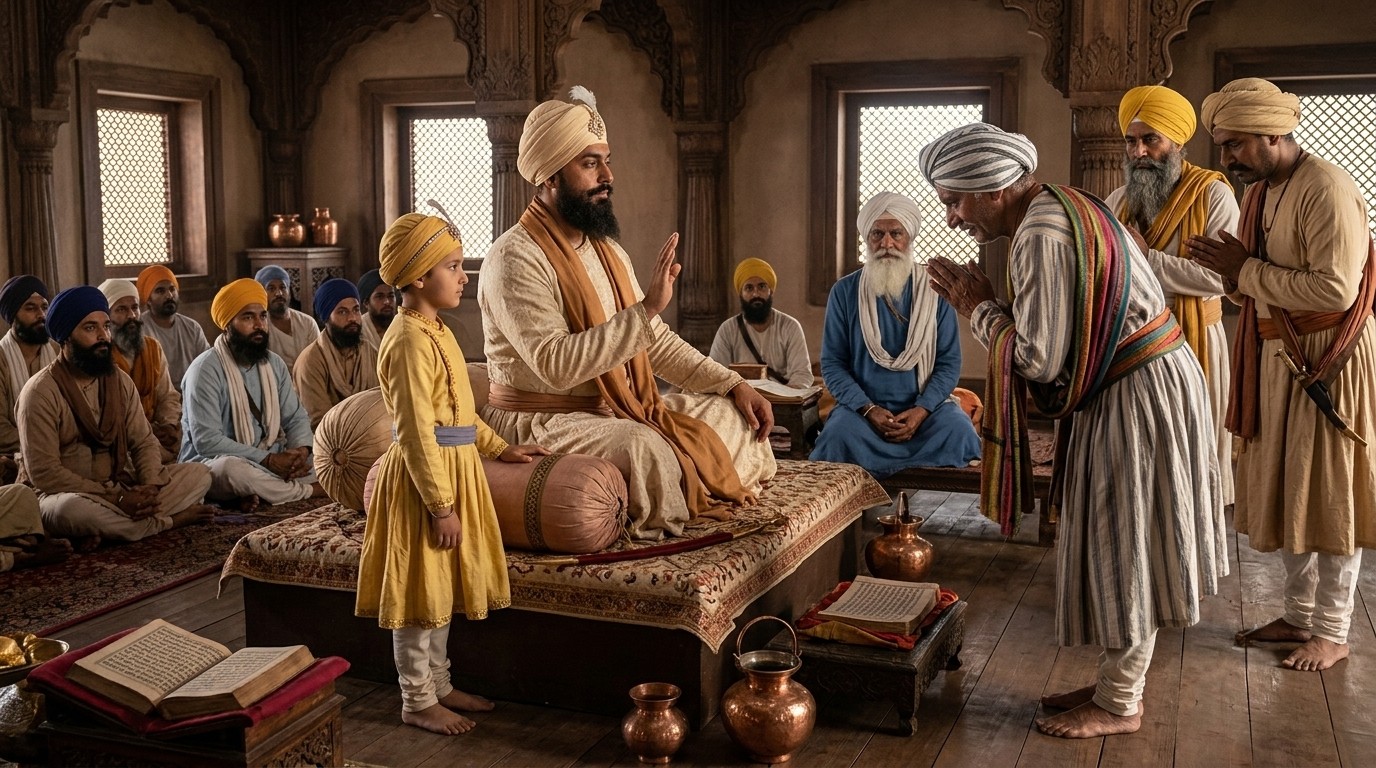
Pandit Kirpa Ram Dutt: The Kashmiri Brahmin Who Sought the Guru’s Protection and Embraced the Path of Sacrifice
Among the many figures who stand at the crossroads of Sikh and Indian history, few possess the profound historical significance of Pandit Kirpa Ram Dutt. His story is not merely that of a learned Brahmin scholar from Kashmir. It is the story of a man who became the representative voice of an entire persecuted community, a courageous leader who journeyed hundreds of kilometers to seek justice, and ultimately a devoted disciple who laid down his life in defense of the ideals embodied by Guru Gobind Singh Ji. His life bridges two defining chapters in Sikh history: the martyrdom of Guru Tegh Bahadur Ji and the heroic defense of Anandpur Sahib and Chamkaur under Guru Gobind Singh Ji. Through his actions, Pandit Kirpa Ram became both a witness to history and an active participant in its transformation.
To understand his importance, one must first appreciate the immense political and religious pressures of seventeenth-century India. During the reign of the Mughal emperor Aurangzeb, aggressive policies of religious conformity generated profound anxiety among many communities. The Kashmir Valley, long celebrated as a center of Sanskrit learning, philosophy, and spiritual inquiry, became one of the regions most affected by these developments. It was in this environment that Pandit Kirpa Ram emerged as a leader capable of articulating the fears, hopes, and determination of thousands of Kashmiri Brahmins. His decision to seek the protection of Guru Tegh Bahadur Ji would alter the course of Indian history and elevate the Sikh tradition into one of the most powerful defenders of religious freedom anywhere in the world.
The Historical Landscape of Seventeenth-Century Kashmir
By the 1670s, Kashmir had endured decades of political instability and administrative transformations under Mughal rule. Although earlier Mughal emperors had often adopted relatively pragmatic policies toward diverse religious communities, the reign of Aurangzeb marked a significant shift. Reports from contemporary Sikh, Persian, and later historical sources describe growing pressures on non-Muslim populations in several regions of the empire. Among the communities facing particular concern were the Brahmins of Kashmir, who occupied a central role in preserving Sanskrit learning, ritual traditions, and cultural continuity.
Pandit Kirpa Ram Dutt belonged to a respected Kashmiri Brahmin family and possessed both scholarship and leadership qualities. Historical traditions describe him as a man deeply trusted by his peers, capable of representing their collective concerns before powerful authorities. As conditions became increasingly difficult, leading Brahmins gathered to discuss their options. The question confronting them was existential: how could they preserve their faith, identity, and traditions in the face of mounting pressure? It was during this crisis that the name of Guru Tegh Bahadur Ji emerged as a beacon of hope.
The Sikh Gurus had already established a reputation for defending human dignity irrespective of caste, creed, or background. Guru Nanak Dev Ji had challenged religious exclusivism from the beginning of the Sikh movement, and successive Gurus had reinforced principles of equality, justice, and spiritual freedom. By the time of Guru Tegh Bahadur Ji, the Sikh community was widely recognized as a moral force capable of standing against oppression. For the Kashmiri Brahmins, seeking the Guru’s counsel was not merely a political act; it was an appeal to the highest ethical authority they could identify.
The Historic Journey to Anandpur Sahib
One of the most celebrated episodes in Sikh history centers on the journey of approximately five hundred Kashmiri Brahmins led by Pandit Kirpa Ram Dutt to Anandpur Sahib in 1675. This was no ordinary pilgrimage. The travelers crossed mountains, rivers, and plains carrying the burden of an entire community’s future. The journey itself symbolized desperation but also hope. These men believed that somewhere beyond the Himalayan foothills stood a spiritual leader capable of confronting the might of an empire through moral courage.
Upon reaching Anandpur Sahib, the delegation presented its plight before Guru Tegh Bahadur Ji. Historical tradition records that they described the hardships faced by the Kashmiri population and pleaded for guidance. The Guru listened carefully. This moment is among the most consequential in Indian history because it prompted a response that transcended sectarian boundaries. Guru Tegh Bahadur Ji did not ask whether the Brahmins belonged to his faith. He did not demand conversion or allegiance. Instead, he recognized that the right to practice one’s religion freely was a universal principle worth defending at any cost.
According to Sikh tradition, the young Gobind Rai, later Guru Gobind Singh Ji, witnessed these discussions. When the Guru reflected upon the need for a supreme sacrifice capable of halting persecution, Gobind Rai declared that no one was more worthy than his own father. This exchange set in motion events that culminated in the martyrdom of Guru Tegh Bahadur Ji in Delhi. Pandit Kirpa Ram thus occupies a unique place in history: his appeal directly contributed to one of the greatest acts of religious sacrifice ever recorded.
The Legacy of Guru Tegh Bahadur’s Martyrdom
The martyrdom of Guru Tegh Bahadur Ji in 1675 transformed the political and spiritual landscape of India. Executed for defending the religious freedom of others rather than his own community alone, the Ninth Guru established a universal standard of conscience and moral responsibility. For Pandit Kirpa Ram and the Kashmiri Brahmins, the Guru’s sacrifice represented far more than an act of protection. It was proof that justice could transcend religious identity.
Many historical accounts suggest that the Kashmiri Brahmins regarded Guru Tegh Bahadur Ji with immense reverence after these events. The memory of his sacrifice endured not only within Sikh tradition but also within broader Indian historical consciousness. For Pandit Kirpa Ram, the experience must have been profoundly transformative. He had approached the Guru seeking assistance; instead, he witnessed a spiritual leader offer his own life in defense of universal liberty.
This event also reshaped the Sikh community itself. The martyrdom of Guru Tegh Bahadur Ji demonstrated that moral resistance alone might not be sufficient against tyranny. The need for a community capable of defending righteousness through both spiritual conviction and martial readiness became increasingly apparent. These developments would later find their fullest expression in the leadership of Guru Gobind Singh Ji.
From Brahmin Leader to Sikh Disciple
Historical traditions maintain that Pandit Kirpa Ram eventually embraced Sikh teachings and became a devoted follower of Guru Gobind Singh Ji. This transformation reflects one of the most remarkable aspects of Sikh history: the ability of the Gurus to inspire individuals from diverse social, regional, and religious backgrounds. Pandit Kirpa Ram’s journey was not one of abandonment but of expansion. His commitment to justice, learning, and spiritual integrity found resonance within the Sikh worldview.
At Anandpur Sahib, he witnessed the evolution of the Sikh community into a disciplined and spiritually energized force. He observed Guru Gobind Singh Ji’s efforts to cultivate courage, equality, and readiness among his followers. The creation of the Khalsa in 1699 represented the culmination of these efforts, establishing a collective identity rooted in devotion, service, and fearlessness.
Although Pandit Kirpa Ram came from a Brahmin background associated with scholarship and religious learning, he increasingly participated in the martial dimensions of Sikh life. This transition exemplifies a defining feature of the Sikh tradition: the integration of spirituality and action. In Sikh thought, righteousness is not merely contemplated; it is defended. Pandit Kirpa Ram’s later years would demonstrate his complete acceptance of this principle.
The Siege of Anandpur and the Road to Chamkaur
The closing years of the seventeenth century witnessed escalating conflict between the Sikhs and a coalition of Mughal and hill-state forces. Anandpur Sahib, the vibrant center of Sikh activity, endured repeated sieges. Guru Gobind Singh Ji and his followers faced immense hardships, including shortages of food, constant military pressure, and relentless attempts to break their resolve.
Throughout these trials, loyal Sikhs remained steadfast. Historical traditions place Pandit Kirpa Ram among those who continued to stand beside the Guru despite overwhelming odds. His presence demonstrates the depth of his commitment. The man who had once come seeking protection now willingly accepted danger in defense of the very ideals that had protected his community.
When Anandpur Sahib was eventually evacuated under disputed assurances of safe passage, the Sikh community faced one of the most perilous moments in its history. Battles erupted across the region as pursuing forces attempted to destroy the Guru and his followers. Amid this chaos, a small band of Sikhs accompanied Guru Gobind Singh Ji to Chamkaur.
Martyrdom at Chamkaur
The Battle of Chamkaur in December 1704 occupies a legendary place in Sikh history. A small group of Sikhs, vastly outnumbered by enemy forces, defended a fortified structure known as the Garhi of Chamkaur. Among those present were the Guru’s elder sons, Sahibzada Ajit Singh Ji and Sahibzada Jujhar Singh Ji, along with many devoted companions willing to sacrifice everything for their faith.
Historical traditions identify Pandit Kirpa Ram Dutt among the defenders who fought with extraordinary courage during this desperate struggle. The battle was not merely a military engagement; it was a profound demonstration of spiritual conviction. Each defender understood the odds yet chose resistance over surrender. In doing so, they transformed the battlefield into a stage for the highest ideals of sacrifice and honor.
Pandit Kirpa Ram’s death at Chamkaur completed a remarkable journey. He had begun as a representative of a persecuted community seeking help. He ended as a Sikh warrior-martyr defending the Guru’s cause with his life. His story illustrates the transformative power of the Sikh tradition, which welcomed individuals from every background and inspired them to dedicate themselves to universal principles of justice and freedom.
The Historical Significance of Pandit Kirpa Ram Dutt
The significance of Pandit Kirpa Ram extends far beyond a single episode or battlefield. He symbolizes the enduring alliance between spiritual conviction and moral courage. His leadership of the Kashmiri Brahmins highlights the importance of organized, principled resistance against injustice. His relationship with Guru Tegh Bahadur Ji underscores the universal nature of Sikh ethics. His later service under Guru Gobind Singh Ji demonstrates the transformative potential of faith rooted in action.
For historians, his life offers valuable insight into the interconnected histories of Kashmir, Punjab, and the broader Indian subcontinent. Through his experiences, we witness the emergence of Sikhism as a powerful defender of religious liberty, the evolution of the Khalsa as a community of saint-soldiers, and the enduring relevance of sacrifice in the pursuit of justice.
His story also challenges simplistic narratives about religious identity. Pandit Kirpa Ram was neither merely a Brahmin leader nor merely a Sikh follower. He was a bridge between communities, traditions, and historical moments. His life reminds us that the defense of human dignity often requires individuals willing to transcend narrow boundaries in service of a greater good.
Conclusion
Pandit Kirpa Ram Dutt remains one of the most important yet sometimes underappreciated figures in Sikh history. His leadership brought the cries of the Kashmiri Brahmins to Anandpur Sahib. His appeal inspired one of the greatest acts of martyrdom in world history. His personal transformation reflected the universal appeal of Sikh teachings. His sacrifice at Chamkaur demonstrated unwavering loyalty to truth and justice.
Today, his legacy endures as a powerful reminder that freedom of conscience is not an abstract ideal but a principle preserved through courage, sacrifice, and moral conviction. The life of Pandit Kirpa Ram Dutt illustrates how a single individual, acting on behalf of his community, can influence the course of history. His journey from Kashmir to Anandpur and finally to Chamkaur remains one of the most inspiring narratives in the Sikh historical tradition.
Frequently Asked Questions (FAQ)
1. Who was Pandit Kirpa Ram Dutt?
Pandit Kirpa Ram Dutt was a prominent Kashmiri Brahmin leader who led a delegation of Brahmins to Guru Tegh Bahadur Ji seeking protection from religious persecution and later became associated with the Sikh community.
2. Why is he important in Sikh history?
His appeal to Guru Tegh Bahadur Ji directly contributed to the circumstances that led to the Guru’s martyrdom for the defense of religious freedom.
3. Where did Pandit Kirpa Ram come from?
He originated from Kashmir and was recognized as a respected scholar and community leader among the Kashmiri Brahmins.
4. How many Brahmins accompanied him to Anandpur Sahib?
Sikh historical traditions commonly state that he led a delegation of approximately 500 Kashmiri Brahmins.
5. What was the purpose of the delegation?
The delegation sought guidance and protection from Guru Tegh Bahadur Ji in response to pressures affecting their religious freedom.
6. Did Pandit Kirpa Ram become a Sikh?
Historical traditions indicate that he later became closely associated with Guru Gobind Singh Ji and embraced Sikh teachings.
7. What role did he play during Guru Gobind Singh Ji’s time?
He remained a loyal supporter of the Guru and participated in the struggles faced by the Sikh community during the late seventeenth century.
8. How did Pandit Kirpa Ram die?
Tradition holds that he attained martyrdom while fighting alongside Guru Gobind Singh Ji’s forces during the Battle of Chamkaur.
9. What does his life symbolize?
His life symbolizes courage, interfaith solidarity, devotion to justice, and the willingness to sacrifice for the protection of religious freedom.
10. Why is his legacy still relevant today?
His story continues to inspire people across communities by demonstrating the importance of defending human rights, standing against oppression, and upholding freedom of conscience for all.
Guru Tegh Bahadur Ji (1621–1675)
Led a group of 500 Brahmins to Anandpur Sahib to seek the Guru's protection against forced conversions. He later became a Sikh and died fighting for Guru Gobind Singh Ji at Chamkaur.
- Role
- Leader of Kashmiri Brahmins
- Group
- The Kashmiri Delegation
- Period
- Guru Tegh Bahadur Ji (1621–1675)