Panthic Personalities · Origins & Gurus · Guru Angad Dev Ji
Pheru Mal Ji (father of Guru Angad Dev ji)
A trader and devotee of Durga; he raised Bhai Lehna in a deeply religious environment.
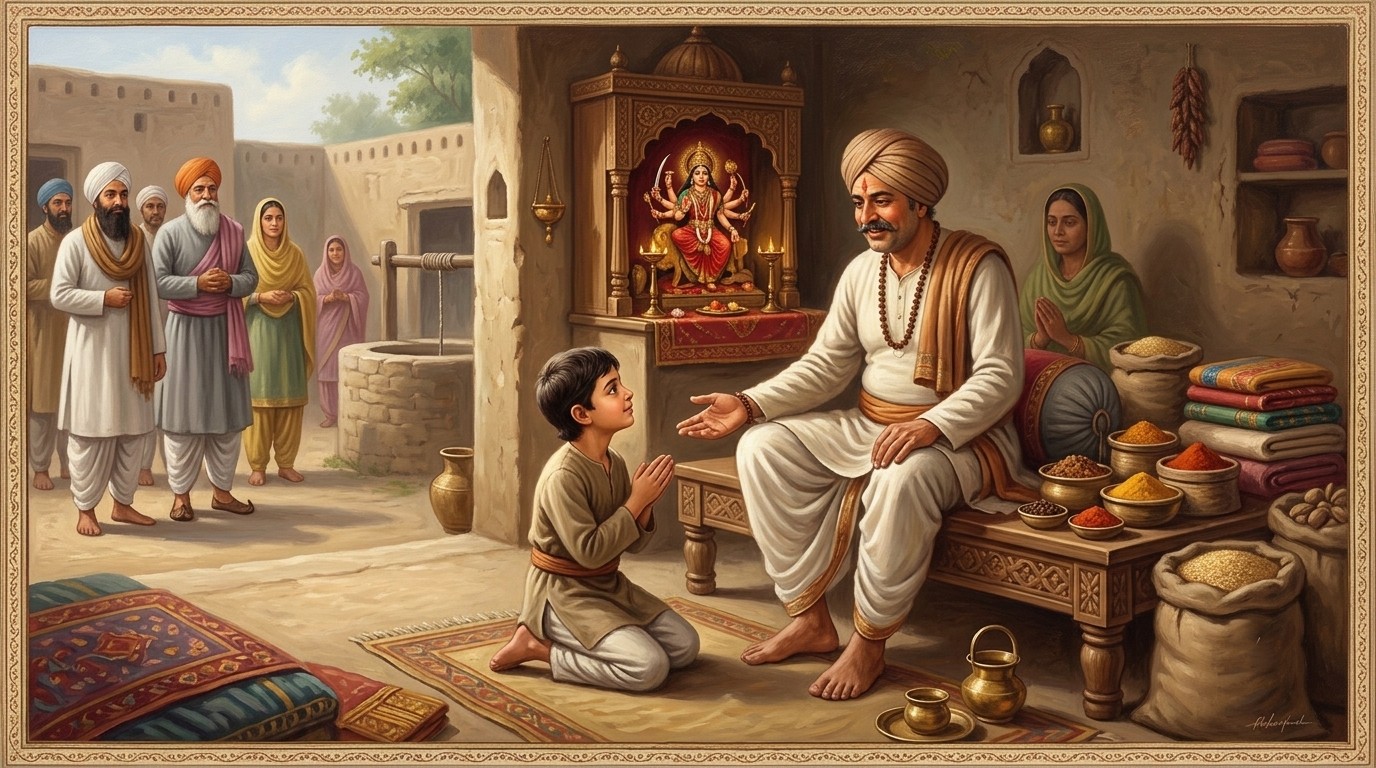
The Unsung Roots of Divine Succession: Bhai Pheru Mal Ji
In the grand tapestry of Sikh historiography, our attention is naturally and repeatedly drawn to the shining luminaries of the Ten Gurus. Yet, a deeper, more analytical exploration of the pre-history of the Guruship reveals that the soil from which these spiritual giants emerged was meticulously prepared by ancestors of extraordinary character, piety, and resolve. Among these foundational figures, Bhai Pheru Mal Ji occupies a position of profound, though often understated, historical significance. As the biological father of Bhai Lehna Ji—who would later be transformed by Guru Nanak Dev Ji into Guru Angad Dev Ji, the second Sovereign of the Sikh faith—Bhai Pheru Mal Ji was the primary architect of the environment that shaped the early life, work ethic, and spiritual discipline of the future Guru. Born into the Trehan clan of the Khatri caste in the late fifteenth century, Bhai Pheru Mal Ji lived during a period of intense socio-political transition in Punjab, marked by the decaying authority of the Lodhi dynasty and the impending, violent arrival of the Mughal Empire under Babur. His life was a testament to the quiet strength of the householder-saint, balancing the rigorous, worldly demands of mercantile trade with an unyielding, intense devotion to the Divine.
For a Sikh historian, the study of Bhai Pheru Mal Ji is not merely a genealogical exercise; it is an investigation into the spiritual lineage of devotion that preceded the formalization of the Sikh Panth. Pheru Mal Ji was not a passive historical bystander. He was a man of deep convictions, whose daily life in the village of Matte-di-Sarai (modern-day Sarai Naga, near Muktsar in Punjab) was a harmonious blend of honest commerce, community leadership, and intense spiritual searching. His choice to raise his son, Bhai Lehna, in a household defined by absolute moral integrity and rigorous religious practice laid the indispensable psychological and spiritual groundwork for Lehna’s eventual encounter with Guru Nanak. By examining Pheru Mal Ji’s life, we gain a clearer understanding of how the virtues of humility, administrative excellence, and relentless devotional discipline were transmitted to Bhai Lehna, preparing him to shoulder the immense spiritual and organizational responsibilities of the young Sikh community during its most vulnerable transitional phase.
Socio-Economic Pillars: The Life of a Khatri Merchant in Medieval Punjab
To reconstruct the life of Bhai Pheru Mal Ji, one must first immerse oneself in the socio-economic realities of sixteenth-century Punjab. The Khatris of this era occupied a unique niche in the regional hierarchy; they were the literate, mercantile, and administrative backbone of both urban centers and rural trade networks. Bhai Pheru Mal Ji was a highly respected trader and shopkeeper who managed the distribution of essential commodities, agricultural tools, and textiles in Matte-di-Sarai and the surrounding agrarian hinterland. His profession required not only mathematical precision and financial literacy but also an exceptional level of personal trust and community diplomacy. In a society where cash was scarce and trade relied heavily on credit and mutual honor, Pheru Mal Ji established a reputation for absolute honesty, fair dealing, and compassion for the impoverished peasantry who frequently fell into debt during seasonal crop failures.
Beyond his independent mercantile activities, Pheru Mal Ji’s administrative acumen led him to serve as a local tax collector or estate manager (Patwari or Mehta) for the local landlord and governmental authorities. This dual role as an independent trader and a public administrator placed him at the crucial intersection of the state and the peasantry. It was a position fraught with moral hazard, as imperial administrative systems under the Lodhis were notoriously corrupt and extractive. Yet, historical accounts emphasize that Pheru Mal Ji navigated these systemic pressures with outstanding moral clarity, refusing to participate in the rampant bribery and extortion of the era. This commitment to ethical livelihood was the direct historical precursor to the Sikh doctrine of Kirat Karni. In this household of honest trade and administrative transparency, young Bhai Lehna learned the practical mechanics of leadership, accounting, and human relations—skills that he would later deploy with masterful efficiency when organizing the first systematic recording of Gurbani and the standardization of the Gurmukhi script in Khadur Sahib.
The Sanctum of Shaktism: Pheru Mal’s Devotion to the Divine Mother
While Bhai Pheru Mal Ji’s days were occupied with the ledgers of trade and land administration, his nights and inner life belonged entirely to the transcendent. He was an exceptionally devout follower of the ancient Hindu tradition of Shaktism, centering his spiritual life on the worship of the Goddess Durga, also revered as Chandi, Sheranwali, or the Divine Mother. In the cultural landscape of medieval Punjab, Shaktism was a vibrant, powerful force, particularly among the Khatri clans of the foothills and plains. For Pheru Mal Ji, this devotion was not a matter of superstitious ritualism or social conformity; it was an intense, heart-centered seeking of cosmic order, strength, and divine protection. His household was a sanctuary where the sacred texts of the Shakti tradition, such as the Devi Mahatmyam (Durga Saptashati), were regularly recited, and the family’s daily rhythms were synchronized with prayers, fasts, and offerings to the Goddess.
The depth of Pheru Mal Ji's devotion is most clearly illustrated by his role as the leader (Sangha or Sangat) of the local community’s annual pilgrimage to the sacred volcanic temple of Jawalamukhi, nestled in the lower Himalayan ranges of modern-day Himachal Pradesh. This pilgrimage was a monumental undertaking, requiring weeks of physical endurance, collective coordination, and spiritual focus. Under Pheru Mal Ji’s leadership, a diverse congregation of devotees would march hundreds of miles through dangerous, bandit-infested territories, singing praises to the Goddess, unified by their shared spiritual yearning. This experience of leading a highly organized, spiritually motivated collective was central to the family dynamics. Bhai Lehna was not merely a spectator to these journeys; he was active in their preparation, absorbing his father’s organizational capability, his capacity for deep faith, and his profound sense of responsibility for the spiritual welfare of others.
Nurturing Bhai Lehna: The Pedagogical Philosophy of Pheru Mal Ji
The spiritual and intellectual environment that Bhai Pheru Mal Ji created for his son was both rigorous and loving. Recognizing the exceptional intellect and sensitive nature of Bhai Lehna, who was born in 1504, Pheru Mal Ji did not confine his son’s education to the mechanical tracking of business accounts. He ensured that Lehna was thoroughly educated in the written languages of commerce and administration, primarily Lande (the merchant script) and Persian, while also deeply immersing him in classical religious lore and philosophy. This comprehensive education was designed to cultivate a balanced human being—one who was fully capable of navigating the complex, material realities of the world while remaining fundamentally anchored in an unshakeable spiritual consciousness.
The pedagogical approach of Pheru Mal Ji was marked by practical demonstration rather than abstract lecturing. Young Lehna watched his father rise before dawn to perform his spiritual disciplines, observed his absolute honesty in the marketplace, and witnessed his radical charity toward the destitute. In the medieval Punjabi household, the father was the spiritual preceptor, and Pheru Mal Ji took this duty with immense seriousness. He taught Lehna that the accumulation of wealth was a secondary pursuit, subordinate to the cultivation of a clean conscience and a devoted heart. This rigorous upbringing forged in Bhai Lehna an intense, burning desire for ultimate truth. When Pheru Mal Ji grew older and passed the leadership of the annual Jawalamukhi pilgrimage to Bhai Lehna, the young man did so with the same burning devotion, wearing small ankle-bells (ghungroos) and dancing in ecstatic praise of the Divine, embodying the pure, uncompromising spiritual discipline he had inherited from his father.
The Crucible of Displacement: The Sacking of Matte-di-Sarai
The peaceful, prosperous life that Bhai Pheru Mal Ji had built in Matte-di-Sarai was shattered by the brutal geopolitical storms that swept through Punjab in the 1520s. As Babur’s Mughal armies marched from Kabul to conquer Delhi, they unleashed a wave of devastation across the towns and villages of Punjab. During these campaigns of conquest, or due to the opportunistic raids of local predatory clans like the Mughals and Baloches who took advantage of the administrative collapse, Matte-di-Sarai was completely plundered and burned to the ground. In an instant, Pheru Mal Ji’s home, business, and community were reduced to ashes. The family, along with many of their neighbors, was forced to flee for their lives, abandoning their ancestral lands and material possessions to become destitute refugees in their own country.
This traumatic displacement was a profound test of Bhai Pheru Mal Ji’s spiritual maturity. Where a lesser man might have succumbed to despair, bitterness, or spiritual disillusionment, Pheru Mal Ji viewed this catastrophe through the prism of divine will. He gathered his family—including his wife, Mata Sabhrai Ji (also known as Mata Ramo), and young Bhai Lehna—and migrated first to Harike, a settlement near the confluence of the Sutlej and Beas rivers. Finding the environment there unsuitable for long-term resettlement, they eventually moved to Khadur Sahib, the ancestral home of Mata Sabhrai’s family. Throughout this grueling ordeal, Pheru Mal Ji kept the family's spiritual practices alive. He rebuilt his business from scratch in Khadur Sahib, proving that his inner peace and economic self-reliance were entirely independent of geographical stability or material accumulation. This resilience in the face of absolute ruin left an indelible mark on Bhai Lehna, teaching him the absolute transience of the physical world and the necessity of maintaining an unwavering focus on the eternal.
The Theological Bridge: From Durga Worship to the Formless Divine
From the perspective of Sikh theology, the deep Shaktism of Bhai Pheru Mal Ji’s household is not an embarrassing historical footnote to be brushed aside; rather, it is a crucial component of the divine plan that led to the succession of Guru Angad Dev Ji. The rigorous discipline of Durga worship—characterized by early morning devotion, strict dietary purity, pilgrimage, and a yearning for a direct experience of the Divine—was the ideal preparation for Bhai Lehna’s ultimate spiritual transformation. Pheru Mal Ji did not raise a passive ritualist; he raised an active, passionate seeker of the Truth. When Bhai Lehna eventually heard the sublime compositions of Guru Nanak (specifically the Asa di Var) sung by the Sikh Bhai Jodha in Khadur Sahib, his soul was instantly stirred. The devotion that his father had directed toward the localized, personified form of the Goddess Durga was instantly elevated and expanded to encompass the formless, omnipresent Creator (Nirankar) proclaimed by Guru Nanak.
Bhai Pheru Mal Ji passed away in 1526, shortly after the family settled in Khadur Sahib and before Bhai Lehna met Guru Nanak Dev Ji. Though he did not live to see his son ascend the spiritual throne of Guru Nanak, his legacy was fully realized in that very ascension. The transition of Bhai Lehna from a devout worshipper of Chandi to the second Guru of the Sikhs was made possible because Pheru Mal Ji had built a solid foundation of devotional purity and ethical living. The discipline of the annual pilgrimage, the stamina required for continuous prayer, and the humility of community service that Pheru Mal Ji had modeled were not discarded; they were reoriented and perfected under the spiritual guidance of Guru Nanak. Thus, in the historical lineage of Sikhism, Bhai Pheru Mal Ji stands as the essential, sacred bridge that linked the ancient, passionate devotional traditions of Punjab to the revolutionary, monotheistic spiritual sovereignty of the Sikh path.
Historical Analysis of Bhai Pheru Mal Ji's Legacy
To systematically understand the structural impact of Bhai Pheru Mal Ji's life, occupation, and spiritual devotion on the development of his son, Bhai Lehna Ji, and the early Sikh community, we can examine the following analytical table:
| Dimension of Analysis | Bhai Pheru Mal Ji's Practice & Experience | Structural Transmission to Bhai Lehna Ji (Guru Angad Dev Ji) |
| Mercantile and Administrative Skills | Managed trade accounts, negotiated credits, and served as an estate manager/tax collector. | Equipped Bhai Lehna with the bureaucratic, administrative, and organizational skills needed to manage the early Sikh center at Khadur Sahib. |
| Ethical Economic Model | Rejected systemic corruption, bribery, and peasant exploitation in the Lodhi administrative machinery. | Formed the foundational psychological basis for the practice of Kirat Karni (honest labor) and ethical householder living. |
| Spiritual Devotion (Shaktism) | Led intense daily prayers, studied religious texts, and cultivated deep devotion to the Goddess Durga. | Instilled a rigorous, lifelong habit of early morning meditation, continuous contemplation, and spiritual searching. |
| Organizational Leadership | Organized, protected, and guided the annual, regional community pilgrimage (Sangat) to Jawalamukhi. | Developed the future Guru’s capacity to guide, feed, and manage large, diverse congregations of spiritual seekers. |
| Response to Imperial Violence | Maintained faith, reconstructed his livelihood, and preserved family unity after the sacking of Matte-di-Sarai. | Demonstrated Bhani Mannana (accepting Divine Will) and absolute resilience during crises, helping Bhai Lehna face future hardships. |
The Eternal Legacy of the Devout Patriarch
In the final analysis, the historical memory of Bhai Pheru Mal Ji must be preserved with deep reverence and scholarly appreciation by all who seek to understand the origins of the Sikh faith. He was the root system that nourished the tree of Guru Angad Dev Ji’s Guruship. His life demonstrates that the path of the householder is not an obstacle to spiritual attainment, but the very arena where it is forged. Through his dedication to honest trade, his refusal to compromise his ethics for state favor, and his dynamic, heartfelt devotion, he set a standard of human excellence that found its ultimate, perfect expression in his illustrious son. As modern Sikhs visit the historical lands of Sarai Naga and Khadur Sahib, they honor not only the Gurus who walked those paths, but also the saintly trader who, through his quiet devotion and loving guidance, prepared the way for the second Divine Light of the Sikh nation.
Frequently Asked Questions
1. Who was Bhai Pheru Mal Ji, and what is his primary significance in Sikh history?
Bhai Pheru Mal Ji was a highly respected merchant, administrator, and spiritual seeker of the Trehan Khatri clan in sixteenth-century Punjab. His primary significance in Sikh history is that he was the biological father of Bhai Lehna Ji, who went on to become Guru Angad Dev Ji, the second Sikh Guru. Through his exemplary life of honesty, resilience, and deep devotion, Pheru Mal Ji raised Bhai Lehna in an ideal environment for spiritual and administrative development.
2. What was Bhai Pheru Mal Ji’s occupation, and how did it influence his son?
Bhai Pheru Mal Ji was a successful trader, shopkeeper, and local land revenue official (Patwari or manager) in the village of Matte-di-Sarai. This background gave him extensive experience in accounting, administrative organization, and public relations. He educated his son, Bhai Lehna, in these practical skills, which later proved invaluable when Guru Angad Dev Ji organized the early Sikh community, managed the free kitchen (Langar), and compiled the compositions of Guru Nanak Dev Ji.
3. What were the spiritual beliefs of Bhai Pheru Mal Ji?
Bhai Pheru Mal Ji was an exceptionally devout follower of Shaktism, a major tradition of Hinduism that focuses on the worship of the Goddess Durga (also known as Chandi or the Divine Mother). He dedicated his inner life to prayers, fasts, and reading sacred texts, and he was a prominent leader of the local community’s spiritual activities.
4. What was the Jawalamukhi pilgrimage, and what role did the family play in it?
Jawalamukhi is a famous temple in the lower Himalayas where the Goddess Durga is worshipped in the form of natural, burning volcanic flames. Bhai Pheru Mal Ji was the organizer and leader of the annual pilgrimage group (Sangat) from his region to this shrine. When Pheru Mal Ji aged, his son Bhai Lehna took over this highly responsible role, leading the group with bells on his feet and singing devotional songs in absolute surrender to the Divine.
5. Where did Bhai Pheru Mal Ji live, and why did his family have to migrate?
Initially, Bhai Pheru Mal Ji lived in Matte-di-Sarai (now Sarai Naga, near Muktsar, Punjab). However, during the early sixteenth century, the village was completely ransacked and burned down—either by Babur's invading Mughal forces or local bandit groups amidst the political chaos. The family was forced to flee, moving briefly to Harike and eventually settling in Khadur Sahib, which was the ancestral village of Pheru Mal's wife, Mata Sabhrai.
6. Who was the wife of Bhai Pheru Mal Ji, and what was her role?
Bhai Pheru Mal Ji’s wife was Mata Sabhrai Ji, who is also recorded in some historical accounts as Mata Ramo. She was a deeply pious and supportive woman who shared her husband's spiritual values and assisted in raising Bhai Lehna in a warm, disciplined, and highly moral household. Her family connections in Khadur Sahib provided the refugee family with a safe haven after their home village was destroyed.
7. How does the Shaktism of Bhai Pheru Mal Ji connect to the Sikh faith?
The intense devotional discipline (Bhakti) cultivated in Pheru Mal’s Shaktivite home served as a vital spiritual precursor for Bhai Lehna. Rather than being a contradiction, the devotion, early morning meditation, and organizational leadership learned in the worship of Durga prepared Bhai Lehna's mind and soul to receive the ultimate, universal message of the formless God (Nirankar) proclaimed by Guru Nanak Dev Ji.
8. Did Bhai Pheru Mal Ji ever meet Guru Nanak Dev Ji?
No, historical records indicate that Bhai Pheru Mal Ji passed away in 1526, shortly after the family settled in Khadur Sahib. This was several years before Bhai Lehna Ji heard the hymns of Guru Nanak through Bhai Jodha and subsequently traveled to Kartarpur to meet the Guru in person. However, Pheru Mal Ji’s legacy lived on through the spiritual search he had ignited in his son.
9. What lessons can modern families learn from Bhai Pheru Mal Ji’s life?
Bhai Pheru Mal Ji teaches modern families the value of resilience in times of crisis, the importance of earning an honest living (Kirat Karni) without compromising one’s ethics, and the responsibility of parents to actively nurture the spiritual and moral character of their children. His ability to rebuild his life after losing everything in Matte-di-Sarai is an inspiring example of faith in action.
10. How is Bhai Pheru Mal Ji remembered today in the Sikh tradition?
Today, Sikh historians and scholars remember Bhai Pheru Mal Ji as a pillar of integrity and devotion who fathered and nurtured the second spiritual king of the Sikhs. His birthplace at Sarai Naga (Matte-di-Sarai) and his home in Khadur Sahib are respected as historical landmarks that trace the sacred roots of the Guruship and demonstrate the profound impact of a righteous upbringing on the destiny of the Sikh nation.
Guru Angad Dev Ji (1504–1552)
A trader and devotee of Durga; he raised Bhai Lehna in a deeply religious environment.
- Role
- Father
- Group
- Family & Lineage
- Period
- Guru Angad Dev Ji (1504–1552)