Panthic Personalities · Origins & Gurus · Guru Amar Das Ji
Preman Khatri (Bhai Prema)
Healed by the Guru’s grace; his story was used to challenge social stigmas surrounding disease and outcasts.
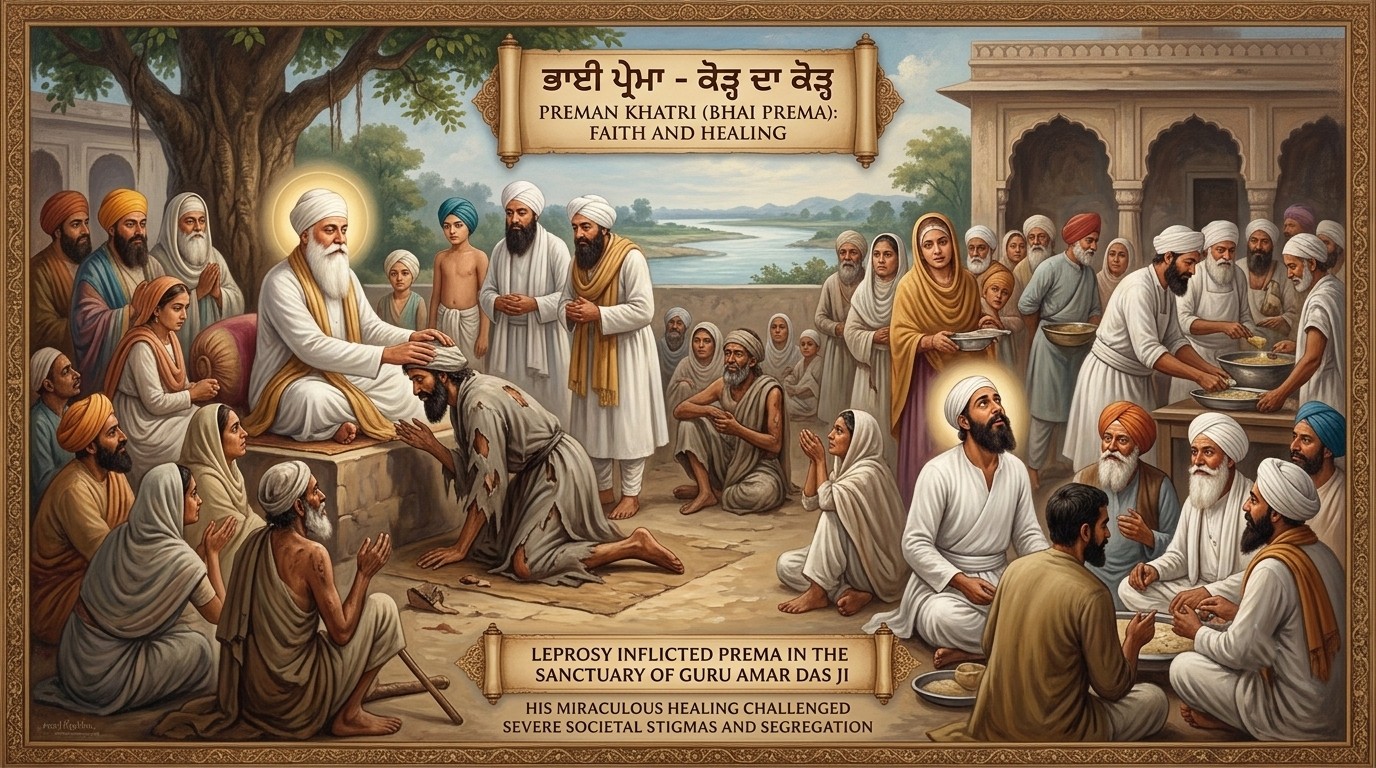
The Outcast Made Heir: Preman Khatri and the Subversion of Leprosy Stigmas in the Early Sikh Panth
To fully comprehend the radical socio-spiritual revolution initiated by the early Sikh Gurus, one must look beyond the macro-political interactions with the Mughal Empire and examine the micro-social transformations occurring within the early congregations. Under the pontificate of Guru Amar Das Ji (1479–1574), the second and third generation of the Sikh Panth was tasking itself with nothing less than a complete re-ordering of human relations. While traditional medieval Indian society was organized around the axes of ritual purity, hereditary caste boundaries, and the absolute marginalization of the physically afflicted, the Gurus were constructing Goindwal Sahib as an alternative, egalitarian space. In this nascent spiritual commonwealth, the discarded, the diseased, and the socially dead were not merely accommodated—they were radically healed, structurally integrated, and elevated to positions of spiritual and temporal authority. There is perhaps no historical narrative that encapsulates this revolutionary praxis more profoundly than the transformation of Preman Khatri, a severely afflicted leper who crawled to the Guru's court, only to be reclaimed as the Guru's adoptive son, renamed Murari, married into a respected family, and commissioned as a sovereign missionary under the Manji system.
The historical reality of leprosy (known in Punjabi vernacular as Korh) in sixteenth-century India was one of absolute ontological exclusion. Rooted in traditional Brahmanical and popular theological interpretations of the law of Karma, physical disease—particularly leprosy—was viewed not merely as a biological misfortune, but as the visible, festering manifestation of heinous sins committed in a past life. To be a leper was to be marked by divine wrath, bearing a physical brand of spiritual corruption. Consequently, society practiced a ruthless quarantine. Lepers were stripped of their civic identities, disinherited of their properties, and driven from their villages to live in squalid, isolated colonies on the margins of forests or waste lands. They were legally and socially dead, denied the right to touch communal water sources, enter temples, or even allow their shadows to fall upon members of the higher castes. It was against this backdrop of institutionalized cruelty that Preman’s early life unfolded, serving as a tragic archetype of the medieval outcast before his encounter with the liberating light of Sikhism.
Therestless Crawl: Preman's Existential Desolation
Sikh chronicles, including the classical recensions of the Suraj Prakash and the Mahima Prakash, record that Preman was born into a mercantile Khatri family. His birth was marked by tragedy: his mother passed away during childbirth, and shortly thereafter, his father also died, leaving him orphaned. Though initially cared for by his paternal aunt and sisters, a series of subsequent deaths left him entirely alone in the world. Seizing upon his vulnerability, unscrupulous local relatives and neighbors devoured his inherited property, leaving him destitute. To compound his miseries, Preman contracted a virulent, fast-progressing form of leprosy. His fingers and toes began to drop off, his flesh began to decay, and blood and pus constantly trickled from his open wounds. He was reduced to crawling on his stomach and elbows, his body infested with flies and emitting an odor so offensive that no one would allow him to approach within shouting distance. A sympathetic passerby eventually tied a small earthen pot around his neck so that the charitable could toss scraps of food or pour water into it from a distance without making physical contact. Preman was trapped in a living hell, experiencing the ultimate limits of human degradation and social abandonment.
The turning point in Preman's tragic existence came when travelers passing near his roadside haunt spoke of Goindwal Sahib, the thriving spiritual headquarters of the third Sikh Master. They spoke of a strange and wonderful sanctuary where a great Guru healed all manner of diseases, restored sight to the blind, made the deaf hear, and, most incredibly, welcomed all human beings as equals without regard to caste, wealth, or physical condition. They described the Guru's Langar, where the king and the beggar, the Brahmin and the outcaste, sat side-by-side to eat of the same food. Hearing these accounts, a spark of hope was ignited in Preman’s desperate heart. Driven by a deep existential longing, he began a grueling, agonizing journey to Goindwal. Lacking the ability to walk, he trundled and crawled along the dusty, unpaved roads of Punjab, dragging his deteriorating body inch by inch over miles of hostile terrain, fueled solely by the belief that if he could only reach the sanctuary of the Guru, his suffering would find its resolution.
The Goindwal Crucible: The Theology of Radical Touch
Upon arriving in Goindwal Sahib, Preman was instantly enveloped by the unique spiritual atmosphere of the Guru’s city. He did not find a quietist monastery or a rigid, ritualistic temple complex; instead, he encountered a vibrant, egalitarian commune echoing with the singing of the Shabad (the divine Word) and bustling with selfless service. Preman crawled to the outskirts of the Guru’s Langar, where the aroma of fresh, simple vegetarian food mingled with the devotional singing of the congregation. The volunteers of the Langar, practicing the Guru's instruction of seeing the Divine in all, did not drive him away. Instead, they placed food and water into the clay vessel suspended from his neck. As Preman partook of the food and rolled in the sacred dust of Goindwal, he felt an immediate mitigation of his physical pain. He began to sing along with the devotional hymns in his stammering, labored voice, finding a deep, inner spiritual peace that he had never known. Yet, a profound anxiety remained: he desperately desired a personal audience with Guru Amar Das Ji, but his physical condition was so repulsive that he feared he would be refused entry into the Guru’s immediate presence.
When a compassionate Gursikh witnessed Preman's plight and narrated his story to Guru Amar Das Ji, the Master’s response bypassed all established social taboos and ritualistic purity laws. Instead of sending a blessing from a distance or directing his disciples to feed the leper outside the city gates, the Guru ordered that Preman be brought immediately to his presence. When the wretched, festering figure of Preman was laid before him, Guru Amar Das Ji did not recoil in disgust or demand ritual purification. In a breathtaking act of radical empathy, the Guru bent down, wrapped the weeping leper in his own personal woolen blanket, and carried him to the waters of the sacred Baoli Sahib (the stepwell). There, with his own hands, the Guru washed Preman’s decaying body, gently cleaning his wounds with the sanctified water. This physical touch was not merely a therapeutic act; it was a profound theological statement. By physically embracing and washing the leper, the Guru was actively subverting the concepts of Sutak (ritual impurity associated with birth, death, and disease) and Patak (pollution), demonstrating that the human body is inherently sacred and that true pollution resides not in physical affliction, but in the spiritual blindness of the ego (Haumai).
The Ontological Transformation: From Prema to Murari
The chronicles record that as the Guru washed Preman and wrapped him in his blanket, a miraculous healing occurred. The decaying flesh was restored, the open wounds closed, and Preman’s skin became smooth, clean, and radiant with health. When the blanket was removed, the congregation stood astonished, witnessing a vibrant, healthy young man standing where a dying leper had been moments before. Preman fell at the Guru’s feet, weeping tears of overwhelming gratitude. Yet, the Guru's healing was not merely physical; it was an ontological recreation. Guru Amar Das Ji lifted him gently, embraced him, and declared to the assembled Sangat: "From today, Preman is no longer a diseased outcast. He is my own beloved son, and his new name is Murari." This naming was highly symbolic. In classical Indian mythology, Murari is an epithet of the Divine (Krishna), signifying the "Slayer of the Demon Mura." By bestowing this name, the Guru was declaring that this young man had conquered the demons of his past karma, his physical affliction, and his social death, emerging as a pure, spiritually realized soul.
By declaring Murari as his son, Guru Amar Das Ji shattered the ultimate barrier of medieval Indian society: the transmission of hereditary lineage and caste identity. In a society where family lineage (Gotra) and caste (Varna) dictated one's entire social existence, legal rights, and spiritual worth, the Guru’s declaration of adoptive fatherhood was a revolutionary act of social engineering. The Guru proclaimed, "My caste is his caste; my family is his family." Murari was no longer an orphaned, disinherited Khatri with a tainted lineage; he was an integrated member of the Guru’s own household, vested with the spiritual sovereignty of Guru Nanak’s court. Through this single act, the Guru demonstrated that the Sikh Panth was not a reformist sect operating within the framework of Hindu caste hierarchy, but a completely new, parallel social order that possessed the sovereign authority to create new identities, erase past lineages, and elevate the lowliest outcasts to the highest levels of familial and spiritual dignity.
The Marital Subversion: The Lineage of Matho-Murari
The true test of Goindwal’s egalitarian commitment occurred immediately following Murari's healing. Having declared Murari as his son, Guru Amar Das Ji looked upon the congregation and asked: "Is there any devout Sikh among you who is ready to marry his daughter to my beloved son, Murari?" To ask a high-caste Sikh family to marry their daughter to a man who, moments prior, was a severely deformed leper of unknown and broken lineage was an unprecedented challenge to the social fabric of medieval Punjab. It demanded a total surrender of caste pride, familial reputation, and societal expectations. For a long moment, silence pervaded the court. Then, standing up with folded hands, a highly respected Gursikh named Bhai Sinha (some chronicles refer to him as Bhai Shihan) stepped forward and declared, "O True King, I offer my daughter, Matho, in marriage to your son, Murari."
However, the radical nature of this decision immediately met with domestic resistance. When Bhai Sinha’s wife heard of the betrothal, she rushed to the Guru's court weeping and wailing in protest, arguing that such a union was highly improper, as they knew nothing of Murari's caste, parentage, or ancestral background, and that marrying their daughter to a former leper would lead to total social ostracization for their family. Guru Amar Das Ji comforted the distressed mother with words of profound spiritual reassurance, stating that in the house of Guru Nanak, worldly caste and ancestry hold no value, and that those who seek shelter in the Guru's sanctuary are purified of all past taints. The Guru famously remarked, "I am his father and mother; my caste is his caste. Your daughter's name is Matho, and my son's is Murari. The world will forever link their names together with the utmost reverence." Appeased by the Guru's grace and witnessing the radiant spiritual glow of Murari, the mother consented. The historic wedding was celebrated with great joy, and the couple was blessed by the Guru. This union established the legendary spiritual partnership of Matho-Murari, proving that the Sikh concept of marriage (Anand Karaj) was a union of two souls bound in service to the Shabad, completely independent of caste endogamy.
The Manji Commission: Sovereign Preaching and Regional Leadership
The story of Matho and Murari does not end with their marriage and domestic integration. Guru Amar Das Ji, recognizing their deep theological understanding, unwavering faith, and exceptional humility, did not relegate them to a quiet, private life. Instead, when the Guru formally established the Manji system—the twenty-two regional seats of administrative and spiritual authority designed to govern the expanding Sikh Panth—he appointed Matho and Murari as joint holders of a primary Manji. This appointment was a masterclass in institutional subversion. A man who had crawled into Goindwal as a rotting leper, carrying a clay pot for scraps of food, was now invested with the delegated authority of the Guru himself, seated upon a low wooden cot (Manji) to preach the Shabad, initiate new seekers, and govern regional congregations.
Furthermore, the appointment of Matho-Murari represented a landmark moment in the gender history of medieval India. In an era when women were subjected to the strictures of Purdah (veiling) and Sati (widow burning), and were generally excluded from religious leadership, Guru Amar Das Ji commissioned women as active, equal partners in the missionary work. By naming the Manji joint-headquarters "Matho-Murari," the Guru established a paradigm of gender-equal spiritual leadership. Together, Matho and Murari traveled extensively, establishing local Sangats, teaching the Gurmukhi script, and organizing community kitchens. Their joint ministry became a powerful living sermon, proving to the masses that the grace of the Shabad could transform the most despised outcast into a beacon of divine wisdom and administrative sovereignty. Their legacy remains etched in the sacred geography of Goindwal and the wider Punjab, serving as an eternal testament to the power of radical equality and spiritual transformation.
Comparative Analysis: Socio-Spiritual Paradigms of Healing and Outcasts
To fully appreciate the revolutionary character of Guru Amar Das Ji's intervention in the life of Preman (Murari), it is valuable to compare the Sikh paradigm with contemporary medieval religious and social systems:
| Dimension of Comparison | The Sikh Panth (Guru Amar Das Ji / Murari) | Medieval Brahmanical Orthodoxy | The Nath Jogi Monastic Tradition | Sufi Khanqahs (Islamic Mysticism) |
| Theological Origin of Disease | Biological/Existential Trial: Disease is a physical condition that does not affect the purity of the soul. True disease is the spiritual ego (Haumai). | Karmic Retribution: Leprosy is the visible physical manifestation of heinous sins committed in past lives; a sign of divine curse. | Physical Limitation: Disease is an obstruction to the mastery of Hatha Yoga; physical perfection is required for spiritual liberation. | Divine Trial: Disease is a trial sent by God to test patience (Sabr) and absolute surrender (Tawakkul) of the believer. |
| Physical Interaction with Afflicted | Radical Touch & Sewa: The Guru personally washes, embraces, and wraps the leper in his blanket, rejecting all concepts of physical pollution. | Strict Isolation: Complete physical and social quarantine. Even the shadow of a leper was considered ritually polluting. | Detachment: Avoidance of physical involvement with the diseased to maintain focus on personal ascetic practices. | Charitable Distance: Alms and food were provided, and Sufis often ministered to the poor, though hereditary caste lines were often maintained socially. |
| Redefinition of Lineage/Caste | Ontological Recreation: Complete erasure of past caste and family lineage; the Guru adopts the outcast, declaring "My caste is your caste." | Hereditary Determinism: Caste is biological and eternal; an outcast cannot change their status in this lifetime, regardless of physical healing. | Ascetic Renunciation: Rejection of caste by abandoning society, but without creating an alternative, egalitarian householder social order. | Spiritual Equality: Spiritual equality in the mosque, but local marriages and social hierarchies (Ashraf vs. Ajlaf) were often preserved. |
| Institutional Elevation | Sovereign Governance (Manji): Elevating the former outcast to a position of regional governor (Manji-holder) and spiritual master. | Absolute Exclusion: Outcasts were strictly barred from entering temples, studying scriptures, or holding any religious authority. | Monastic Hierarchy: Authority was restricted to advanced male ascetics who demonstrated mastery of complex esoteric disciplines. | Spiritual Succession: Succession to spiritual seats (Gaddi) was highly selective and often reserved for direct descendants (Sajjada Nashin). |
Frequently Asked Questions (FAQs) About Preman Khatri (Bhai Murari Ji)
1. Who was Preman Khatri, and what was his condition before meeting Guru Amar Das Ji?
Preman was a young Khatri man who suffered from severe, virulent leprosy (Korh) in medieval Punjab. Orphaned at a young age after his mother, father, aunt, and sisters passed away, his relatives seized his property, leaving him completely destitute. His disease was so advanced that his fingers and toes had dropped off, his body was decaying and emitting a foul odor, and he was reduced to crawling on his stomach. He carried a small clay pot around his neck for passersby to drop food into without making physical contact.
2. Why was leprosy considered such a severe social stigma in medieval India?
In medieval Indian society, leprosy was viewed through the lens of karmic fatalism—as a physical manifestation of severe sins committed in a past life. Lepers were believed to carry spiritual and ritual pollution. Consequently, they were subjected to absolute social and physical quarantine. They were driven out of their villages, disinherited of their properties, banned from public water sources and temples, and treated as living corpses on the absolute margins of society.
3. How did Preman first hear of Guru Amar Das Ji, and how did he travel to Goindwal?
Preman heard of Guru Amar Das Ji from travelers who passed by his roadside dwelling. They described Goindwal Sahib as a revolutionary spiritual commune where the Guru healed the sick, treated all human beings as equals, and operated a free community kitchen (Langar) open to all. Inspired by a deep hope, Preman embarked on a painful and grueling journey, dragging and crawling his deteriorating body over miles of unpaved roads to reach Goindwal.
4. What was the significance of Guru Amar Das Ji wrapping Preman in his own blanket?
When Preman was brought to the Guru, Guru Amar Das Ji physically embraced him and wrapped him in his own personal woolen blanket. This act was a profound theological and social subversion. By physically touching and wrapping the leper, the Guru openly rejected the deeply entrenched medieval concepts of physical pollution (Sutak and Patak). He demonstrated that human life is inherently sacred and that physical affliction cannot diminish the divine light within an individual.
5. How did the name "Murari" originate, and what does it signify?
After physically washing and healing Preman at the Baoli Sahib, Guru Amar Das Ji declared that Preman was no longer a diseased outcast but his own adopted son. The Guru renamed him "Murari," which is a classical epithet of the Divine (Krishna) meaning the "Slayer of the Demon Mura." This name signified that through the Guru's grace, the young man had slain the demons of his past karma, disease, and social death, emerging as a pure and spiritually triumphant soul.
6. Who was Bhai Sinha, and why was his daughter's marriage to Murari so controversial?
Bhai Sinha (or Shihan) was a highly devoted Gursikh who, in response to Guru Amar Das Ji's call, offered his daughter, Matho, in marriage to Murari. This betrothal was highly controversial because medieval society strictly practiced caste endogamy. Marrying a daughter to a former leper of unknown and broken lineage was viewed as a severe violation of social norms that would lead to total social ruin and ostracization for Bhai Sinha’s family.
7. How did Guru Amar Das Ji resolve the objections of Bhai Sinha's wife regarding the marriage?
Bhai Sinha's wife was initially horrified by the marriage and rushed to the Guru's court crying in protest. Guru Amar Das Ji comforted her and declared: "I am his father and mother; my caste is his caste. Your daughter's name is Matho, and my son's is Murari. The world will forever link their names together with the utmost reverence." The Guru's spiritual assurance and the visible transformation of Murari appeased the mother, who then joyfully consented to the marriage.
8. What is the significance of the joint name "Matho-Murari" in Sikh history?
The names of Matho and Murari are historically linked together as "Matho-Murari" to denote their joint spiritual and missionary partnership. Unlike traditional systems where a wife's identity was completely submerged or restricted to domestic duties, Guru Amar Das Ji elevated them as equal partners. Their names are recorded together in Sikh chronicles, establishing an early paradigm of gender-equal spiritual leadership within the Panth.
9. What was the "Manji" system, and what role did Matho-Murari play in it?
The Manji system was a network of twenty-two regional seats of administrative and spiritual authority established by Guru Amar Das Ji to manage the rapidly expanding Sikh community. The Guru appointed Matho and Murari as joint holders of a primary Manji. In this capacity, they were authorized to sit upon the missionary seat (Manji), interpret Gurbani, teach the Gurmukhi script, initiate new seekers, collect community tithes (Dasvandh), and govern local congregations.
10. What major historical lessons does the story of Preman/Murari offer to modern society?
The story of Preman (Bhai Murari Ji) offers several eternal lessons:
- The Subversion of Stigma: It shows that physical diseases are biological conditions, not divine punishments, and must be met with radical empathy and medical care rather than social isolation.
- The Creation of New Identity: It demonstrates the power of the Guru's grace to completely erase past social taints, low-caste status, and broken lineages, replacing them with a sovereign spiritual identity.
- Gender and Social Equality: Through the lineage of Matho-Murari, it highlights the early Sikh commitment to active female leadership and inter-caste marriages, constructing a parallel, egalitarian society.
Guru Amar Das Ji (1479–1574)
Healed by the Guru’s grace; his story was used to challenge social stigmas surrounding disease and outcasts.
- Role
- Leper turned Disciple
- Group
- Religious Reform & Debates
- Period
- Guru Amar Das Ji (1479–1574)