Sikh Sakhis · Origins & Gurus · Guru Amar Das Ji
Raja of Haripur
Accompanied Akbar to meet the Guru; his queen's refusal to unveil her face led to a discourse on the equality of women and the abolition of the Purdah system.
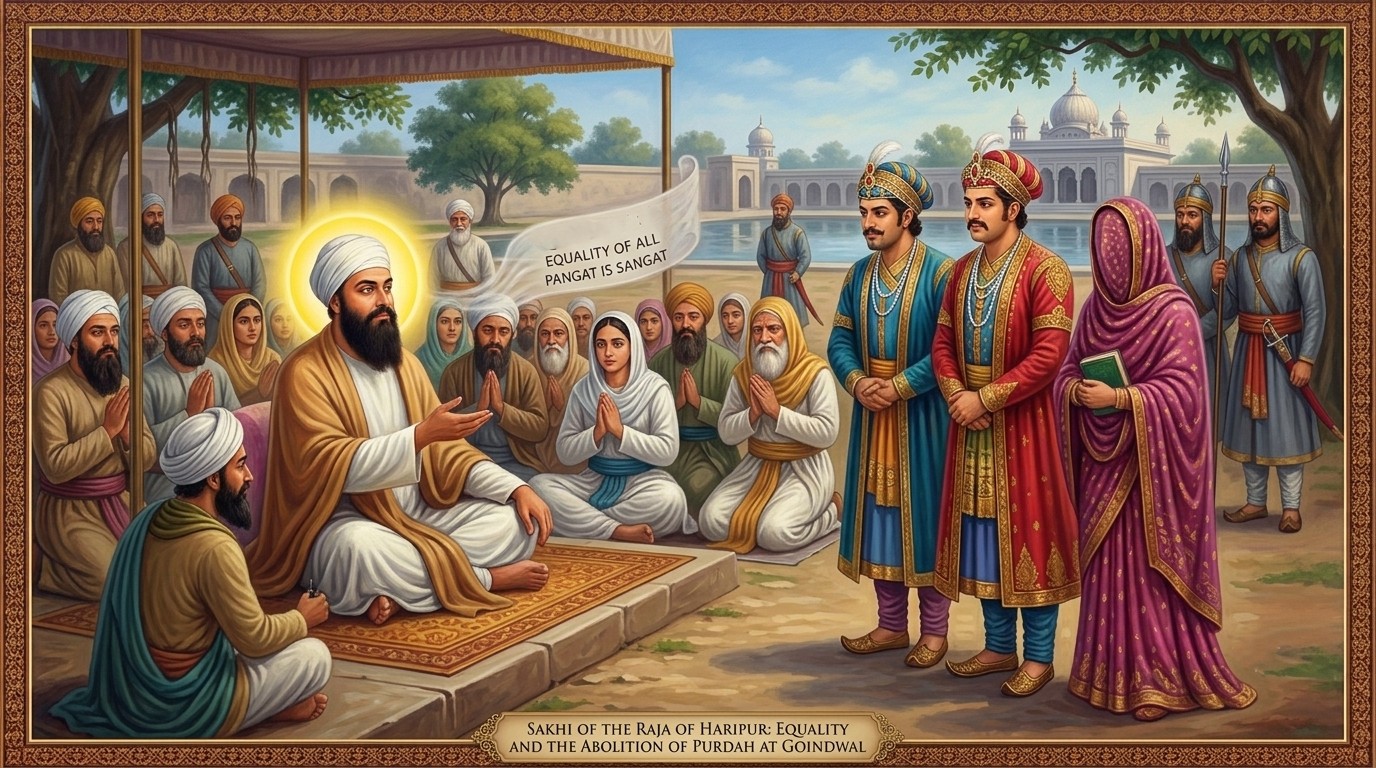
The Goindwal Revolution: Unmasking the Illusions of 16th-Century Society
Imagine walking into a space where every single rule of society is completely turned on its head. Picture a world deeply fractured by caste divisions, where the touch of a lower-caste person is treated as spiritual contamination, and where women are relegated to the dark, silent corners of households, hidden behind thick veils, or worse, forced onto the burning funeral pyres of their husbands. This was the grim reality of 16th-century India. But in the midst of this darkness, a magnificent spiritual and social revolution was quiet but powerful, pulsing through the dusty streets of Goindwal Sahib, led by Guru Amar Das Ji, the third spiritual sovereign of the Sikhs. To our young adults navigating the modern world—a world filled with digital masks, social media filters, and superficial hierarchies—Goindwal Sahib represents the ultimate sanctuary of raw, uncompromised, and unmasked truth. It was a place where temporal crowns bowed to spiritual sovereignty, and where the human soul was finally liberated from the artificial chains of caste, class, and gender.
Guru Amar Das Ji did not merely preach abstract, mystical concepts in isolation; he operationalized them into daily, revolutionary actions. He established the bedrock principle of "Pangat Sangat"—the mandatory rule that whoever wished to have an audience with the Guru must first sit flat on the floor in a single line (Pangat) and partake in a simple, free meal from the communal kitchen (Langar) alongside the poorest outcasts, the untouchables, and the beggars of the land. This was a direct, devastating strike against the caste system. When the mighty Mughal Emperor Akbar made his periodic journey from Delhi to Lahore and stopped at Goindwal Sahib to pay his respects, he was told the same rule applied to him. Without a single moment of hesitation, the Emperor of India sat on the mud floor with commoners, ate the simple vegetarian food, and bowed before the spiritual majesty of the Guru. But the revolution did not stop with the leveling of social classes; it was about to confront the deeply entrenched, patriarchal oppression of women through a dramatic encounter with the royal court of Haripur.
The Pride of Haripur: Royalty Enters the Court of the True King
Shortly after the visit of Emperor Akbar, the Raja of Haripur, a proud and powerful Rajput ruler named Raja Hari Chand, decided to visit Goindwal Sahib. He had heard of this incredible, elderly Guru who commanded the respect of emperors, cured the sick, and established a new, sovereign way of life. The Raja, accompanied by his massive royal entourage of ministers, soldiers, and his queens, arrived in Goindwal with all the pomp and pageantry of medieval royalty. The Raja was accustomed to absolute subservience; wherever he walked, commoners fell to their knees, and his subjects trembled at his word. Yet, as he stepped into Goindwal, he was met with the humbling requirement of the Guru’s court: before he could see Guru Amar Das Ji, he, too, had to sit in the Langar line and eat with the common folk. Bowing to the spiritual authority of the Guru, the Raja agreed, sitting shoulder-to-shoulder with peasants to eat his meal, a powerful testament to the breaking of his aristocratic ego.
However, the real test of this encounter lay not with the Raja, but with his royal household. Among his entourage was his newly married, young queen, a Rani who had been raised in the strict, ultra-conservative traditions of the Rajput nobility. In her world, a woman’s modesty and honor were inextricably tied to the Purdah (or Parda) system—the mandatory practice of wearing a thick, heavy veil over the face to shield herself from the gaze of the world. The Purdah was not merely a piece of fabric; it was a physical manifestation of a patriarchal structure that viewed women as private property, hidden away as objects of luxury, denied a public voice, and excluded from active participation in society. As the royal family prepared to enter the presence of Guru Amar Das Ji for their formal audience (Sangat), the young queen refused to lift her veil, insisting on maintaining her hidden, aristocratic isolation in the spiritual court of the True King.
The Clash of Pride and Purdah: The Guru's Radical Stance on Women's Dignity
As the royal queens filed into the presence of Guru Amar Das Ji, they sat among the congregation of devout Sikhs, both men and women, who were listening to the sublime singing of Gurbani. In the Guru’s court, women did not sit behind screens or in segregated enclosures; they sat as equal, sovereign participants in the divine gathering. When the young queen of Haripur entered, she sat down but remained completely veiled, her face shrouded in the heavy folds of her royal Purdah. Guru Amar Das Ji, whose inner vision saw through all physical and psychological masks, immediately noticed this act of stubborn adherence to oppressive cultural norms. The Guru did not view her veil as a symbol of modesty; he recognized it as a symbol of spiritual pride, social division, and a refusal to accept the absolute equality of the Khalsa congregation.
With immense spiritual authority and complete fearlessness, Guru Amar Das Ji addressed the veiled queen directly. The Guru calmly but firmly remarked: "If you do not wish to see the face of the Guru, or if you consider the congregation of the True Lord to be unworthy of your gaze, why have you come here at all? In the house of Guru Nanak, there is no room for the artificial concealment of women. Lift your veil, cast away this false pride of status, and stand as a free, equal soul in the light of the Creator." This was a revolutionary declaration. The Guru was openly challenging a centuries-old social institution that had been enforced by both the Hindu Rajput nobility and the ruling Islamic elites. He was declaring that a woman’s face is a reflection of the Divine, not a source of shame or temptation that must be hidden away from the world. He was asserting that true modesty lies in the purity of the heart, not in the confinement of a veil.
Guru Amar Das’s Radical Manifesto: Dismantling the Structures of Patriarchy
To fully appreciate the magnitude of this encounter, my dear young friends, we must understand that Guru Amar Das Ji was carrying out a systematic, theological deconstruction of gender oppression. The rejection of the Purdah system was not an isolated incident; it was a core pillar of his spiritual manifesto. In medieval India, women were subjected to the horrific practice of Sati—the forced or coerced self-immolation of a widow on her deceased husband's funeral pyre. Guru Amar Das Ji fiercely campaigned against this murderous custom, writing beautiful, revolutionary verses in the Sri Guru Granth Sahib to redefine what a true "Sati" is. He declared: "They are not Satis, who burn themselves with their husband's corpse. Rather, they are Satis, who die by the mere shock of separation, and those who abide in modesty, contentment, and virtue, remembering their Lord daily."
Furthermore, Guru Amar Das Ji completely revolutionized the religious and administrative structures of the early Sikh Panth by establishing the **Manji** and **Pirhi** systems. To manage the rapidly growing Sikh community across the subcontinent, he appointed twenty-two dioceses (Manjis) led by devout Sikhs. In a move that was entirely unprecedented in the global history of religion, he established a parallel missionary system called **Pirhian** (literally meaning "spiritual cots"), which were led entirely by highly educated, spiritually advanced women. These women were sent out as sovereign emissaries to preach, teach Gurbani, administer communities, and educate other women in social, political, and spiritual matters. By giving women the authority to lead congregations, manage finances, and guide spiritual seekers, Guru Amar Das Ji proved that in Sikhism, gender is completely irrelevant to spiritual attainment and administrative leadership. The veil of the queen of Haripur was a direct challenge to this newly established era of female empowerment, and the Guru refused to let it stand.
The Madness of the Mask: The Queen's Psychological and Spiritual Crisis
When the young queen of Haripur heard the penetrating, authoritative words of Guru Amar Das Ji, her fragile world was completely shattered. Her entire identity had been constructed on her royal status, her high-caste Rajput lineage, and the physical boundaries of her veil. To be publicly challenged by the Guru, to be told that her veil was an instrument of false pride and that she was no different from the common peasants sitting around her, triggered a severe psychological crisis. In a state of intense shock, embarrassment, and spiritual blockage, she lost all control of her mind. The heavy burden of her suppressed emotions and her massive, bruised ego erupted. She began to scream hysterically, tore off her royal veil, ripped her fine silken clothes, and ran out of the Goindwal sanctuary in a state of absolute madness.
The young queen, once a symbol of pampered, aristocratic luxury, fled into the dense, wild jungles surrounding Goindwal Sahib. For months, she lived like a wild animal, her hair matted, her body covered in dirt, completely out of her mind. She would wander through the forest, screaming to herself, stealing scraps of food from the outskirts of the town at night, and living in complete exile. This tragic descent into madness is a powerful psychological metaphor for what happens when we cling to our false egos and societal masks. When our external titles, our social media personas, and our material illusions are stripped away, if we do not have a strong spiritual foundation of humility, we break. The queen’s physical madness was simply the externalization of the internal spiritual chaos she had carried behind her beautiful, expensive veil. She had become a captive of her own pride, exiled in the jungle of her shattered ego.
The Path of Sachan Sach: Humility, Surrender, and the Miracle of Redemption
In Goindwal Sahib, there lived a deeply devoted, simple-hearted Sikh named Bhai Sachan Sach. He was a man of intense faith who spent his days gathering firewood from the jungle for the Guru’s Langar, washing dishes, and serving the Sangat. He was called "Sachan Sach" because after every single word spoken by Guru Amar Das Ji, he would simply say with absolute, child-like devotion, "Sach ji, sach" (True sir, true). He had completely surrendered his intellect and his ego to the Guru. One day, while gathering wood deep in the forest, Sachan Sach was suddenly attacked by the wild, screaming, and naked queen. She scratched and bit him, driven by her madness. Sachan Sach managed to escape and returned to Goindwal, bruised and battered, and told the Guru that a "demon-possessed witch" had attacked him in the jungle.
Guru Amar Das Ji listened to the story with deep compassion. He knew that the wild woman was the fallen queen of Haripur, and that the time for her spiritual redemption had come. The Guru handed Sachan Sach one of his old, worn leather slippers (slippers or shoes were historically considered symbols of the lowest humility) and told him: "Go back into the jungle, my beloved Sikh. When this woman attacks you again, simply touch her head with this slipper." Sachan Sach, with his characteristic faith, went back into the forest. When the wild queen leapt out to attack him, he quickly reached out and touched her head with the Guru's slipper. In that instant, a miracle occurred. The spiritual vibration of the Guru's humility, channeled through the humble slipper, shattered her madness. Her ego died, her mind cleared, and she was instantly restored to her full senses. She looked at her dirty, naked state, filled with confusion and shame, realizing for the first time the tragic folly of her past pride.
The Shawl of Equality: Rebuilding a Life on the Foundation of Gurmat
Seeing her confusion and vulnerability, Sachan Sach was filled with immense compassion. He did not judge her for her past arrogance or her wild behavior. He tore his own shawl in half and gave it to her so she could cover herself, demonstrating the true, protective, and respectful nature of a Sikh warrior-scholar. He brought her back to the sanctuary of Goindwal Sahib, where she fell at the feet of Guru Amar Das Ji, weeping tears of genuine repentance and gratitude. The Guru blessed her, explaining that her madness was the painful but necessary death of her false, veiled ego, and that she had now been reborn as a free, sovereign daughter of the Guru. She discarded the Purdah system forever, realizing that her true covering was not a physical veil of oppression, but the robe of divine grace, modesty, and honor given to her by the Guru.
With the Guru’s blessings, the redeemed queen and Bhai Sachan Sach were married, establishing a beautiful, egalitarian household that became a shining beacon of the Sikh way of life. The Raja of Haripur, witnessing this incredible transformation of his queen and the profound wisdom of the Guru, became a devoted disciple of the Sikh path, dedicating his wealth and influence to the service of humanity. This Sakhi is a powerful reminder that Guru Amar Das Ji did not just talk about women’s rights; he actively intervened to rescue women from the physical, social, and psychological prisons of their era. He replaced the oppressive Purdah with the "Shawl of Equality," proving that a woman’s worth is found in her direct, unmediated relationship with the Creator, and her active, unmasked leadership in the community.
A Paradigm Shift: Breaking the Veils of Oppression
To help us systematically understand the radical social changes introduced by Guru Amar Das Ji through this encounter and his wider ministry, let us examine the differences between the prevailing medieval social systems and the revolutionary Gurmat paradigm:
| Social Dimension | The Medieval Feudal Paradigm (Rajput/Mughal) | The Revolutionary Gurmat Paradigm (Guru Amar Das Ji) |
| Social Visibility (Purdah) | Mandatory veiling; women hidden from public life, assemblies, and decision-making. | Abolished the Purdah; women participate openly in Sangat and sit as equals without veils. |
| Leadership Roles | Women excluded from religious clergy, administrative power, and intellectual leadership. | Established the Pirhi system; appointed women as spiritual and administrative leaders. |
| The Practice of Sati | Forced or coerced self-immolation of widows, viewing them as useless without a husband. | Banned Sati; redefined true devotion as living a life of spiritual grace and remembering the Divine. |
| Marital Autonomy | Widows treated as cursed outcasts, forbidden from ever remarrying or living normal lives. | Advocated for and institutionalized widow remarriage, restoring their dignity and social rights. |
| The Source of Modesty | Externalized through physical veils, segregation, and restriction of movement. | Internalized through character, humility, devotion, and a pure heart. |
Unveil Your Soul: The Challenge for Modern Young Adults
My beloved young friends, as we reflect on this historic Sakhi, we must ask ourselves an urgent question: What are the "veils" that we are wearing today? We may not wear physical, embroidered Rajput Purdahs, but we carry heavy, invisible veils every single day. We wear the veil of social media perfection, hiding our anxieties and struggles behind carefully curated feeds. We wear the veil of peer pressure, conforming to toxic trends to avoid being judged or ignored. We wear the veils of arrogance, intellectual pride, and material status, looking down on others who do not have the same privileges. Just like the queen of Haripur, our obsession with these masks can lead to a quiet, internal madness—an anxiety-ridden exile in the jungle of our own fragile egos, detached from our true spiritual selves.
The call of Guru Amar Das Ji to the queen of Haripur is the exact same call he extends to you today: "Lift your veil." Cast away the false pride, the superficial filters, and the fear of judgment. True empowerment does not come from hiding your true self or conforming to the oppressive expectations of a hyper-materialistic society. True sovereignty is found when you stand courageously in your own skin, anchored in the values of humility, selfless service, and love for the Creator. Let us honor the legacy of Goindwal Sahib by actively fighting against modern forms of female objectification and inequality, championing the voice of women in our Gurdwaras and communities, and living lives of unmasked, royal authenticity. Stand strong, stay humble, tear down the veils of division, and let the revolutionary light of the Guru guide your path forever.
Frequently Asked Questions
1. Who was the Raja of Haripur, and what was his historical connection to Guru Amar Das Ji?
The Raja of Haripur, named Raja Hari Chand, was a prominent Rajput ruler of a princely state in Punjab/Himachal hills. He visited Goindwal Sahib during the mid-16th century to pay his respects to Guru Amar Das Ji after hearing of the Guru’s rising spiritual influence, which also attracted the attention of Emperor Akbar.
2. What was the "Purdah" system, and why was it practiced in medieval India?
The Purdah (or Parda) system was a social and religious practice of veiling women's faces and segregating them from public gatherings. It was heavily practiced by both the ruling Muslim elites and the conservative Hindu Rajput nobility to enforce notions of family honor, but it effectively excluded women from public, intellectual, and spiritual life.
3. Why did Guru Amar Das Ji refuse to meet the queen of Haripur while she was veiled?
The Guru designed the Sikh path to be a sanctuary of absolute equality. He refused to grant an audience to the veiled queen to make a radical, public statement against the oppressive Purdah system, declaring that the court of Guru Nanak did not tolerate the artificial segregation or concealment of women based on patriarchal pride.
4. What psychological and spiritual lesson does the queen's subsequent "madness" teach us?
The queen's descent into madness symbolizes the spiritual crisis that occurs when a person's fragile, ego-based identity (built on royalty, status, and external masks) is shattered by absolute truth. Her exile in the jungle represents the internal state of a soul that is trapped by pride and disconnected from the humility of the Divine.
5. Who was Bhai Sachan Sach, and what was his role in this Sakhi?
Bhai Sachan Sach was a deeply devoted and humble Sikh of Guru Amar Das Ji who spent his days doing manual service (Seva) like gathering firewood for the Langar. He was sent by the Guru into the jungle to rescue the mad queen, using the Guru's slipper of humility to restore her sanity.
6. What is the spiritual significance of the Guru's slipper curing the queen's madness?
In Indian culture, the foot or slipper is a symbol of extreme humility. Touching the queen's head with the Guru's slipper represents the ultimate dismantling of her royal, caste-based arrogance. It was not a physical magic trick, but a spiritual catalyst of humility that broke her ego and restored her connection to her true, sane self.
7. What was the "Pirhi" system established by Guru Amar Das Ji?
The Pirhi system was a revolutionary missionary network established by Guru Amar Das Ji, consisting of highly educated, spiritually advanced Sikh women who were appointed to lead congregations, teach Gurbani, and spread the message of equality and social reform specifically among women across India.
8. How did Guru Amar Das Ji address the horrific practice of Sati?
Guru Amar Das Ji was a fierce opponent of Sati (widow burning). He wrote Gurbani verses defining a true Sati as a woman who lives in high moral character, devotion, and contentment, remembering the Creator, rather than physically immolating herself on her husband's pyre, thus banning the practice among Sikhs.
9. Did the queen of Haripur ever return to her royal lifestyle?
No. After her spiritual redemption, she chose to live a life of simple, unmasked devotion. She discarded her royal veil forever, married the humble Sikh Bhai Sachan Sach with the Guru's blessings, and together they established an exemplary, egalitarian household dedicated to the service of the Panth.
10. How does this Sakhi apply to the struggles of modern young adults?
This Sakhi challenges modern young adults to identify and remove their own "invisible veils"—such as social media personas, toxic peer conformity, and superficial ego-drives. It teaches that true empowerment and mental peace come from discarding false masks and living in absolute, uncompromised spiritual authenticity and equality.
Guru Amar Das Ji (1479–1574)
Accompanied Akbar to meet the Guru; his queen's refusal to unveil her face led to a discourse on the equality of women and the abolition of the Purdah system.
- Role
- Local Hill King
- Group
- The Mughal Throne
- Period
- Guru Amar Das Ji (1479–1574)