Historical Turning Points · Living Heritage
The Akali Movement & SGPC in 1920
A non-violent struggle to liberate Gurdwaras from Mahant control, leading to the formation of the SGPC.
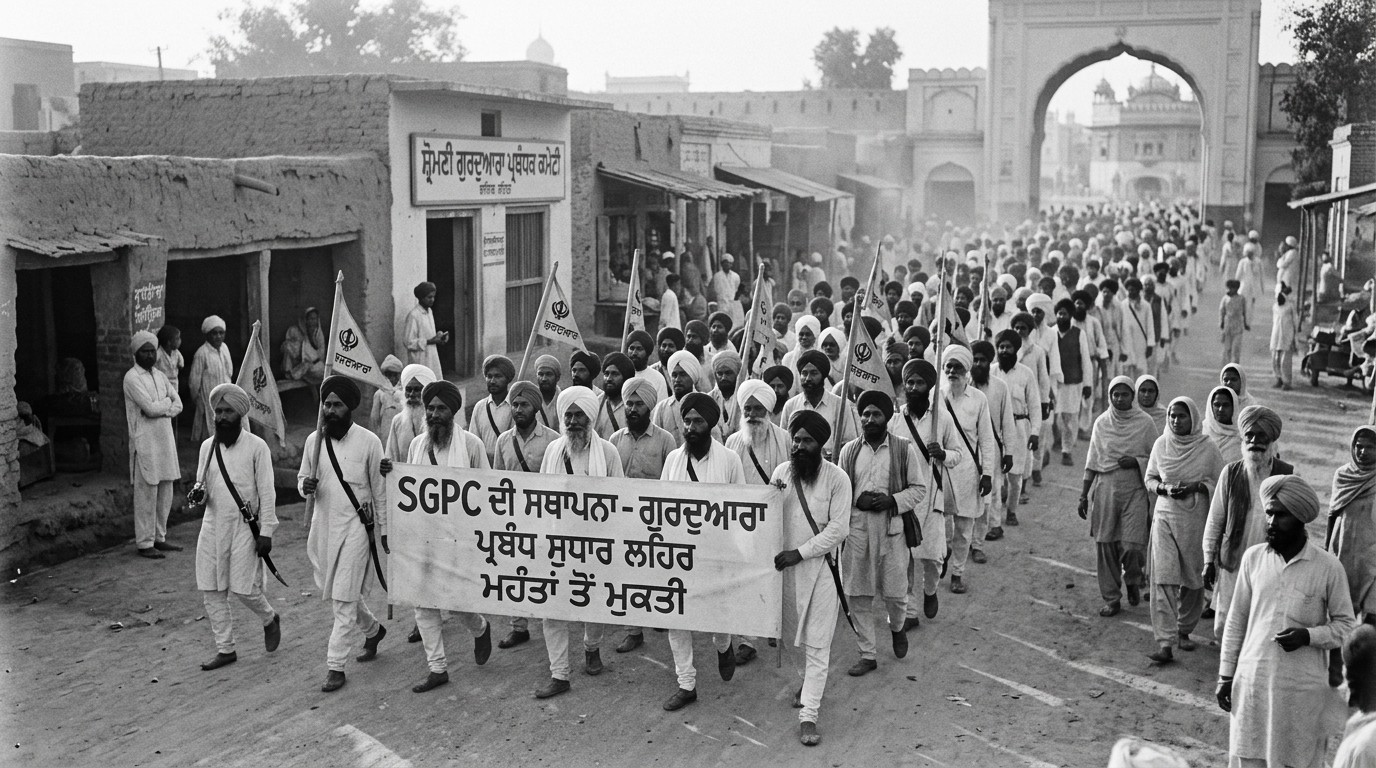
The Akali Movement and the Birth of the SGPC: A Non-Violent Sikh Struggle for Religious Freedom and Institutional Reform
The history of the Sikh community in the early twentieth century is marked by one of the most remarkable examples of disciplined, mass-based, non-violent resistance in South Asia. The Akali Movement, which emerged during the 1920s, was not merely a campaign to reclaim buildings and religious properties. It was a profound struggle for spiritual integrity, community self-governance, and the restoration of Sikh religious institutions to the principles established by the Sikh Gurus. The movement arose from widespread dissatisfaction with the control exercised by hereditary custodians known as Mahants over many historic Gurdwaras. These custodians, who had often inherited their positions over generations, managed some of the most sacred Sikh shrines. Yet by the late nineteenth and early twentieth centuries, many Sikhs believed that numerous Mahants had drifted far from Sikh teachings, misused Gurdwara resources, and transformed institutions established for collective worship into personal estates. The resulting conflict gave rise to a powerful reform movement that reshaped Sikh history and culminated in the formation of the Shiromani Gurdwara Parbandhak Committee (SGPC), an institution that remains central to Sikh religious administration today.
The Historical Background: How the Mahants Came to Control Sikh Shrines
To understand the Akali Movement, one must first examine the historical circumstances that allowed Mahants to dominate Sikh religious institutions. During the eighteenth century, Sikhs faced severe persecution under Mughal and Afghan rulers. In those turbulent decades, many historic Gurdwaras lacked centralized administration because the Sikh community was focused on survival and military resistance. As a result, local custodians often assumed responsibility for maintaining shrines. Over time, these custodians evolved into hereditary managers known as Mahants. During the Sikh Empire under Maharaja Ranjit Singh, many Gurdwaras received generous land grants and financial support. Following the British annexation of Punjab in 1849, colonial authorities generally preferred indirect control and often recognized Mahants as legal custodians of Gurdwara properties. This policy strengthened their authority while weakening community oversight. In many places, Mahants accumulated considerable wealth and autonomy, creating a system that increasingly distanced Sikh institutions from the collective management envisioned in Sikh tradition.
By the late nineteenth century, Sikh reformers began voicing concerns about the condition of several major shrines. Allegations emerged that some Mahants engaged in practices inconsistent with Sikh doctrine, including ritual activities influenced by non-Sikh traditions, financial mismanagement, and personal enrichment through religious endowments. Although not every Mahant fit this description, the perception of widespread corruption gained significant traction among the Sikh population. Reform-minded Sikhs believed that sacred institutions established through the sacrifices of the Gurus and countless martyrs should not function as hereditary possessions. Instead, they argued that Gurdwaras belonged to the Sikh Panth and should be administered through representative and accountable institutions.
The Rise of Sikh Reform Consciousness
The foundations of the Akali Movement were laid by earlier Sikh reform initiatives, particularly the Singh Sabha Movement of the late nineteenth century. Founded in 1873, the Singh Sabha sought to revive Sikh education, literature, theology, and identity. Its leaders worked tirelessly to promote the teachings of the Guru Granth Sahib, standardize Sikh practices, and counter both missionary activity and internal religious distortions. Through newspapers, schools, publications, and public debates, the Singh Sabha cultivated a renewed awareness of Sikh history and doctrine. This intellectual awakening helped create a generation of Sikhs who viewed the control of Gurdwaras by unaccountable Mahants as incompatible with Sikh values.
The reformist spirit generated by the Singh Sabha eventually evolved into a more organized campaign focused on institutional change. Sikhs increasingly recognized that religious reform required structural transformation. While theological education was essential, it could not fully address concerns surrounding the administration of sacred shrines. The demand for community control of Gurdwaras therefore became one of the defining issues of Sikh public life in the early twentieth century.
The Formation of the Akali Movement
The Akali Movement emerged as a mass mobilization dedicated to liberating Sikh Gurdwaras from Mahant control and placing them under representative management. The term "Akali" carried deep historical significance, recalling the fearless Sikh warriors associated with the Khalsa tradition. Yet the movement adopted methods that emphasized non-violent discipline rather than armed confrontation. Inspired by Sikh principles of sacrifice, courage, and service, volunteers organized themselves into disciplined groups known as jathas. These jathas traveled to contested Gurdwaras, conducted peaceful occupations, and accepted arrest, imprisonment, and even death without retaliation.
The movement gained momentum because it appealed to ordinary Sikhs across social, economic, and regional boundaries. Farmers, laborers, merchants, students, religious scholars, and veterans joined the struggle. Women also played significant roles by supporting volunteers, organizing community resources, and participating in public demonstrations. The Akali Movement thus evolved into a broad-based expression of Sikh collective identity. It demonstrated the capacity of the Panth to mobilize around religious principles while maintaining remarkable organizational discipline.
The Nankana Sahib Tragedy: A Turning Point
One of the most significant and tragic events in the Akali Movement occurred at Gurdwara Nankana Sahib, the birthplace of Guru Nanak. The shrine was under the control of Mahant Narain Das, whose administration had become the subject of serious criticism. Reformers accused him of corruption, moral misconduct, and resistance to community oversight. In February 1921, a peaceful jatha of Sikh volunteers entered the shrine intending to assert Panthic control. Instead, they encountered brutal violence. Armed men associated with the Mahant attacked the unarmed volunteers, resulting in the massacre of a large number of Sikhs.
The Nankana Sahib massacre shocked Punjab and reverberated throughout the Sikh world. The victims had entered the shrine peacefully and without weapons, making their deaths symbols of religious sacrifice. Public outrage intensified demands for reform and attracted widespread support for the Akali cause. The tragedy transformed the movement from a regional campaign into a powerful moral crusade. It also exposed the inability of existing structures to protect Sikh religious interests and strengthened calls for a representative governing body.
The Keys Morcha and the Assertion of Sikh Rights
Another pivotal episode occurred during the Keys Morcha of 1921. The British authorities seized the keys of the treasury belonging to the Golden Temple complex, a move widely interpreted as interference in Sikh religious affairs. Sikh leaders launched a peaceful campaign demanding the return of the keys. The issue quickly became symbolic of a larger struggle for religious autonomy and community rights. Faced with sustained public pressure and determined non-violent resistance, the colonial government eventually returned the keys.
The victory carried significance far beyond the immediate dispute. It demonstrated that organized, disciplined action could compel authorities to recognize Sikh demands. The event also enhanced the legitimacy of emerging Sikh leadership and strengthened confidence in collective mobilization. Many Sikhs viewed the return of the keys as a moral triumph that validated the principles guiding the Akali Movement.
The Guru Ka Bagh Morcha and the Power of Non-Violent Resistance
The Guru Ka Bagh Morcha of 1922 further illustrated the extraordinary discipline of Akali volunteers. The dispute centered on the right of Sikhs to collect firewood from land associated with a Gurdwara. When authorities intervened and arrests began, volunteers responded with organized non-violent resistance. Jathas marched forward in succession, fully aware that they would face severe beatings and imprisonment. Observers, including journalists and international witnesses, documented scenes of volunteers enduring violence without retaliation.
The moral impact of the Guru Ka Bagh Morcha was immense. Reports of the volunteers' courage spread throughout India and beyond. The movement demonstrated that non-violent resistance was not merely a political tactic but a profound expression of Sikh spiritual conviction. Participants viewed suffering endured for a righteous cause as an extension of the Sikh tradition of martyrdom and sacrifice. Their conduct earned widespread admiration and further legitimized demands for Gurdwara reform.
The Creation of the Shiromani Gurdwara Parbandhak Committee (SGPC)
As the struggle intensified, Sikh leaders recognized the need for a central institution capable of managing Gurdwaras on behalf of the Panth. In November 1920, representatives from across the Sikh community gathered and established the Shiromani Gurdwara Parbandhak Committee, commonly known as the SGPC. The committee was conceived as a democratically accountable body responsible for supervising major Sikh shrines, safeguarding religious traditions, and ensuring transparent administration.
The SGPC represented a revolutionary departure from hereditary management. Instead of authority flowing through family lineage, governance would be rooted in collective representation. The institution embodied the Sikh principle that the community as a whole bears responsibility for preserving and administering its religious heritage. Through elected representation and structured oversight, the SGPC sought to align Gurdwara administration with Sikh teachings and community expectations.
The formation of the SGPC also provided organizational coherence to the Akali Movement. It served as a central coordinating body for reform efforts, negotiations, legal challenges, and public campaigns. By creating a recognized institution capable of articulating Sikh demands, the movement gained greater unity and effectiveness.
The Sikh Gurdwaras Act of 1925
The sustained pressure generated by the Akali Movement eventually compelled the British government to address the issue through legislation. After years of protests, arrests, negotiations, and public campaigns, the Sikh Gurdwaras Act was enacted in 1925. This landmark legislation legally recognized Sikh control over many historic Gurdwaras and established frameworks for their administration through representative institutions.
The Act marked a watershed moment in Sikh history. It transferred authority from many Mahants to bodies accountable to the Sikh community and formalized the role of the SGPC in managing major shrines. While debates and legal disputes continued in some cases, the legislation represented a decisive victory for the reform movement. It validated years of sacrifice and confirmed the principle that Sikh religious institutions should be governed by the Sikh Panth rather than hereditary custodians.
The Legacy of the Akali Movement
The Akali Movement occupies a unique place in the history of religious reform movements worldwide. It combined spiritual conviction, democratic aspirations, organizational discipline, and non-violent resistance in a manner that profoundly transformed Sikh institutional life. The movement demonstrated that ordinary believers could challenge entrenched systems of authority through collective action grounded in ethical principles. Its success was achieved not through military force but through sacrifice, perseverance, and moral courage.
The SGPC emerged as the most enduring institutional legacy of the movement. Today, it continues to oversee the administration of major Sikh Gurdwaras and plays a central role in religious, educational, and cultural affairs. Although the SGPC has evolved over time and remains subject to debate and criticism like any major institution, its origins lie in a historic struggle to ensure that Sikh shrines would be managed in accordance with the values of accountability, community participation, and service.
The Akali Movement also reinforced broader themes within Sikh history. It reflected the enduring commitment of the Sikh community to justice, collective responsibility, and the defense of religious principles. The volunteers who participated in the morchas embodied the Sikh ideal of standing firmly against injustice while maintaining discipline and dignity. Their sacrifices continue to inspire generations of Sikhs around the world.
Conclusion
The Akali Movement was far more than a campaign for administrative reform. It was a transformative chapter in Sikh history that sought to restore the connection between sacred institutions and the community they served. Through non-violent resistance, immense sacrifice, and remarkable organizational unity, Sikhs succeeded in reclaiming control of their historic shrines and establishing a representative system of governance through the SGPC. The movement stands as a testament to the power of collective action rooted in faith, demonstrating how spiritual principles can guide successful struggles for justice and institutional renewal. Nearly a century later, the story of the Akali Movement continues to resonate as one of the most significant examples of religious reform, democratic mobilization, and non-violent resistance in modern history.
Frequently Asked Questions (FAQ)
1. What was the Akali Movement?
The Akali Movement was a Sikh reform movement during the 1920s that sought to free historic Gurdwaras from the control of hereditary Mahants and place them under accountable Sikh management.
2. Why did Sikhs oppose the Mahants?
Many Sikhs believed that numerous Mahants had become corrupt, misused Gurdwara resources, and introduced practices inconsistent with Sikh teachings.
3. Was the Akali Movement violent?
No. The movement is remembered primarily for its disciplined non-violent methods, with volunteers willingly enduring arrests, beatings, and imprisonment without retaliation.
4. What was the significance of the Nankana Sahib massacre?
The massacre of peaceful Sikh reformers in 1921 galvanized public opinion, intensified support for the movement, and became a symbol of Sikh sacrifice.
5. What was the Keys Morcha?
The Keys Morcha was a campaign demanding the return of keys to the Golden Temple treasury after British authorities seized them. The successful protest became a major victory for Sikh rights.
6. What happened during the Guru Ka Bagh Morcha?
Sikh volunteers engaged in peaceful resistance while facing severe police violence. Their discipline attracted international attention and strengthened support for the reform movement.
7. When was the SGPC formed?
The Shiromani Gurdwara Parbandhak Committee (SGPC) was established in November 1920 as a representative body to manage Sikh Gurdwaras.
8. What is the role of the SGPC?
The SGPC administers major Sikh Gurdwaras, promotes Sikh education and culture, oversees religious affairs, and helps preserve Sikh heritage.
9. What was the Sikh Gurdwaras Act of 1925?
The Act legally recognized Sikh control over many historic Gurdwaras and established the framework for their management through representative institutions, including the SGPC.
10. Why is the Akali Movement important today?
The movement remains a powerful example of non-violent resistance, religious reform, democratic governance, and collective Sikh action in defense of faith and community rights.