TheSri Harmandir Sahib (The Golden Temple Sarovar)

Guru Ram Das Ji designed and began the excavation of the sacred 'Amrit Sarovar' (Pool of Nectar) in 1577, inviting 52 types of tradespeople to settle around it to ensure the city's prosperity. The Amrit Sarovar became the Blueprint of Amritsar.
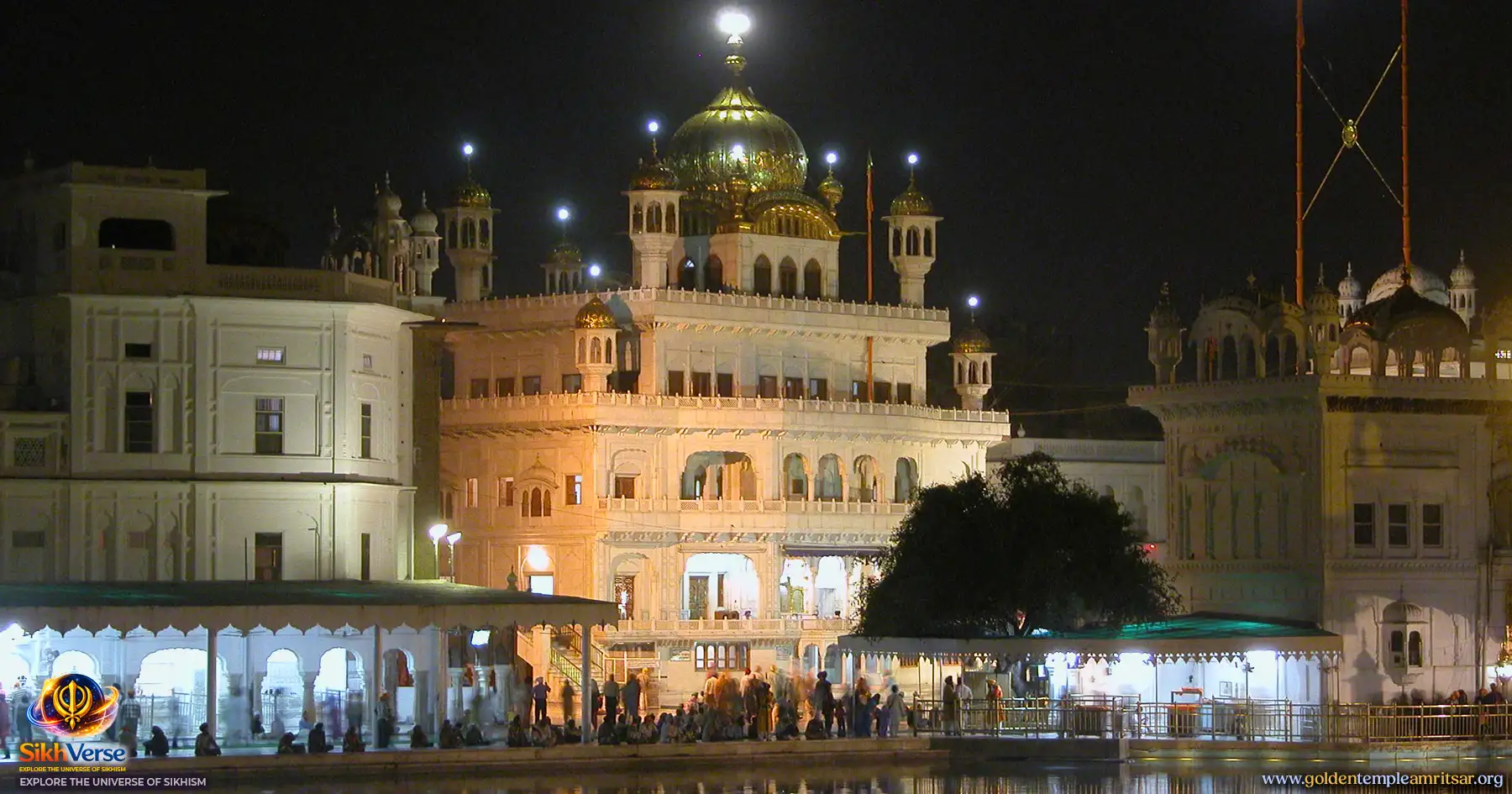
There is a moment — and every pilgrim who has ever descended the marble steps into the Amrit Sarovar knows it with absolute certainty — when history stops being an abstraction. The water is cool, and it is old, and it holds within its depth more than four centuries of supplication, suffering, resilience, and gratitude. As a historian who has spent three decades tracing the evolution of Sikh sacred space, I confess freely that no manuscript I have ever read, no firman or hukamnama or colonial survey report, has communicated the meaning of the Sarovar to me quite so directly as simply standing waist-deep within it at the hour before sunrise, when the dome of the Harmandir Sahib glows above the dark water like a sovereign sun that has chosen to rise from the earth rather than the heavens.
The Naming of a City
The Amrit Sarovar — "the pool of the nectar of immortality" — is not merely a feature of the Golden Temple complex; it is the reason the city of Amritsar exists at all. The land on which it sits was granted to Guru Ram Das, the fourth Sikh Guru, by the Mughal Emperor Akbar sometime around 1574 CE, according to the most widely accepted historical accounts, though the precise date and terms of the grant have been subject to scholarly debate. What is not in dispute is that Guru Ram Das chose this flat, marshy ground in the Punjab plains and began excavating a tank of remarkable scale. The project was continued and substantially completed by his son and successor, Guru Arjan Dev, the fifth Guru, between approximately 1581 and 1604 CE. It was Guru Arjan Dev who also composed the Adi Granth — the original compilation of Gurbani — and installed it within the newly completed Harmandir Sahib at the center of the Sarovar in 1604, an act of theological and architectural unity that declared the scripture and the sacred pool to be inseparable. The town that grew up around this excavation took its name directly from the water: Amritsar, "the city of the immortal pool."
"The water does not merely surround the shrine — it is its argument. The Harmandir Sahib floats because it must; divinity, the architecture insists, is not anchored to the earth."
Architecture as Theology
The Sarovar measures approximately 150 meters on each side — a nearly perfect square of roughly 500 by 500 feet — and this symmetry is deliberate. The square in Sikh cosmological thought signifies completeness, the equal embrace of all directions, and by extension all peoples. Unlike many Hindu tirths of the period, which were bounded by elaborate ghats accessible only to the ritually pure, the Sarovar was designed from its inception to receive everyone. Guru Arjan Dev made the four entrances to the complex face the four cardinal directions, a pointed theological statement in an age of rigid caste hierarchy: there is no direction from which one cannot approach the Divine. The parkarma — the marble walkway that circumambulates the tank — connects these four entrances in an unbroken circuit, so that a pilgrim walking its 1,700-foot perimeter is participating in a living symbol of inclusivity made stone and water.
The causeway — the Guru's Bridge, the Gurus' Pul — stretches sixty-two meters from the northern parkarma out to the island shrine, and it is one of the more quietly extraordinary pieces of sacred engineering in South Asia. Measuring approximately four feet in width, it is deliberately narrow: the pilgrims who walk it must walk slowly, and largely in single file, which breaks the rhythm of ordinary life and imposes a meditative pace before one arrives at the threshold of the Harmandir Sahib itself. This is not accidental. Guru Arjan Dev was a poet of immense subtlety — his compositions constitute the largest single contribution to the Guru Granth Sahib — and the approach to his shrine reflects a poet's understanding that arrival must be earned through preparation, that sacred space is not simply entered but approached.
The Hydraulics of the Holy
The engineering of the Sarovar deserves more attention than it typically receives in popular accounts, which tend to dwell on its spiritual significance while neglecting the remarkable practical intelligence that sustains it. The tank is fed by a channel drawn from the Ravi River — now, after the Partition-era canal redistributions, from the Upper Bari Doab Canal system — and it has been maintained through a sophisticated system of sluices and drainage channels since at least the early seventeenth century. The Sarovar is not stagnant water; it circulates. Mughal-era records, and later the detailed surveys conducted during British administration in the nineteenth century, confirm that the water level and purity of the tank was a matter of continuous institutional concern. The tank is periodically drained and cleaned — a process called sewa, or selfless service — in which tens of thousands of devotees participate voluntarily, using their hands, small shovels, and buckets to remove the silt and deposit from the bed, before the tank is refilled. The most famous such sewa in recorded history occurred in 1923, when the Shiromani Gurdwara Parbandhak Committee organized a cleaning that drew participants from across the subcontinent and lasted for several days. There is a theological completeness to the idea that the holiest water in Sikhism is kept holy not by priests but by ordinary devotees who wade into the emptied tank with their tools of labour.
A History Written in Destruction and Reconstruction
To understand the Sarovar is to understand Sikh history as a whole, for the tank has been desecrated, drained, filled with rubble, and restored more times than any other sacred site on the subcontinent. The Afghan general Ahmad Shah Durrani, who invaded the Punjab multiple times in the mid-eighteenth century, made the destruction of the Sarovar a deliberate instrument of religious terror. In 1757, his forces defiled the tank by slaughtering cows within it — a calculated act of pollution aimed at making the water ritually unusable. Sikh oral tradition records that a young warrior named Baba Deep Singh, already wounded in battle, managed to reach the parkarma of the Harmandir Sahib before dying; his willingness to die in the defense of the Sarovar became one of Sikhism's most enduring martyrdom narratives. The Afghans returned in 1762, filling the Sarovar with debris and demolishing the Harmandir Sahib itself in an event known to Sikh historiography as the Vadda Ghalughara, or the Great Massacre. Within five years, the Sikh confederacy had expelled the Afghan garrison from Amritsar, excavated and refilled the tank, and rebuilt the shrine — a reconstruction achieved with such collective will and energy that it stands as one of the more remarkable instances of communal resilience in eighteenth-century South Asian history.
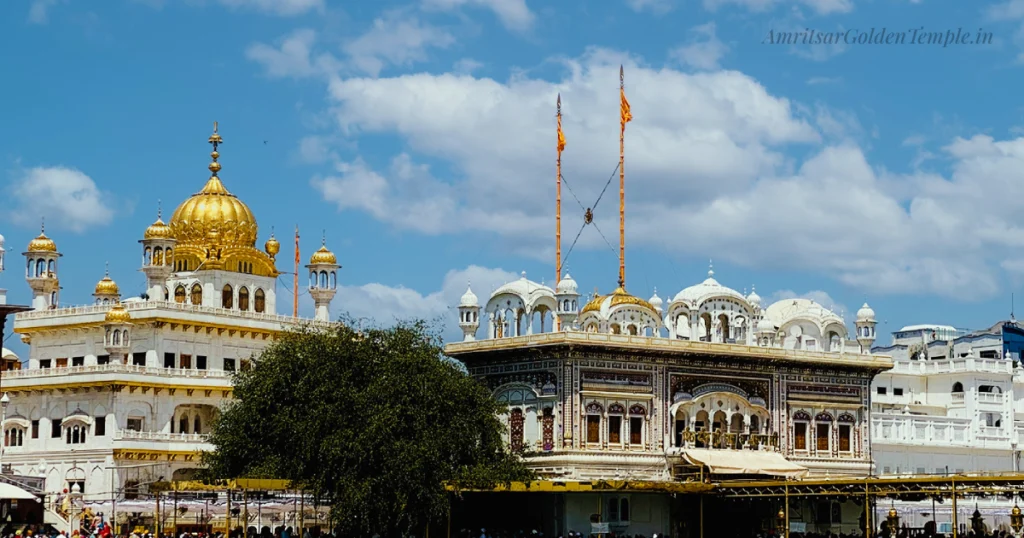
It was in the early nineteenth century, under the patronage of Maharaja Ranjit Singh, who ruled the Sikh Empire from Lahore, that the Harmandir Sahib received its famous covering of gilded copper sheets — the aesthetic transformation that gave the complex its colonial-era name, the Golden Temple. Ranjit Singh is said to have spent the equivalent of vast personal fortunes on the marble parkarma, the gold plating, and the extensive renovation of the surrounding complex. His contributions were motivated in part by personal piety — he visited the Sarovar regularly and credited his military successes to Waheguru's grace — and in part by the very legible political logic of a ruler who wished to present himself as the sovereign protector of the Sikh faith. Whatever the mixture of motives, the result was the complex that largely survives today: the white marble parkarma with its intricate pietra dura inlay, the gold dome reflected in the still water of the Sarovar, and the surrounding buildings — including the Akal Takht, the seat of temporal Sikh authority — that together constitute the most visited pilgrimage destination in South Asia.
The Sarovar as Living Scripture
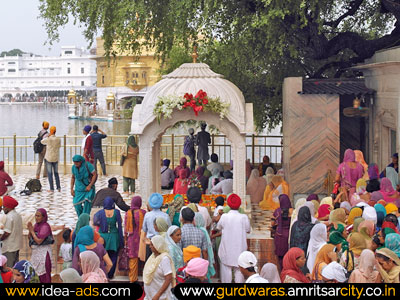
For the historian, the most compelling aspect of the Amrit Sarovar is not its architecture or even its turbulent past, but rather the way it functions as a living community. The tank is never empty of people. At two in the morning, there are bathers; at noon under the summer sun, there are bathers; at the hour before the Guru Granth Sahib is brought out for the daily procession in a gold palanquin — the Palki Sahib — there are bathers. The water is understood not as a metaphor for spiritual cleansing but as an agent of it, a medium through which the grace transmitted by the Gurus into the Sarovar at its founding continues to operate. This belief places the Amrit Sarovar within a very specific theological category — the tirth, or sacred ford — that is ancient in the Indian religious imagination, predating Sikhism by millennia. What Guru Arjan Dev and his predecessors did was to redefine the terms of what makes water holy: not the presence of a deity, not the geological accident of a confluence of rivers, not the sanction of a brahminic priesthood, but the community of faith that gathers around it, serves it, and entrusts to it their deepest needs.
When I stand on the parkarma in the early morning hours, I am aware — as a historian must always be — that the marble under my feet was laid in stages over two hundred years, that the reflections in the water before me are being seen simultaneously by a grandmother from a village in Hoshiarpur and a Sikh soldier from the diaspora in Vancouver and a young man from Hyderabad who has never been to Amritsar before, all of them drawn to the same water by the same gravitational pull that Guru Ram Das felt when he first looked at this flat Punjab ground and saw — with the peculiar vision of the faithful — an ocean. The Sarovar does not belong to the past. It belongs, with a completeness that few other sacred spaces in the world can claim, to the present.
-----------
- The founding under Guru Ram Das and completion by Guru Arjan Dev in the late 16th–early 17th century, and how the Sarovar gave Amritsar its name
- The theological architecture — the four cardinal entrances, the narrow causeway, the square geometry — and how each design choice makes an argument about equality and devotion
- The hydraulic engineering: how the tank circulates, drains, and is cleaned through communal *sewa*
- The cycles of desecration and rebuilding — particularly Ahmad Shah Durrani's attacks in the 1750s–60s and the extraordinary reconstruction by the Sikh confederacy
- Maharaja Ranjit Singh's golden renovation in the early 19th century
- A closing meditation on the Sarovar as a living community, not a museum piece
Location & contact
Amritsar, Punjab
- Associated Gurus: Guru Arjan Dev Ji