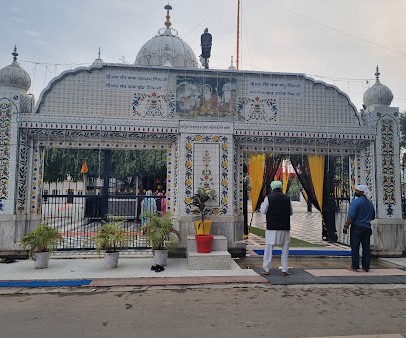
Gurudwara Shri Vivah Asthan Guru Teg Bahadur Sahib Ji
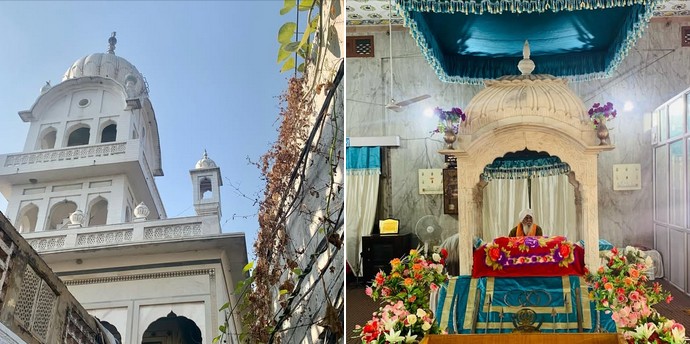
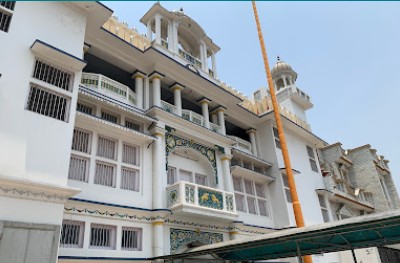
It is in the heart of this Jalandhar-district town that the magnificent, five-story <strong>Gurdwara Shri Niwas Ate Vivah Asthan Shri Guru Teg Bahadur Sahib Ji. On these grounds marriage of Mata Gujri Ji and Tyag Mal (later revered as Guru Teg Bahadur Ji, the ninth Guru of the Sikhs) was solemnized on February 4, 1633.
Gurudwara Niwas Ate Vivah Asthan Shri Guru Teg Bahadur Sahib Ji
There is a deeply historical town named Kartarpur in the Jalandhar district of Punjab, India. Founded in 1594 by the fifth Sikh Guru, Guru Arjan Dev Ji, this eastern Kartarpur became a thriving center of the Sikh faith during the 16th and 17th centuries.
It is in the heart of this Jalandhar-district town that the magnificent, five-story Gurdwara Shri Niwas Ate Vivah Asthan Shri Guru Teg Bahadur Sahib Ji stands.
This sacred space is far more than a monument of stone and marble; it marks the exact location of the ancestral home of Bhai Lal Chand Subhikkhi and Mata Bishan Devi—the parents of Mata Gujri Ji—and serves as the hallowed ground where her marriage to Tyag Mal (later revered as Guru Teg Bahadur Ji, the ninth spiritual guide of the Sikhs) was solemnized on February 4, 1633.
The Geopolitical and Familial Matrix of 17th-Century Kartarpur
To fully comprehend the historical weight of Gurdwara Vivah Asthan, one must delve into the migratory patterns and societal structures of early 17th-century Punjab.
The family of Mata Gujri Ji originally hailed from the village of Lakhnaur in the Ambala district. However, as the town of Kartarpur developed under the patronage of the Sikh Gurus, it attracted an array of traders, scholars, and devout families seeking both economic stability and spiritual proximity to the Guru's court.
Bhai Lal Chand, a noble and prosperous merchant, shifted his household to Kartarpur, constructing a prominent residence along what would historically be recorded as Rababariyan Vali Gali (the Lane of the Rabab Players).
During this epoch, Kartarpur was operating as a secondary capital of the Sikh faith under the guidance of the sixth Guru, Guru Hargobind Sahib Ji. The Guru’s household resided in the nearby fortress-like structure of the Sheesh Mahal.
This close spatial proximity meant that the daily lives of the local citizenry and the Guru's family were deeply intertwined.
When the time came to seek a suitable union for the Guru’s youngest son, Tyag Mal—a youth noted for his deep contemplative reserve and profound philosophical introspection—the lineage of Bhai Lal Chand was selected.
The choice highlights the egalitarian social fabric being woven by the Gurus, where familial ties were forged based on spiritual alignment, modesty of temperament, and integrity, rather than feudal status.
The Nuptial Rites of 1633: A Cultural and Spiritual Confluence
The marriage ceremonies, which commenced in the winter of 1633, provide invaluable insights into the evolution of early Sikh traditions.
At a time when Indian marriages were bound by rigid, orthodox caste configurations and elaborate Brahmanical rituals, the weddings of the Guru’s sons began establishing a distinct communal identity.
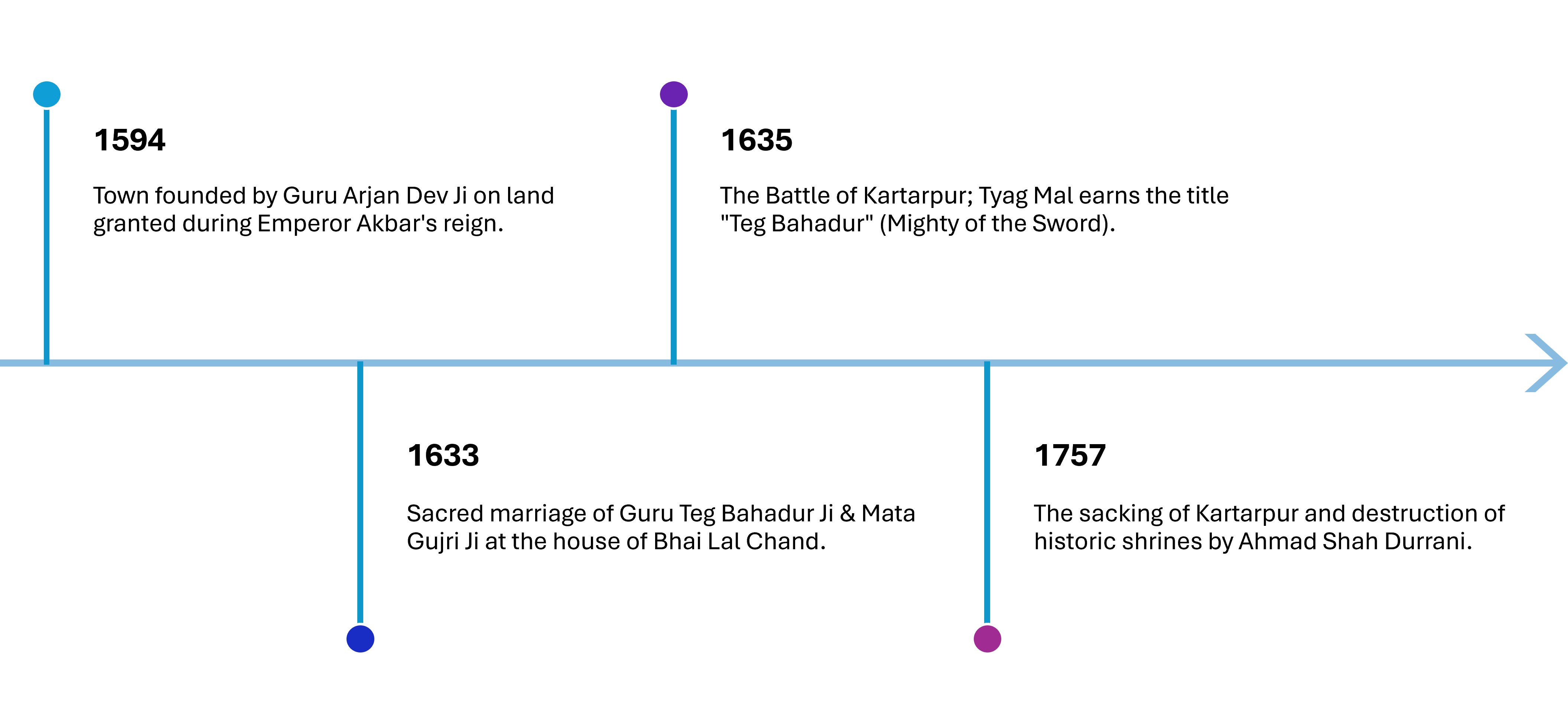
The union of Guru Teg Bahadur and Mata Gujri was celebrated with immense joy by the Sangat (congregation) of Doaba, turning the house of Bhai Lal Chand into a focal point of festive devotion.
The historiographical significance of this marriage lies in its long-term impact on the trajectory of South Asian history.
Mata Gujri Ji was not merely a passive witness to history; she was an exceptional pillar of resilience.
From this union, born decades later in Patna, came Gobind Rai—who would ascend as Guru Gobind Singh Ji, the tenth Guru, the creator of the Khalsa, and a transformative figure in the resistance against Mughal tyranny.
The very domestic space preserved by Gurudwara Vivah Asthan thus represents the genesis of a lineage defined by unprecedented sacrifice, wherein Mata Gujri Ji would eventually embrace martyrdom alongside her young grandsons (the Sahibzadas) at Sirhind.
The Crucible of Warfare: From Tyag Mal to Teg Bahadur
For the visiting historian, the landscape surrounding Gurdwara Vivah Asthan is heavy with the memories of shifting eras.
Shortly after his marriage, the young Tyag Mal was thrust from domestic tranquility into the harsh realities of defensive warfare.
In April 1635, the geopolitical equilibrium of the Doaba region was shattered when Painda Khan, a disgruntled former general and protégé of Guru Hargobind, turned traitor.
Collaborating with the Mughal Faujdar (garrison commander) of Jalandhar, Painda Khan launched a fierce assault on Kartarpur.
The fields surrounding the town transformed into a bloody theater of war.
It was during this conflict, fought near the historic well of Gangsar Sahib, that the newlywed Tyag Mal displayed such extraordinary, fluid swordsmanship and cool bravery that his father, Guru Hargobind, bestowed upon him the title Teg Bahadur—meaning "Mighty of the Sword."
This transformation from a quiet, meditative youth into a brilliant defender of righteousness occurred within walking distance of his marital home.
The proximity of the peaceful wedding site to the brutal realities of the battlefield underscores the core Sikh philosophical ideal of the Sant-Sipahi (Saint-Soldier), an individual capable of supreme inner stillness while executing righteous duties in the material world.
Architectural Evolution and Desecration: The Physicality of Memory
The physical history of the shrine mirrors the volatile, blood-soaked history of 18th-century Punjab.
Following the passing of Guru Hargobind, the town slipped briefly into internal administrative conflict.
The Guru's grandson, Dhir Mal, refused to leave Kartarpur and withheld the original recension of the Adi Granth (the Kartarpur Bir), establishing a breakaway sect.
For generations, the town was controlled by the Sodhis of Kartarpur.
The greatest physical catastrophe for the town's heritage occurred in 1757, when the Afghan invader Ahmad Shah Durrani ransacked the Doaba region.
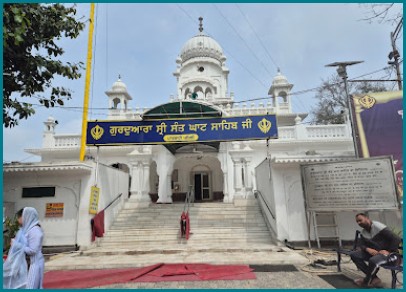
Seeking to crush the rising Sikh pocket of resistance, Durrani’s forces targeted Kartarpur, burning down the primary shrine of Gurdwara Sri Tham Sahib and looting the historic residential sectors, including the ancestral quarters of Mata Gujri’s family.
The reclamation of these spaces began in earnest during the Sikh Misls and reached its zenith under the unified empire of Maharaja Ranjit Singh in the early 19th century, when imperial funds were allocated to rebuild the major shrines of Kartarpur.
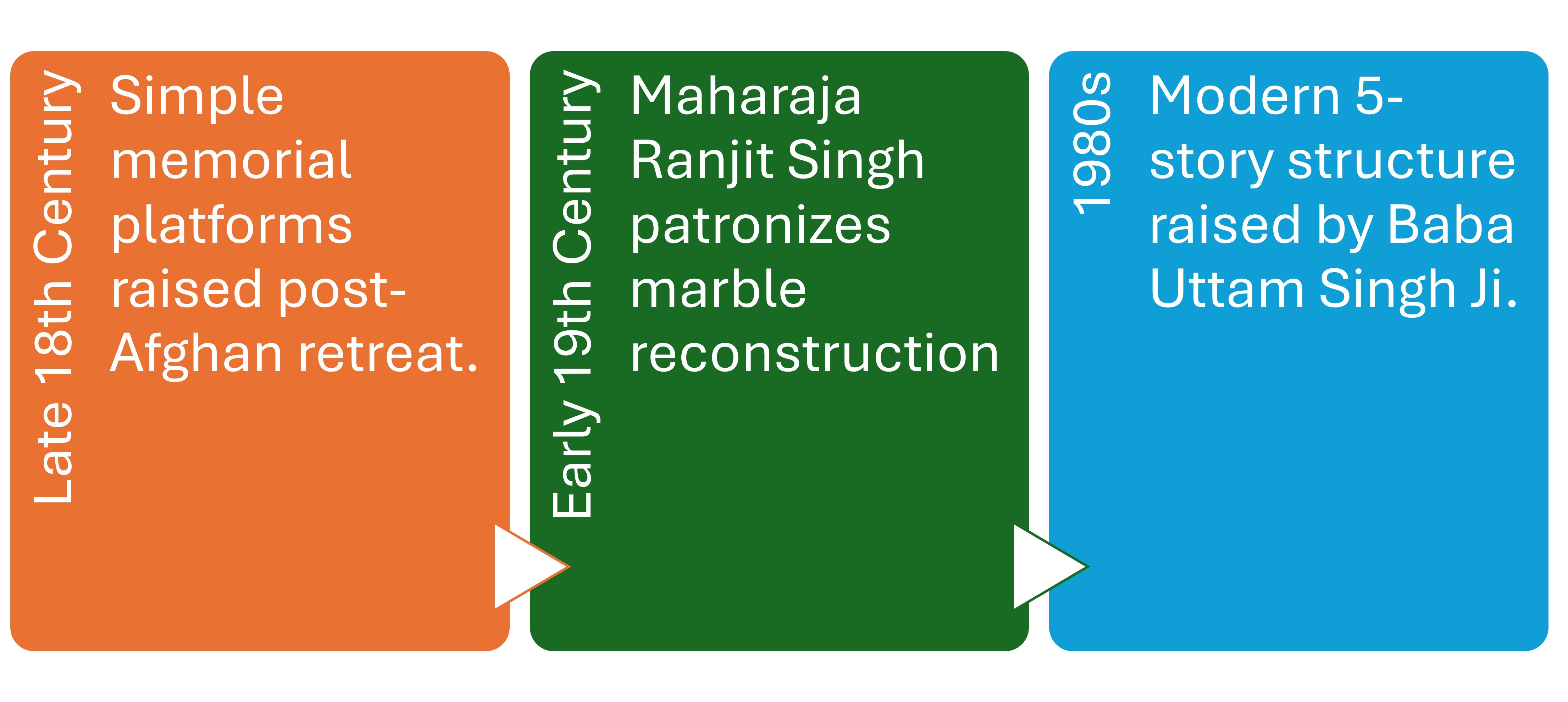
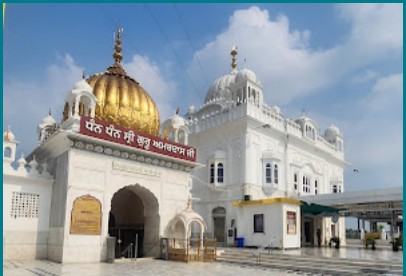
The present five-story structure of Gurdwara Vivah Asthan that stands today was meticulously reconstructed during the 1980s under the spiritual guidance and Kar Seva (voluntary labor) of Baba Uttam Singh Ji of Khadoor Sahib.
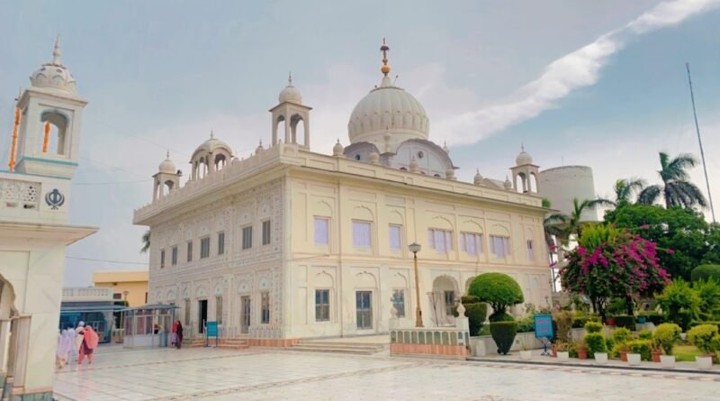
This modern structure features a prominent gilded dome and vast marble-floored halls designed to accommodate thousands of pilgrims, successfully preserving the intimate geography of the original 17th-century courtyard within a grand, defensive architectural footprint.
Historiographical Reflection: The Domestic as Sacred History
When evaluating the vast spectrum of global religious architecture, historians note that monuments are typically erected to commemorate public miracles, mass conversions, or great military victories.
The preservation of Gurdwara Vivah Asthan Guru Teg Bahadur Ji offers an alternate paradigm: the sanctification of the domestic sphere.
It reminds us that within the Sikh ethos, the householder's life (Grihastha Jeevan) is considered the highest arena for spiritual realization.
By preserving the site of a marriage, the Sikh community asserts that historical evolution is driven not just by statecraft and battles, but by the quiet virtues of family, mutual respect, and maternal fortitude.
Standing in the shadow of its towering stories, located just a few hundred meters from the historic Tham Sahib, the contemporary observer is forced to reckon with the profound domestic foundations that anchored the lives of the faith’s greatest martyrs.
Location & contact
- Map: Open in Google Maps
- Associated Gurus: Guru Tegh Bahadur Ji