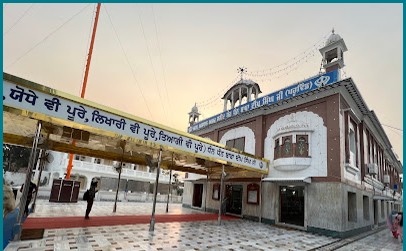
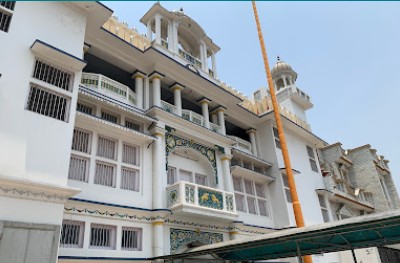
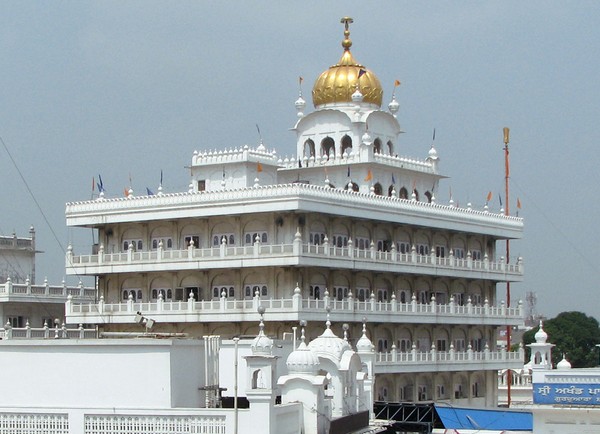
Gurdwara Sri Sant Ghat (Sultanpur Lodhi)
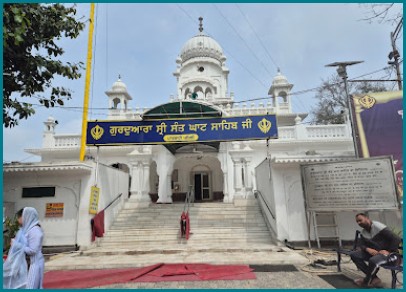
Located further downstream along the Kali Bein. This marks the exact geographical spot where Guru Nanak Dev Ji re-emerged from the river waters after his three-day spiritual journey.
The Cradle of Revelation: A Historical and Theological Analysis of Gurdwara Sri Sant Ghat, Sultanpur Lodhi
To understand the genesis of Sikhism as a distinct, world-historical religious dispensation, one must look beyond the agrarian heartlands of Majha and Malwa and focus on a small, ancient town in the Doaba region of Punjab: Sultanpur Lodhi. If Nankana Sahib (now in Pakistan) is revered as the physical birthplace of Guru Nanak Dev Ji, the first Sikh preceptor, Sultanpur Lodhi is indisputably the cradle of his active spiritual mission. It was here, along the banks of the quiet, winding rivulet known as the Kali Bein, that the quiet, introspective householder and state administrator transformed into the radical, traveling prophet of an egalitarian cosmos. At the quiet heart of this historical transformation stands Gurdwara Sri Sant Ghat, a monument marking the physical and metaphysical site of Guru Nanak's reemergence after three days of mystical disappearance in the waters. For the historian of religions, Sant Ghat is not merely a place of quiet contemplation, but the literal locus of the first public proclamation of the Sikh faith—an event that shattered the sectarian frameworks of medieval India and initiated a new epoch in South Asian spirituality.
Sultanpur Lodhi: The Geopolitical and Religious Matrix of the Doaba
Before analyzing the profound events at Sant Ghat, we must reconstruct the historical landscape of Sultanpur Lodhi at the turn of the sixteenth century. Long before the arrival of Guru Nanak, the town had a rich and complex history. Archaeological and literary evidence suggests that the town, originally known as Tamasvana or Sarwmanpur, was a prominent center of Buddhist meditation and learning as early as the first century CE. By the medieval period, its strategic location on the major imperial trade route connecting Delhi and Lahore made it a vital commercial and administrative hub. Under the Lodhi dynasty, the governor of Lahore, Tatar Khan Lodhi, granted the territory of Sultanpur as a jagir (fiefdom) to his ambitious son, Daulat Khan Lodhi, who turned the town into a prosperous, wealthy capital. It was often referred to as "Peeran Puri" (the City of Monks) due to the dense concentration of Sufi saints, Islamic scholars, and Hindu ascetics who lived and debated within its white-domed mosques and riverside hermitages. It was into this intellectually vibrant and religiously diverse environment that a young Nanak arrived in the late fifteenth century, seeking employment through the connections of his brother-in-law, Jai Ram, who was married to Guru Ji's beloved elder sister, Bebe Nanaki Ji.
Guru Nanak’s fourteen-year stay in Sultanpur Lodhi (roughly from 1483 to 1497) was marked by a deliberate engagement with the mundane structures of householder life. He was employed as the chief storekeeper (Modi) of Nawab Daulat Khan Lodhi’s state granary (Modikhana). Historical accounts emphasize that Guru Nanak discharged his duties with impeccable honesty, and despite the malicious rumors spread by jealous courtiers who accused him of squandering state resources, subsequent audits revealed that the granary was perpetually full and financially sound. During this period, Guru Nanak married Mata Sulakhni Ji, and the couple was blessed with two sons, Baba Sri Chand Ji and Baba Lakhmi Das Ji. Yet, underneath this facade of domestic normalcy, a powerful spiritual energy was gathering. Every evening after his administrative work was finished, Guru Nanak would sit with his companion, Bhai Mardana, a Muslim rabab player, and sing praises of the Formless Divine. A devoted congregation (Sangat) began to crystallize around him, leading the great Sikh chronicler Bhai Gurdas Ji to declare in his Vaars that Sultanpur had become a "treasure of God’s adoration."
The Mystical Ablution: The Three-Day Disappearance in the Kali Bein
The turning point of Guru Nanak’s life—and the pivot upon which Sikh history rotates—occurred during his daily morning ritual of bathing in the Kali Bein. The Kali Bein (literally meaning the "Black Rivulet," named after the rich black soil of its bed) flowed along the western edge of the town. For fourteen years, Guru Nanak had walked to its banks before dawn to bathe and meditate under the shade of a wild Ber (jujube) tree, a site now marked by the majestic Gurdwara Sri Ber Sahib. However, on one fateful morning, the routine was broken by a transcendent event. According to the Puratan Janamsakhi and other early hagiographical accounts, Guru Nanak dove into the cold waters of the Bein and did not resurface. The servant waiting on the bank returned to the town in a state of panic, carrying the Guru's clothes and announcing his apparent drowning. The news sent shockwaves through the community. Nawab Daulat Khan Lodhi, who held the Guru in deep personal and professional esteem, personally rushed to the riverbanks, ordering dragnets to be cast and divers to search the deep pools of the Bein, but to no avail. For three days, the town mourned the loss of a beloved administrator, a family man, and a holy soul.
The Janamsakhis describe these three days not as a physical tragedy, but as a period of absolute, direct communion between Guru Nanak and the Formless Creator (Nirankar) in the celestial realm of Sachkhand (the Realm of Truth). In this spiritual laboratory, away from the sensory distractions of the material world, Guru Nanak was ushered into the divine presence. The divine light offered him a cup of Naam (the nectar of the Divine Name) and instructed him to go back into the world to preach the path of righteous living, meditation, and radical charity. It was during this cosmic encounter that Guru Nanak was blessed with the Mool Mantar, the foundational theological root formula of the Sikh faith, starting with the iconic declaration: "Ik Onkar" (There is One Universal Creator). The three-day immersion in the Bein was thus a symbolic death and rebirth—a descent into the deep, maternal waters of the earth to shed the identity of the state Modi and an ascent into the light of global prophethood.
The Epiphany at Sant Ghat: Proclaiming Cosmic Humanism
On the third day, the grief of Sultanpur Lodhi was suddenly shattered when Guru Nanak emerged from the waters of the Bein, not at the spot where he had entered, but at a quiet, sandy bank located approximately two kilometers upstream. This site of reemergence, where he sat in deep, silent contemplation to ground his monumental spiritual experience, would henceforth be known as Sant Ghat (the Quay of the Saint). The news of his survival spread like wildfire, and a massive crowd of townsfolk, led by his sister Bebe Nanaki, his wife Mata Sulakhni, and Nawab Daulat Khan, rushed to the riverbank. When they arrived, they found a transformed man. Guru Nanak sat in absolute silence for an entire day, his eyes reflecting a deep, otherworldly peace. When he finally spoke, his first words were not a complex theological treatise or a ritualistic instruction, but a simple, earth-shaking declaration: "Na koi hindu, na koi musalmaan" (There is no Hindu, there is no Muslim).
As historians, we must unpack the revolutionary, deconstructive power of this simple sentence within the socio-political climate of sixteenth-century India. At a time when the subcontinent was deeply fractured by caste hierarchies, Brahmanical orthodoxy, and the military and political dominance of Islamic rulers, Guru Nanak’s declaration was a direct challenge to the very concept of religious tribalism. He was not asserting that Hindus and Muslims did not exist as social categories; rather, he was declaring that in the eyes of the One Universal Creator, these sectarian labels were completely irrelevant. True religion, Nanak argued, was not a matter of outward rituals, sacred threads, circumcision, or dietary laws, but of internal purity, moral conduct, and the recognition of the shared divine spark in all human beings. When the bewildered Islamic judge (Qazi) of Sultanpur challenged him, asking whose path he would follow if there were no Hindus or Muslims, the Guru famously replied, "I will follow God’s path, and God is neither Hindu nor Muslim." This sermon at Sant Ghat laid down the core philosophical foundation of Sikhism: a radical, uncompromising universal humanism that transcended all cultural, national, and religious boundaries.
Historical Geography and the Chronology of the Epiphany
| Historical Milestone | Geographical Location | Socio-Spiritual Significance |
| The Daily Bath and Meditation | Site of Gurdwara Sri Ber Sahib | Guru Nanak spent 14 years, 9 months, and 13 days meditating here under a Ber tree before his daily state duties. |
| The Mystical Disappearance | The Kali Bein Rivulet | The Guru disappears into the waters for three days, experiencing a direct divine communion (Sachkhand). |
| The Reemergence and First Sermon | Site of Gurdwara Sri Sant Ghat | Guru Nanak emerges upstream and utters his historic declaration of universal human brotherhood. |
| The Theological Challenge | Gurdwara Sri Antaryamta Sahib | Guru Nanak debates the Qazi and Nawab, demonstrating that true prayer is internal and not merely physical posturing. |
| The Departure for Udasis | Sultanpur Lodhi Outskirts | Guru Nanak leaves his home, family, and government job to embark on four global journeys spanning thousands of miles. |
The Architecture and Evolution of the Sacred Shrine
The physical transformation of the spot where Guru Nanak emerged into the grand structure of Gurdwara Sri Sant Ghat Sahib reflects the turbulent and triumphant history of the Sikh community. For many decades after Guru Nanak’s departure to embark on his extensive missionary travels (Udasis), the site remained a simple, natural riverbank preserved by local devotees. During the era of Sikh political ascendancy in the late eighteenth and early nineteenth centuries, particularly under the reign of Maharaja Ranjit Singh, the administration of the shrine was managed by the Udasi and Nirmala Mahants (ascetic scholars). These caretakers kept the memory of the Guru’s epiphany alive, though the physical structure suffered repeatedly from the seasonal flooding of the nearby Kali Bein. The natural shifts in the river's course often threatened the foundation of the historical buildings, requiring periodic and intensive restoration work.
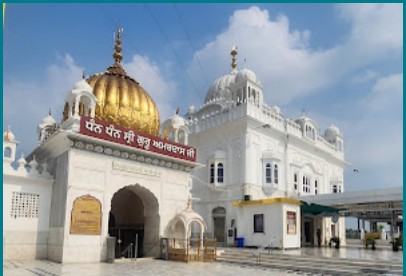
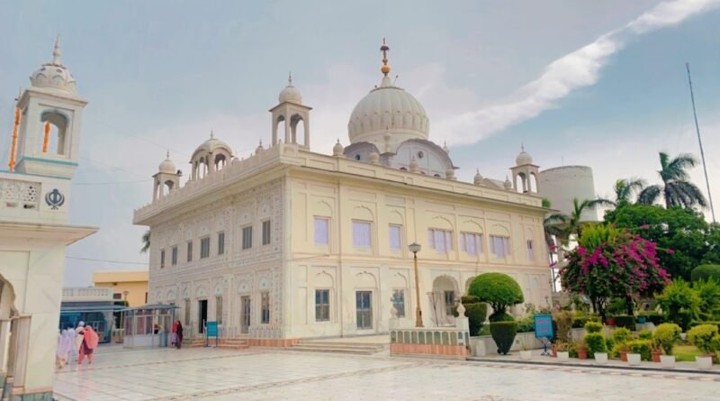
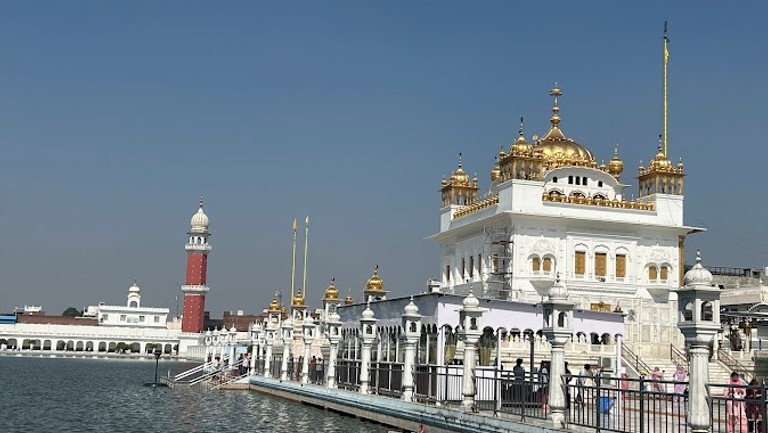
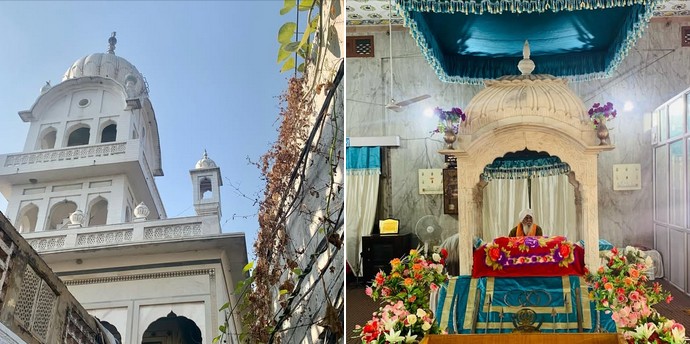
The modern architectural complex we see today is largely the result of dedicated collective labor (Kar Seva) led by twentieth-century Sikh saints, including Sant Sadhu Singh Nirmala, Jathedar Sant Singh Lasuri, and Sant Udham Singh. Rising majestically on the banks of the Bein, the gurdwara features a beautiful white marble facade topped by a magnificent, gold-plated lotus dome and ornate chhatris (pavilions) at the corners. The sanctum sanctorum, where the Sri Guru Granth Sahib is seated on an exquisite marble palanquin, is designed to evoke a sense of deep, meditative silence, mimicking the quiet environment Guru Nanak sought upon his emergence. Adjacent to the main hall is the Sant Sarovar, a sacred pool fed by the natural, filtered waters of the Bein. Pilgrims from all over the world come to dip in these waters, seeking spiritual purification and physical healing in the very stream that once cradled the founder of their faith.
The Living Legacy of Sant Ghat: Environmental and Social Renewal
In the twenty-first century, Gurdwara Sri Sant Ghat has taken on a new, profound significance as a symbol of ecological preservation and community mobilization. By the late 1990s, the historic Kali Bein, once a pristine source of life, had degenerated into a highly polluted sewer, choked by industrial waste, domestic sewage, and invasive water hyacinths from surrounding towns. This ecological disaster was not just a threat to public health but a desecration of one of the most sacred landscapes in Sikh history. In the year 2000, under the leadership of Baba Balbir Singh Seechewal, a prominent Sikh environmentalist and saint, a massive, grassroots Kar Seva was launched to clean and restore the Bein. Drawing inspiration directly from Guru Nanak’s teachings of reverence for the natural world—famously summarized in his hymn, "Pavan Guru Pani Pita, Mata Dharat Mahat" (Air is the Guru, Water is the Father, and the Earth is the Great Mother)—thousands of volunteers worked manually to clear silt, remove weeds, build stone embankments, and plant trees along the river's path.
Today, the restoration of the Kali Bein is celebrated globally as one of the most successful community-led environmental cleanups in history. As the clean, fresh water once again flows past Gurdwara Sri Sant Ghat, it serves as a vivid, modern manifestation of Guru Nanak’s spiritual legacy. For the modern visitor, Sant Ghat is a powerful reminder that Sikhism is not a religion of passive contemplation, but an active, dynamic path that demands the protection of the earth and the service of humanity. Walking through the quiet courtyards of Sant Ghat, listening to the continuous, soothing strains of Gurbani kirtan, and watching the water ripple against the white marble steps, one can still feel the profound, revolutionary energy of that morning five centuries ago when a lone seeker stood on this very bank, looked out at a divided world, and dared to declare that we are all, ultimately, one.
Location & contact
Lower Banks of Kali Bein, Sultanpur Lodhi, Kapurthala District, Punjab 144626
- Email: info@sgpc.net
- Map: Open in Google Maps
- Website: Visit website
- Associated Gurus: Guru Nanak Dev Ji