Gurdwara Dera Sahib
The Martyrdom of Guru Arjan Dev Ji - The physical site on the banks of the River Ravi is identified by local devotees. Establishment of a Thara (Platform) by Guru Hargobind Ji , the sixth Guru constructed a small memorial platform and appoints Bhai Langaha to look after it.
The Silent Witness of the Ravi: A Historical and Spiritual Deep Dive into Gurdwara Dera Sahib, Lahore
To step into the walled city of Lahore is to traverse a landscape thick with historical memories, where empires have risen, merged, and dissolved into the dust of the Punjab. Yet, for a Sikh historian, Lahore is not merely a museum of Mughal grandeur or colonial leftovers; it is the sacred geography of our deepest grief and our most profound spiritual triumphs. Standing immediately adjacent to the towering bulwarks of the Lahore Fort and the expansive red-brick courtyard of the Badshahi Mosque, Gurdwara Dera Sahib represents an irreplaceable anchor of the Sikh collective consciousness. It is the site that marks the Shahadat (martyrdom) of the fifth Guru of the Sikhs, Guru Arjan Dev Ji, in the blistering summer of 1606. This sacred space stands as a monument to a pivotal moment in South Asian history, representing the exact historical juncture where the peaceful, meditative community of Nanak transformed into a sovereign, defensive, and politically conscious spiritual nation.
The Geopolitical Landscape of 1606 and the Emperor's Anxiety
To truly appreciate the significance of Gurdwara Dera Sahib, we must first reconstruct the volatile socio-political atmosphere of early seventeenth-century Punjab. Under the first four Gurus, the Sikh movement had grown from a quietist community of seekers into a highly organized and economically self-sufficient society. Guru Arjan Dev Ji had consolidated this growth by compiling the Adi Granth in 1604, establishing the city of Amritsar, and constructing the Harmandir Sahib as a central focal point for the faith. However, this spiritual consolidation did not escape the suspicious gaze of the Mughal administration. The death of the relatively pluralistic Emperor Akbar in 1605 brought his son, Jahangir, to the throne. Jahangir was eager to consolidate his power among conservative Islamic factions who viewed the rapid expansion of the Sikh panth with rising alarm. In his personal memoirs, the Tuzuk-i-Jahangiri, the Emperor candidly documented his anxiety, noting that Hindus and Muslims alike were flocking to the Guru's court, and declared his intent to either bring this "false shop" to an end or force the Guru into the fold of Islam.
The immediate political pretext for the state's intervention was the rebellion of Jahangir's eldest son, Prince Khusrau, who fled toward Kabul and sought refuge in the Punjab. During his flight, Khusrau met with Guru Arjan Dev Ji, who, in keeping with the ancient Indian tradition of hospitality and the Sikh ethos of universal sanctuary, blessed the prince and applied a saffron mark of protection to his forehead. Jahangir seized upon this act of pastoral kindness, framing it as an act of treason. The Guru was summoned to Lahore, and a heavy fine of two hundred thousand rupees was imposed upon him, along with a demand to erase certain hymns from the Adi Granth that the orthodox authorities found objectionable. Guru Arjan Dev Ji steadfastly refused both demands, declaring that the money of the common treasury belonged to the poor and could not be used to pay an unjust fine, and that the words of the Granth were divine revelations that no mortal had the authority to alter.
The Trial of Fire and Water: Five Days in Lahore
The events that transpired over the subsequent five days in Lahore during the peak of the Punjabi summer remain etched in the heart of every Sikh. The Guru was handed over to Murtaza Khan, the governor of Lahore, and the fanatical financial administrator, Chandu Shah, who harbored personal animosity toward the Guru due to a rejected marriage alliance. The nature of the torture devised was designed to inflict maximum physical agony without shedding blood, in accordance with the Mughal law of Yasa, which was often applied to spiritual figures to prevent their blood from sanctifying the earth. For days, Guru Arjan Dev Ji was subjected to unimaginable horrors: he was made to sit on a glowing, red-hot iron plate while burning desert sand was poured over his bare head and body from ladles. Through it all, contemporary accounts and later hagiographies record that the Guru remained in a state of absolute equanimity, repeating the words of his own composition: "Tera Kea Meetha Lagei, Har Nam Padarth Nanak Mangei" (Thy Will is sweet to me; Nanak begs only for the treasure of Thy Name).
On the final day, the Guru requested permission to bathe in the cool waters of the River Ravi, which at that time flowed directly beneath the walls of the Lahore Fort. Surrounded by guards and watched by a weeping crowd of devotees, including the famous Sufi saint Hazrat Mian Mir, who had laid the foundation stone of the Harmandir Sahib, the Guru walked into the river. As his physically battered body touched the water, his soul departed, merging back into the divine light from which it came. The physical body was swept away by the swift currents of the Ravi, leaving behind no earthly remains for his tormentors to desecrate. It is the precise spot on the banks of the Ravi where the Guru vanished from mortal sight that Gurdwara Dera Sahib preserves today, marking a literal and figurative crossing-over point in Sikh destiny.
Chronology of the Sacred Site
The transformation of this historical site from a simple riverside memorial to the magnificent architectural complex we see today occurred over several centuries, reflecting the changing fortunes of the Sikh community itself.
| Year/Period | Historical Development | Significance |
|---|---|---|
| 1606 | The Martyrdom of Guru Arjan Dev Ji | The physical site on the banks of the River Ravi is identified by local devotees. |
| 1619 | Establishment of a Thara (Platform) by Guru Hargobind Ji | The sixth Guru constructs a small memorial platform and appoints Bhai Langaha to look after it. |
| 1799–1839 | Construction of the Gurdwara by Maharaja Ranjit Singh | The Sikh Empire funds a grand marble temple with a gilded dome, transforming the site into a royal monument. |
| 1947 | Partition of the Punjab | The Sikh community is forcibly evacuated from Lahore, leaving the shrine behind in the newly formed state of Pakistan. |
| Present Day | Management by ETPB and PSGPC | The shrine is maintained as a protected heritage site, hosting international Sikh pilgrims during the annual commemoration of the Guru's martyrdom. |
Architectural Synthesis of Gurdwara Dera Sahib
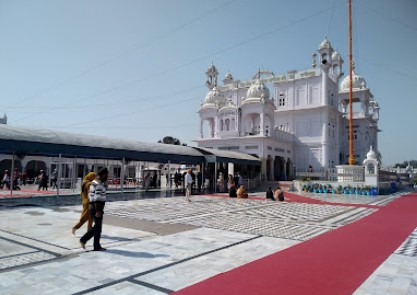
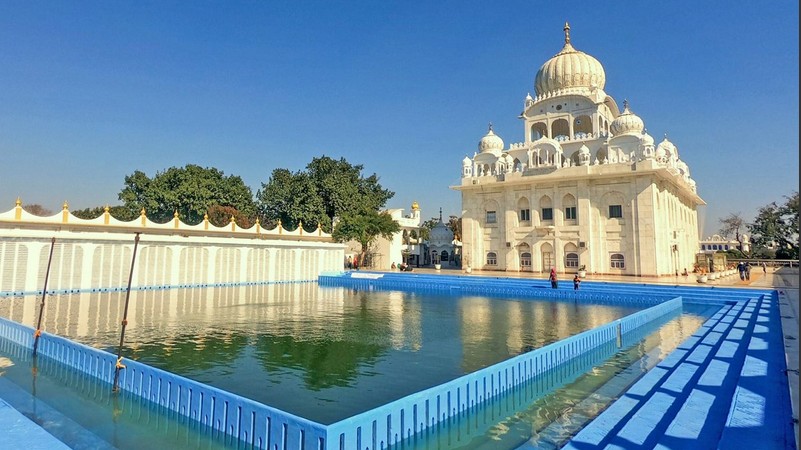
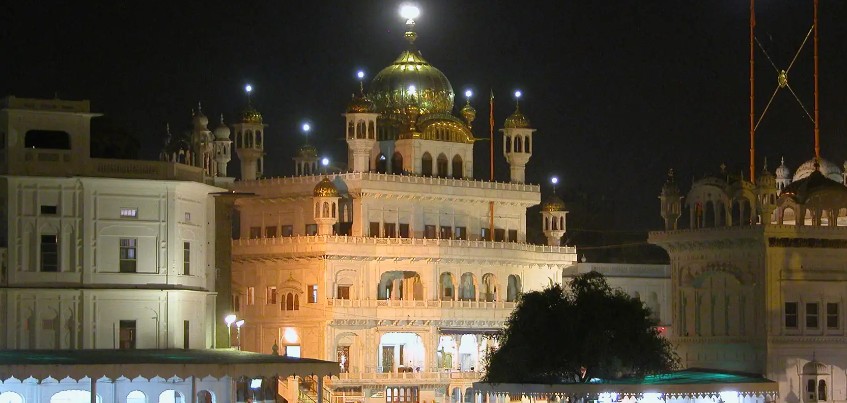
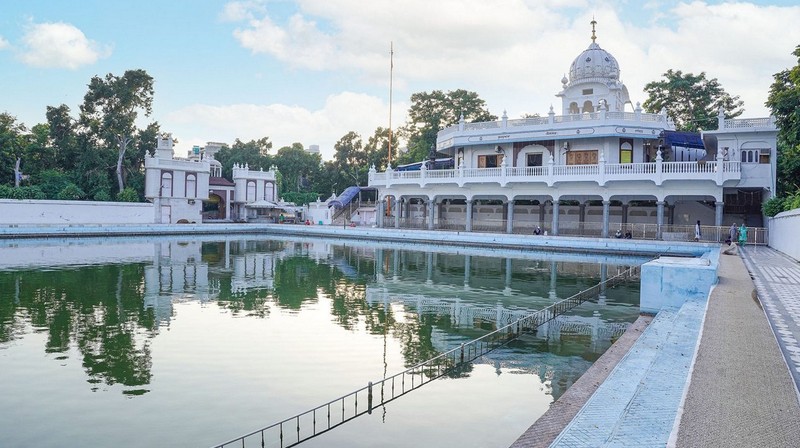
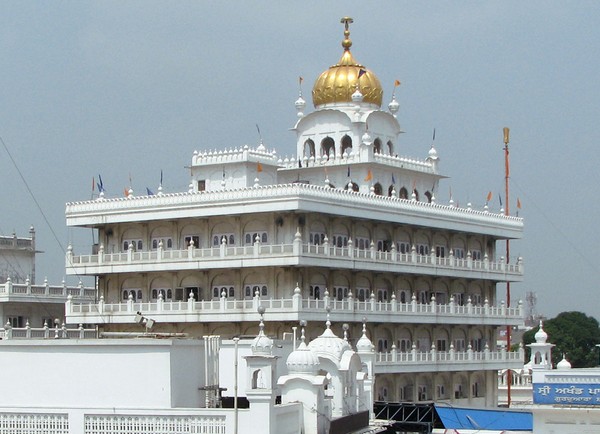
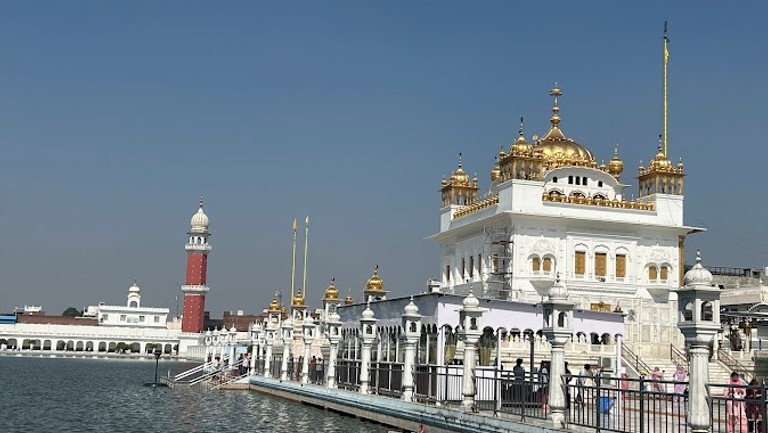
The architectural vocabulary of Gurdwara Dera Sahib is a testament to the aesthetic sensibilities of the Sikh Empire under Maharaja Ranjit Singh. The monument is a beautiful synthesis of Mughal symmetry and Rajput ornamentation, adapted specifically to serve the congregational needs of Sikh worship. The main building features a square plan, built upon a raised plinth. The exterior walls are decorated with intricate stucco work, floral patterns, and elegant frescoes that reflect the lush natural beauty of the Punjab. The crowning glory of the Gurdwara is its fluted, gold-plated dome, which sits atop a low octagonal drum, flanked by delicate decorative turrets (guldastas) and miniature domed kiosks (chhatris) that give the structure its characteristic floating appearance.
Upon entering the main sanctuary, the pilgrim is greeted by a richly decorated interior. The ceiling is embellished with Sheesh Mahal-style mirror work, where thousands of tiny convex mirrors are set into plaster patterns to catch and multiply the light of the central chandelier and the flickering lamps. The Prakash Asthan, where the Sri Guru Granth Sahib is ceremonially seated, is placed under a beautifully carved marble canopy (palki sahib) supported by elegant pillars. This interior design serves a profound theological purpose: the play of light and the reflection of the sacred words on the mirror-clad walls are intended to create a sensory experience of the infinite, mirroring the Guru's teachings on the omnipresence of the Divine. Over the generations, the physical landscape has changed; the River Ravi has shifted its course miles away to the west, but the architectural integrity of the shrine remains a solid, physical testimony to the empire that once was.
The Post-1947 Reality: Partition, Preservation, and the Living Heritage
The division of British India in 1947 was a catastrophic rupture for the Sikh community, resulting in the sudden loss of access to hundreds of our most sacred historical shrines, which found themselves on the Pakistani side of the Radcliffe Line. Overnight, Gurdwara Dera Sahib was transformed from a bustling daily center of community life, charity, and theological debate into a quiet, heavily guarded island of minority heritage. The vibrant Sikh population of Lahore, which had contributed so deeply to the city's cosmopolitan culture, was forced to flee eastward. For decades, the doors of Dera Sahib remained closed to the vast majority of its traditional worshipers, and the daily prayers (Ardas) recited by Sikhs worldwide began to include a poignant plea for the unhindered visitation and management of the shrines left behind ("Khule darshan didar te seva sambhal").
In the contemporary era, the management of Gurdwara Dera Sahib is overseen by the Evacuee Trust Property Board (ETPB) of Pakistan in collaboration with the Pakistan Sikh Gurdwara Parbandhak Committee (PSGPC). While the geopolitical relationship between India and Pakistan remains fraught with tension, the shrine itself has become a vital site for interfaith diplomacy and cultural tourism. Every year, during the commemoration of Guru Arjan Dev Ji’s martyrdom (referred to as the Shaheedi Purab), thousands of Sikh pilgrims from India, the United Kingdom, Canada, and the United States make the emotional journey to Lahore. For these pilgrims, walking through the gates of Dera Sahib is a profound emotional homecoming. They are greeted by Pakistani citizens who recognize the shared heritage of the land, demonstrating that while borders may partition nations, they cannot sever the deep-seated spiritual roots that connect a community to the soil of its Gurus' historical struggle.
The Intellectual and Spiritual Legacy of the Fifth Guru
As we reflect on the history of Gurdwara Dera Sahib, we must look beyond the physical brick, mortar, and gold to understand the intellectual and spiritual revolution that this site represents. Guru Arjan Dev Ji’s martyrdom was not an act of passive resignation; it was a deliberate, courageous demonstration of the concept of Chardi Kala—relentless optimism and high spirits in the face of absolute adversity. By willingly accepting death rather than compromising on the integrity of the Adi Granth or paying an unjust tax, the Guru established a precedent that would define the Sikh character for all future generations. He demonstrated that physical survival is secondary to the preservation of moral principles and spiritual sovereignty.
This historical sacrifice directly catalyzed the evolutionary path of the Sikh panth. Upon his arrest, Guru Arjan Dev Ji sent a message to his young son and successor, Hargobind, instructing him to sit upon the Guru's throne wearing two swords—one representing spiritual authority (Piri) and the other representing temporal power (Miri). The quietist, meditative path of the earlier Gurus was thus reinforced with a protective steel armor, culminating in the creation of the Khalsa by the tenth Guru, Gobind Singh, in 1699. Therefore, when we stand before Gurdwara Dera Sahib today, we are looking at the cradle of the Sikh martial and political identity. It is a monument that reminds us that true peace is not merely the absence of conflict, but the presence of justice, and that sometimes, the ultimate sacrifice of a single peaceful soul is required to shatter the complacency of a tyrannical empire.
Location & contact
Machi Hatta, Walled City
- Map: Open in Google Maps
- Associated Gurus: Guru Arjan Dev Ji · Guru Hargobind Sahib Ji